Showing posts with label theology. Show all posts

Saturday, November 3, 2012

All Saints vs Reformation Day

from WikiPaintings
On October 31st, 1517 Martin Luther nailed his Ninety-Five Theses to the door of All Saints Church in Wittenberg, Germany. For many, this marks the beginning of the Reformation, and the end of Roman dominion in the western church. Because October 31st marked the beginning of Protestantism, it is celebrated by many as Reformation Day.

It is fine for those of us not in fellowship with the Holy See to celebrate what we see as the end of many abuses perpetrated by the Church of Rome. Yet, there is an even more important holiday that we should not forget to celebrate. For October 31st is the eve of All Saints. Last year, I wrote a blog post commending the celebration of Halloween over the celebration of Harvest Festivals, since in the celebration of All Saints we celebrate "the holistic communion between all the saints extended throughout history and geography - the catholic communion."

This year, for the same reason, I want to commend the celebration of All Saints over the celebration of Reformation Day. As I said, it is fine to celebrate what we see as being gained in the Ninety-Five Theses, but we should not loose sight of the fact that Protestantism is an expression of a faith older and larger than it. The final reality we should all point to is the eschatological reality of union in Christ. The Church, despite her broken outward appearance, is spiritually one. To celebrate the communion of Saints is thus a much more noble thing than to celebrate any particular expression of that communion. Especially, it is greater than celebrating an event which, however important, was also responsible for the most serious visible fracturing of that Church since the Great Schism.

Therefore, with all the Saints let us give glory to God the Father, through Jesus Christ, in the unity of the Holy Spirit, for the Passion and Resurrection of His Son by which we have been called from all peoples into one family. 

Friday, October 19, 2012

Holy Virginity

Virgin Mary Annunciate by Fra Angelico
from WikiPaintings 
Sex is good. Or so I've been told, loudly and often, by churches eager to set themselves apart from a past perceived as anti-sex. We are not those old Greek Fathers who hated sex. We now see that the Jews perceived sex as unambiguously good, and so, therefore, should we. Nevermind, of course, that the culture which surrounded the Greek Fathers also saw sex as good, and engaged in it, apparently, in ways wild enough to make the sexual revolution look like a Victorian luncheon. Nevermind that when Socrates, in Phaedrus, contrasted love and sex, he was doing so in a society in which pederasty was the norm. Nevermind that Christianity, in making virginity a virtue for all people actually created great liberty for women.

And certainly let's not ask how we got from the (admittedly extreme) place of St. Gregory of Nyssa insisting that the Song of Songs could only be allegory and not about sex at all, to a place where Mark Driscoll can claim it's not at all allegory, but just a sex manual.

No, nevermind all that, the Greek Fathers were prudes, and we most certainly are not.

Of course, we are quickly reminded, this is sex in its proper context, which is marriage. Till we can have this proper sex, we should wait. Virginity, then is virtuous.

Yet what if the Greek Fathers had a point? Yes, sexuality is a good thing, when it is, and we should never cease to give glory to God for His gift to us of it. Yet in a world in which sin is a reality, it is hardly unambiguously good. Its not just promiscuous sex that's the problem either, married relations have their fair share of problems.

I vehemently affirm the proposition that sex is good, and that we should not forget this fact. Yet, it's a fact that would be hard for us to forget in the world we live in. Our culture frequently tells us that sex is good. We tell ourselves sex is good. And let's not forget the huge problems that single men and women in the pastorate have in finding jobs, or the marginal place which single people are assigned in our churches. Nor is it unproblematic that, in my experience, the Christian desire for companionship looks almost identical to that of the contemporary non-Christian world, and radically different from that of the past. The pendulum has swung too far.

Let us continue to affirm the goodness of sex, but let us recover virginity. Let us affirm the positive goodness of virginity as a virtue, and not just its negative goodness. In other words, let us not just see virginity as avoiding a sin of commission, but as a positive commission of virtue. Let us also not fall into the trap of thinking that spiritual virginity is asexual. To engage virginity as a Christian virtue is very much to engage ones sexuality. One cannot be a virgin without being a sexual being.

We should also not let the religious virgins and sacramental marriages be two different worlds. Both expressions of Christian virtue ought to speak into and inform each other.

Many of the great Saints of the Church, from St. Paul to St. Thomas Aquinas, and above all, of course, the Virgin Mary, have been such virgins.

 I will close by saying that it is not impossible to transverse from one world into another. For those, like me, who are single, but do not feel a call to lifetime celibacy, there is still a place for positively engaging our virginity as a special gift by which can be identified with the great Saints of the Church, and be shaped more into the image and likeness of Christ. We can, and ought to, engage our virginity as a prayer unto God, and not merely as a waiting room for the glorious future of marital bliss. Let us be present to where we are, that, in the sacrament of the present moment, we, with all the Saints, might be transformed by God's love so that our lives might be a good for the sake of others.

The Martyrs Testify: Christian Catholicity Against the Victim Mentality

The Martyrdom of St. Stephen
by Annibale Carracci from WikiPaintings
A few weekends ago, Regent College had a conference on faith and politics. During this conference, Peter Leithart spoke on the role of martyrs in the transformation of society. He emphasized the powerful witness of the Christian martyrs against the system of power in the old roman world, and how this witness stood as a prophecy of the coming destruction of pagan Rome, and as a prayer to the God who would surely not let the seed of the martyr blood lie fallow. Leithart then emphasized that we ought to identify ourselves with the martyr witness.

In response to this, Iwan Russel-Jones worried that to focus on the martyrs would simply encourage the harmful victim mentality of modern evangelical Christians.

And he's right - it might. Indeed, I think it will if we continue to forget the catholicity of the Church. If we forget that we are one body with the martyrs past, present and future, then we may indeed exaggerated our own sense of cultural alienation into melodramatic martyr language.

However, I believe that the prescription of Peter Leithart is precisely what we need to cure the victim mentality. For Leithart is not advocating a localized view of martyrdom and the church, but a global one. When we are truly catholic, remembering that many Christians today are true martyrs, and that they are our brothers and sisters, along with the saints in Heaven who's prayers continually go up before the throne of God, then we can be under no illusion that our present trials are martyrdom. Our witness will become the prayers, fasting and acts of service we do in honour of those whose lives have become true sacrifices.

Let us remember the martyr-saints who have gone before us, and those who stand beside us in the Church militant.


Tuesday, September 18, 2012

The Orthodox Way

I've always been an ecumenist. I believe in one holy, catholic and apostolic church, and believe that every creed professing person is a member of Christ's Church. A few years back, however, I had a few realizations that changed the form of my ecumenism.

The first was the realization that sola scriptura, when seen in the ahistorical way many modern Evangelicals view it, is an untenable position.

Second, I realized that the sort of ecumenism I had developed bordered dangerously on consumerism. Denominations don't really matter, they're like fashion. I put on liturgy, you put on anabaptism and none of it matters substantially. I truly believe that ecumenism is good, but when it reduces to matters of taste, it becomes dangerously individualistic.

These two realizations led me to the third. If I am to be a serious ecumenist, and not merely one who considers the diversity of the church merely a matter of fashion, then I need to take seriously the identity and claims of the branches of the Church. Moreover, since I could no longer hold to simplistic sola scriptura, I could no longer dismiss out of hand the claims of those branches of Christianity, namely the Roman Catholic and Eastern Orthodox churches, that depended upon the authority of tradition. At the same time, I was also reading much Medieval Philosophy, and beginning to see the coherence of some of the views of Roman Catholicism.

I had always thought that Roman Catholics and Eastern Orthodox believers could very well be real Christians, just as easily as any Protestant could. However, this had always amounted to thinking they could in virtue of the fact that the core of what they believed matched what I believed. It was, in other words, a kind of patronizing ecumenism. They got in because, despite all their weird additions, they were in essence like me. Yet, both these churches claim for themselves the identity of being the one true holy, catholic and apostolic Church. The rest of us might be Christians, but we are so in virtue of being, as it were, accidental members of their faith. That's a serious claim, and I decided that if I would be a serious ecumenist, then I should give it genuine consideration.

So, on and off for the last couple of years I have been giving Roman Catholicism and Eastern Orthodoxy a serious look. This has not, necessarily, been with an eye towards converting, and I highly doubt I will. On the one hand, there is something about the two churches I find highly aesthetically compelling. At times I feel like Protestantism looks like a sketch of Christianity, while Roman Catholicism looks like a detailed Renaissance painting and Eastern Orthodoxy like one of its Ikons, with all the colour and symbolism it brings. Yet, there's too much about Rome and the East that doesn't sit easy with me, their absolute rejection of a female priesthood for example, so that even if some of their claims compel me, I'm not sure I could ever align myself with them.

Still, in the end I want to seek Jesus where He may be found, and I at times I think there is something of Him in the Old High Churches that we have lost, so I continue to look at them and learn from them, and only God knows what will happen.2

Researching Roman Catholicism has been relatively easy. They have many books that clearly lay out their views and apologetics, including their very detailed catechism. Searching the East, however, has proved more challenging. I have long desired to find a kind of Mere Christianity of Eastern Orthodoxy, and had so far come up empty. I was, thus, understandably excited to see The Orthodox Way in the list of extra readings for one of my classes, and quickly picked it up.

I am extremely happy with the book. It is beautifully written and clearly exposits the Eastern faith not merely propositionally, but as a living faith. I find that much written here I can wholeheartedly agree with, and those things that I don't agree with I at least find compelling. Most of all, the book fills me once again with wonder at God's glory and excitement about the future of my faith here on Earth, leading me in turn to fervent prayer. I have not been so wholly captivated by a work of theology since I read N.T. Wright's Surprised by Hope several years ago.

As I said in my long preamble, I do not expect that I will ever go over to the East, but I am deeply grateful for this book, and it certainly gives me food for thought. If you are a Christian of any stripe, but especially one with questions about our brothers and sisters in the East, I heartily recommend a look at this book.

There is much more I could say about this book, and I may indeed write more posts on it in the future weeks reflecting on what I have read within its pages. For now though, I simply want to leave you with a glowing recommendation.

The peace of the Lord be always with you.
________________________________
1. This is why I am so opposed to re-baptism. If there is "one Lord, one faith, one baptism," (Ephesians 4:5) by which "we were all baptised into one body" (1 Corinthians 12:13), then to re-baptise is to declare the other baptism unreal, and thereby to declare that all baptised in that other church aren't members of the body.
2. I certainly hope you will pray for me as I ask these important questions. I don't want my decision to be based on fashion, the sexiness of a certain theological view, or even my own limited reasoning, but on the guidance of God's Spirit.

Friday, August 24, 2012

Sometimes Something Goes Right

By NASA. Photo taken by either
 Harrison Schmitt or Ron Evans (of the Apollo 17 crew).
[Public domain], via Wikimedia Commons
Sometimes something goes right in the world.

It's been a rough week for sane readers of the news. With everything from a certain Republican showing an abysmal ignorance of female anatomy to horribly offensive topical bibles... it's been easy to fall to despairing.

But sometimes, something goes right with the world, and I can't help but smile.

You see, being pro-life should be about more than an opposition to abortion. It should be about a passionate respect for all life, and a commitment to the protection of those who cannot protect themselves, be they the unborn or rape victims. Yet, as Rep. Akin's comments earlier this week showed, those in the pro-life movement can sometimes loose sight of that fact.

Then today I read this piece of news at the Huffington Post. Go ahead, read it.

Now let that soak in. 50,000 Pro-Life Christians are supporting care for the environment. 50,000 Pro-Life Christians are putting life first, not a particular issue. 50,00 Pro-Life Christians understand that protecting the environment is not about the defense of some abstract thing, but about the stewardship of our world.

Somewhere, right now, out there in America, 50,00 Pro-life Christians who get it are walking around.

Sometimes something goes right in the world.

Monday, August 20, 2012

Every Man Just Wants To Be a Princess

Aaaand now that I have your attention.

That's exactly what I mean. Well, almost exactly. "Every" is a bit of an exaggeration, since it's hard to say that every individual member of any particular group wants one thing. There's always exceptions (like sociopaths for example). But given that caveat, and the context I'll shortly be giving you, I'm pretty sure that what I said is 100% true.

So, onto that all important context. If you're the sort of person who reads this blog, then you probably know what a complementarian is. Nevertheless, I'll give you the short of it. A complementarian is someone who thinks that there is an essential difference between men and women, and that this essential difference in some way suits them to different roles (that complement each other). Just what these different roles are can very wildly from one complementarian to another, but in general I've found it's not in terms of, say, work. I've rarely met a complementarian who just thought women should stay at home.1 More often, the important axis for explaining the essential differences purported to exist between men and women is marriage.

Frequently, the details of this essential difference are couched in mythic terms. In everything from Wild at Heart to the unintentionally ironic organization "Lancelot Lives" (which itself is apparently no longer alive2), the difference perceived between men and women is painted in vivid pictures of knights and princesses. This, they say, is no accident because those tales aren't accidental, they portray something essential about humankind. Men, you see, are knights, or at least desire to be, and women are princesses. The men want to fight battles, rescue the weak and defend there homes. Women want to be rescued, and... um.. be beautiful... and some other stuff I guess. Both parties, they say, want love, but love of a different kind. The men want their strength and leadership to be respected. The women want to be cherished.

And I say that's a load of crock. Of course men want respect for what they've accomplished, but so do women. Men want to be cherished too. I don't there's a man in the world who, when faced with darkness, doesn't desire to be rescued, held, shown nurturing love. It's not always a romantic desire to be sure. Sometimes they just want it from friends, sometimes from their parents, sometimes from God. But they want it.

Moreover, as a Christian I'm inclined to say this is a good thing. The faith we practice teaches us that we are dependent upon God, that we are literally nothing without Him. Every Christian, male or female, should experience points in their life where they fall on their knees and cry out to God for rescue, beg Him to come down, wrap His wings around them and cherish them. Moreover, every Christian, after having been cherished by God and fed at His table, should find the strength to gird themselves for the battle of faith and go out into the world as knights for the gospel, spreading not violence, but the very cherishing love they have been given.  So, in short I agree with the complementarians that the myth of the knight and the princess is no accident. It tells us something about ourselves, but it isn't a lesson about gender. Every man just wants to be a princess, and every woman wants to be a knight.3

___________________________________
1. Though most are opposed to women in ministry. 2. At least I cannot find it anymore, but I saw it once, I swear.
3. None of this is to say I don't think there's any difference between men and women. At the very least, our bodies are different, and I think that's important. I don't know what the difference is though, and I certainly think it's problematic to make it a matter of roles. Especially when those roles involve terms like "submission" and "leadership".


Saturday, July 21, 2012

I Forgive

By Radomil [GFDL or CC-BY-SA-3.0,
 via Wikimedia Commons
Jared Wilson has issued an apology for the language used in his post on 50 Shades of Grey. For my part, I accept and acknowledge this apology, and extend my forgiveness for the language used.

I wish that Jared Wilson could acknowledge the problems with the views he expressed (not complimentarianism per se, but the accusations he levelled against egalitarianism) but I'm not surprised. That remains a problem, but at least the harmful language has been addressed, and the apology given with immense grace and humility.

Regardless of the problems I have with Jared's point of view, the manner of this apology shows character. Some in the comments have refused to accept his apology, some because they felt it inadequately addressed their problems with the original post (fair enough), but others who insist that it was insincere. To those people I offer an injunction. You cannot know someone's heart. If you don't want to accept the apology because you feel it inadequate compared to the hurt it caused you, fine, but do not insist that he did it just to save face. You can't know that, and it is wrong to assume you do.

Jared, I accept your apology for the words used, and I continue to hope and pray you will see the problems with the viewpoint you advocate. Blessings to you, my brother in Christ.

Thursday, July 19, 2012

Colonization According to My Tin Poetic Ear

Gary Halvorson, Oregon State Archives [Attribution],
via Wikimedia Commons
Warning: This post discusses sexual violence.

In my last post I wrote about why, in the plainest English possible, I found the recent Gospel Coalition complimentarian post disturbing. I wrote it because I felt their defense in response to the outrage had completely missed the point. Anyway, earlier today I read this post, which I felt did a much more thorough job of explaining the problem, and in the meantime defending egalitarianism, than I had done.

Reading this post led to a discussion with one of my roommates, and brought up some points I had glossed over in my last post. I mentioned in my footnotes that the language of colonization and conquest really are a problem, because no matter what you intend to be saying, the realities of public language can mean you're saying something quite different. I would think that at least the problem with the language of conquest should be obvious. War is hell, conquest is brutal. The connotations of that language can't be anything but dark.

Yet, I'm inclined to think that the language of colonization is actually more disturbing, precisely because of the dissonance between its myth and its reality. The myth of colonization is one of brave men and women making a virgin land fertile. The reality was white settlers taking land that already belonged to other people, destroying those people and then reshaping the land in their own image.

 So with the language of colonization, you bring in a metaphor that is, as my roommate pointed out, very appropriate for patriarchy, but also very disturbing. The one thinks he is simply taking something fresh and unclaimed, the other is brutalized and destroyed. There is no virgin land to be taken, a person is already there, and she has the right to that land. If she invites you in, well and good, but if you colonize then you violate her, plain and simple.

Perhaps I have, "a poetic ear like three feet of tin foil" but I do not think these implications can be missed. Do I think Wilson and Wilson were advocating rape? No. Do I think they intended their metaphors to carry these connotations? No, but they do anyway. Language is public, you can't bring in symbols without getting all their baggage. Moreover, a white man especially can't use the language of colonization without some very disturbing implications.

Wednesday, July 18, 2012

Victim Blaming, or Missing the Point Entirely

Image Taken from Restoration Community Church 
Warning: This post discusses sexual violence.

Today, a friend drew my attention to this post over at The Gospel Coalition, then Rachel Held Evans' response, and finally TGC rebuttal.

In the original post, TGC writer Jared C. Wilson writes about the perverted sexuality of 50 Shades of Grey, and quotes from Douglas Wilson’s book Fidelity: What it Means to be a One-Woman Man. The quote, which I won't bother to reproduce here since you can read it both in the original post and in Evans' response, has caused a great deal of outrage.

The reason for this outrage is that Wilson and Wilson appear to be claiming that egalitarianism is ultimately responsible for the existence of rape, sexual violence and forms of sexual perversion that glorify them. In other words: victim blaming. Again.

Wilson and Wilson, of course, responded to the outrage, but their response completely misses the point. They seem to think that they're being accused of advocating rape and other forms of sexual violence. I actually wouldn't be surprised if some people have accused them of it, since they use language of "conquest" and "colonization" in their description of "proper" sexual authority and submission,1 which would quite rightly upset some people.2 By-and-large, though, that isn't what people are complaining about.

People get that Wilson and Wilson are saying that rape and sexual violence is bad. That's hard to miss. Unfortunately, it's also hard to miss when Douglas Wilson says "Because we have forgotten the biblical concepts of true authority and submission, or more accurately, have rebelled against them, we have created a climate in which caricatures of authority and submission intrude upon our lives with violence." Wilson is, undeniably, claiming that egalitarianism creates the environment for sexual violence. He is saying that because woman desire something apart from the life of the curse, and desire to live in equality with men, rape happens. That is a highly disturbing thing to say, and I hope and pray Wilson and Wilson can come to see how horrifying what they're saying is.

I know complimentarians I respect. I don't think that point of view is inherently evil, though I do think it's wrong, but this is not merely complimentarianism, it's sheer unbridled patriarchy, and it's wrong.

________________________________________________

1. Douglas Wilson thinks that using these terms is okay because not all conquest and colonization is violent and destructive... apparently.


2. Just because you intend to be saying one thing, your text can still be saying quite another. In a world in which sexual violence is so prevalent, the use of terms like "conquest" and "colonization" for healthy sexuality is not okay, even if you think you mean something different by it. Language is public. 

Wednesday, February 22, 2012

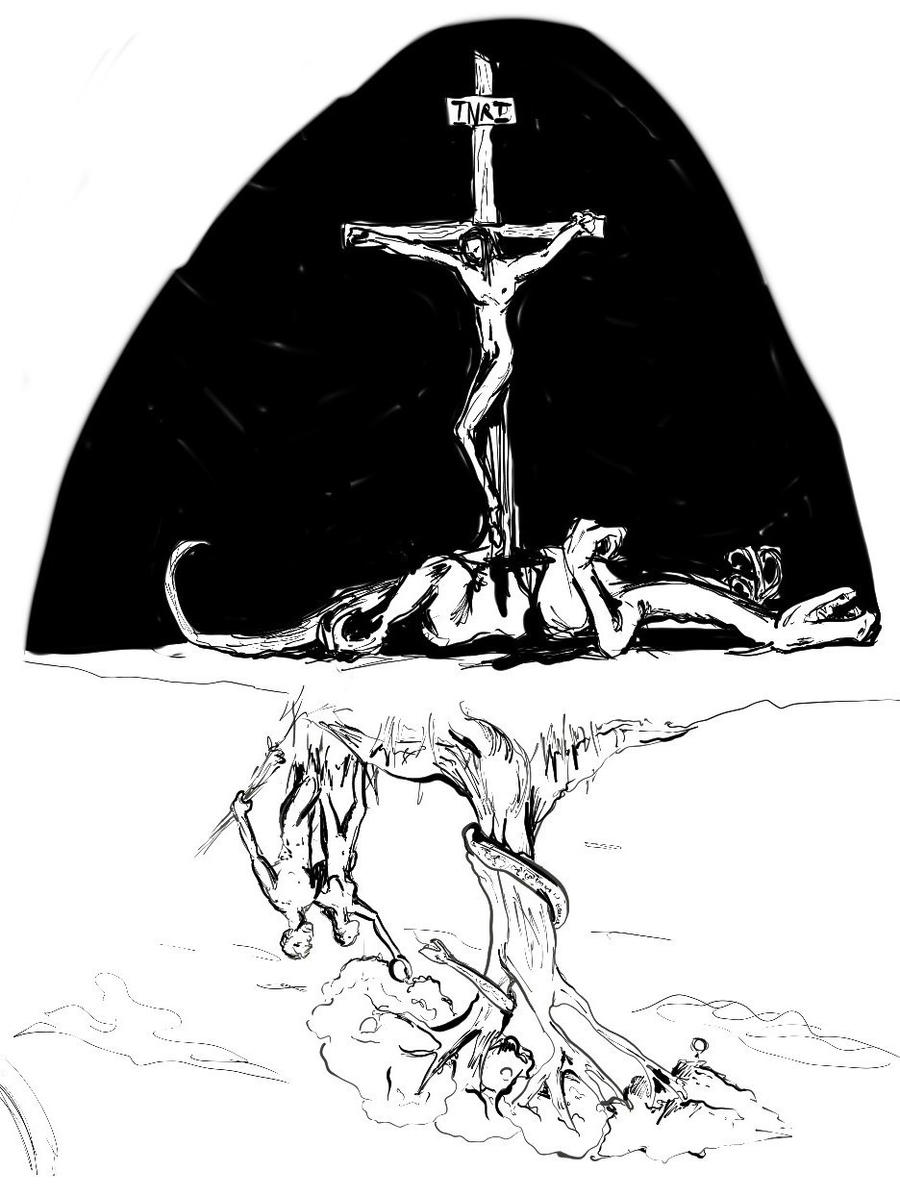
That Cursed Tree


Death came by a tree, in the deception of the serpent, by the First Adam
Life came by a tree, in the destruction of the serpent, by the Last Adam 

Monday, January 30, 2012

The Passionate God


by Desconocido Francais [GFDL]1
via Wikimedia Commons
It is an old axiom in Christian theology, borrowed from the Greek philosophers but supported by scripture, that God is unchanging. The reason for this, on the philosophical side, is that God must by nature be perfect. Any change is, however, either a change for the better or for the worse. Thus, God is immutable. Some points about that idea might be argued, but by and large I agree with it and it is not the focus of my post today.

Rather, I want to address a particularly corollary of the immutability of God according to the Church Fathers and most who came after them - that God is passionless. Passions (or emotions) are themselves changes of state, encompassing certain physical and relational states experienced by the subject. Because they necessarily involve change, the Greek philosophers would argue, the passions are necessarily imperfections, and so God cannot have passions. This led to problems for the Church Fathers, who by and large accepted the Greek vision, but who also acknowledged the genuine incarnation of God as a human person who did indeed suffer. In explaining this, the Church Fathers appealed to Christ's nature as fully God and fully man. He suffered passions as a man, but not as God.

Many, including myself, later questioned this explanation. This, in turn, leads to questions about whether or not God's perfection can in fact be understood in the manner the Greeks understood it. I think the answer is both yes and no.

I say yes to the Greeks because I do believe perfection does in fact entail a kind of immutability. God, if He is truly perfect, cannot grow wiser, for then He would be less then perfectly wise. However, I think their understanding that all change is a change for the better or for the worse is at least partially flawed. For some things, the relative virtue of a change very much depends on that to which it stands in relation. For example, if I want to go to the store, which is to the right of where I am currently sitting, a turn to the left would be bad, while a turn to the right would be good. Lacking a goal, any turn would, of course, be neutral. This, as of yet, does not defeat the Greek's point. For, that I can turn either to the better or to the worse relative to my goal and I am thus not in the best of all possible positions (i.e. perfection) in which no change could either improve or worsen by case.

What then, of passions? Passions themselves are, I believe, good or bad depending very much on circumstances. Fear is a good and appropriate emotion when faced with danger, but bad if it is in response to something neutral or helpful. Important in the world of passions is the conditioning of the emotional system. The perfect emotional being would always have the proper emotional response to every possible stimuli. Few of us, of course, have this. Even the most healthy mind might find itself experiencing fear at a needle bearing beneficial medicine. The point here is that fear is always good/right/fitting when facing genuine danger and always bad when not facing genuine danger. Though our emotional lives are often an admixture of the good and the bad, there is an ideal emotional state in which a change in emotions is not a change for the better or the worse, but simply the appropriate response to the stimuli at hand.

My contention is that God, especially an incarnate God, can in fact have passions without those passions being changes for the better or worse, but instead appropriate. It is appropriate for God to have anger at sin, love for His creatures and joy in their salvation. Moreover, if God incarnates, then it would be appropriate for Him to experience fear at the threat of crucifixion or anger at corrupt and heartless religion.

Divine passions would, of course, not look fully like ours (human language must always fall short in describing the perfect being afterall). Certainly, God the Father would not experience the physical change of state that we associate with emotions. Questions of temporality come in too, but dealing with that is outside of the scope of this article.

So is God immutable perfection? Yes, but that does not mean he is without appropriate passions. Understanding always, that until we meet Him face to face, we always see as in a mirror darkly (1 Corinthians 13:12).
_______________________________________________________
1. By English: Unknown Español: Desconocido Français : Inconnu (Luis García (Zaqarbal), 27–September–2008) [GFDL or CC-BY-SA-3.0-2.5-2.0-1.0]

Friday, January 20, 2012

The Good Side of Prayers to the Saints

by Fra Angelico [Public domain] via Wikipedia
It's been quite a while since I've written a post. As I've hinted at, I've been in a time of great transition, but that doesn't excuse the disservice I've done to you my readers. I thank you for your grace and your patience. I've started grad school now, and am settling into my new home in Vancouver quite well. This, of course, means I'll be quite busy, but it also means that I'm going to have a good deal of fuel for this blog. Already today, after being remonstrated by one of my fellow grad students for the lack of new postings on my blog, I have thought of two subjects to blog on. Hopefully this will continue.

The second post will becoming soon, as well as (hopefully) an update on my life for those of you interested. First, however, I thought I would address again the topic I left you with last time - the saints. Specifically, I want to address the topic of prayers to the saints, and something I think we may have lost in giving them up.

Before I do that, however, let me stress that I am not advocating that we pray to the saints, I certainly do not. I am, as a protestant, well aware that such prayers, particularly in their form as patrons of certain areas, walks dangerously close to paganism. Indeed, while the doctrine surrounding the practice is most emphatically not worship, it all do often degenerates into syncretistic worship in practice. This is certainly the case where my sister and brother-in-law minister in central Mexico, where the feast of the Virgin of Guadalupe is a more important celebration than Easter. Worse though, the practice in its actual application often puts a wall of separation between the people and Christ, denying that we can approach the throne of Grace boldly (Hebrews 4). Again, to my Roman Catholic and Eastern Orthodox brothers and sisters, I must stress that I understand this does not represent the practice at its best, but is a corruption of it.

However, I do not think the practice is, at least in it's general form (i.e. not in the form of patronage) as out of left field as many of those who share my confession might think. We are, as I talked about in my last post, a catholic church. Moreover, that catholicity is not merely geographical but also temporal. In Baptism we are joined under the headship of Christ to all the saints, both those living (Militant) and dead (Triumphant). Furthermore, I believe that prayer is first and foremost communal and only afterwards individual (that would have to be discussed in more detail in another post). In the communal nature of prayer, we both join together liturgically, and intercess for one another. When we do this, we join in with the Church Triumphant who forever stands before the throne of God giving Him glory and praise.  If then, I can ask my friends or family to pray for me, it seems to me not insane that we could ask those now asleep for prayers as well. Of course, this begs further questions about temporality, the state of souls before the Resurrection and much much more.

There is, of course, the question of just who stands in the Church Triumphant, which makes the patronage system of further dubiousness in my mind (though I understand that's the entire point of Canonization of Saints on the basic of attributed miracles). Nevertheless, I believe that this is largely why prayers to the Saints can be effective, because the saints are praying and (forgive me) God meets us in our weakness.

However, I think by and large the Protestant restraint on this issue is a correct move. What I want to stress to those in my tradition, however, is that in emphasizing our direct access to Christ (which we are right to do) we do lose the constant awareness of the Church Triumphant which prayers to the Saints brings. I therefore think that we, as children of the Reformation, need to be extra careful not to loose that creedal truth. In light of that, it is I think important for us to emphasize or implement liturgical practices which bring to us an awareness of that truth. Thus, for example, the Anglican Church as part of its liturgical calendar recognizes feast days for saints without and the same time praying to saints. This, as I understand it, is traditionally put forward as a way of lifting up examples of good Christians past who we can emulate. That's a worthy goal, insofar as it goes, but I think we should moreover take those times to emphasize that these Saints are (insofar as we can know) with us in our worship of God.

That, of course, is just one idea, and I'm sure there are many other ways Anglicans could express this truth liturgically, as well as ways in which other traditions might do the same.

The Lord be with you.

Wednesday, November 2, 2011

Your Harvest Festival is Pagan

By Neznani slikar [Public domain],
via Wikimedia Commons
So after a long period away, dealing with my day to day life, I'm finally back to the blogosphere.

This post itself is slightly delayed, but I'm sure you'll forgive me. I want to talk to you about Halloween. Specifically, I want to talk to you about a certain trend that's been around for quite some time. The trend goes like this, a church wants to have celebrations for kids that are safe and fun on the night of the year that Halloween happens. This church, however, believes that Halloween is pagan and decides instead to have a "Harvest Festival."

The practices of these Harvest Festivals are, on the whole, not much different from Halloween, except children and adults might be discouraged from wearing monster and witch costumes.

There's a problem with this though. The problem is they have it all backwards. It's true that Halloween has its roots historically in a pagan festival of the dead, specifically that of Samhain. The latter was a Celtic festival of the dead, and it literally means "summer's end."

The old church, with the understanding they applied to the creation of many of their holidays, used the summer's end festival to create a different and distinctly Christian holiday. This holiday would celebrate a distinctly Christian doctrine - namely that of the communion of all saints (which is one of those creedal doctrines that is essentially core to the faith). This day, November 1st, was All Saints Day, and celebrates the holistic communion between all the saints extended throughout history and geography - the catholic communion. There was another name for this day - All Hallows Day. The night before, then, was All Hallows Eve, which shortened is Halloween. Of course, the separation wasn't perfect, pagan rites did make their way into the celebration, and Halloween itself became a festival for the memory of those in purgatory. Naturally we Protestants wouldn't care for that part.

Call it a Harvest Festival, though, and at least in your name you get rid of the distinctly Christian element, and go straight back to the pagan celebration of seasons. To call it "harvest festival" is to be more pagan than to call it Halloween.

Don't get me wrong, what is pagan isn't necessarily bad. After all, to use a Medieval analogy, the gold of the Egyptians was pagan, but the Hebrews were able to take it and put it to better use in the service of God. To take a time of year dedicated to the celebration of the dead spirits, and baptize it towards the celebration of the communion of Saints is a beautiful and characteristically Christian activity. There is also, as I've talked about before, a sacramental quality to the macabre.

So celebrate Halloween. If you want to call it a Harvest Festival, fine, but don't think you're somehow making it less pagan if you do so. Most of all, if you call it a Harvest Festival, don't forget what it's about. Don't miss celebrating the communion of saints for a secular candy gorge (though don't forget to gorge on candy either, bodies are important and the celebration of the good material things in this world is also a very Christian thing).

Wednesday, August 24, 2011

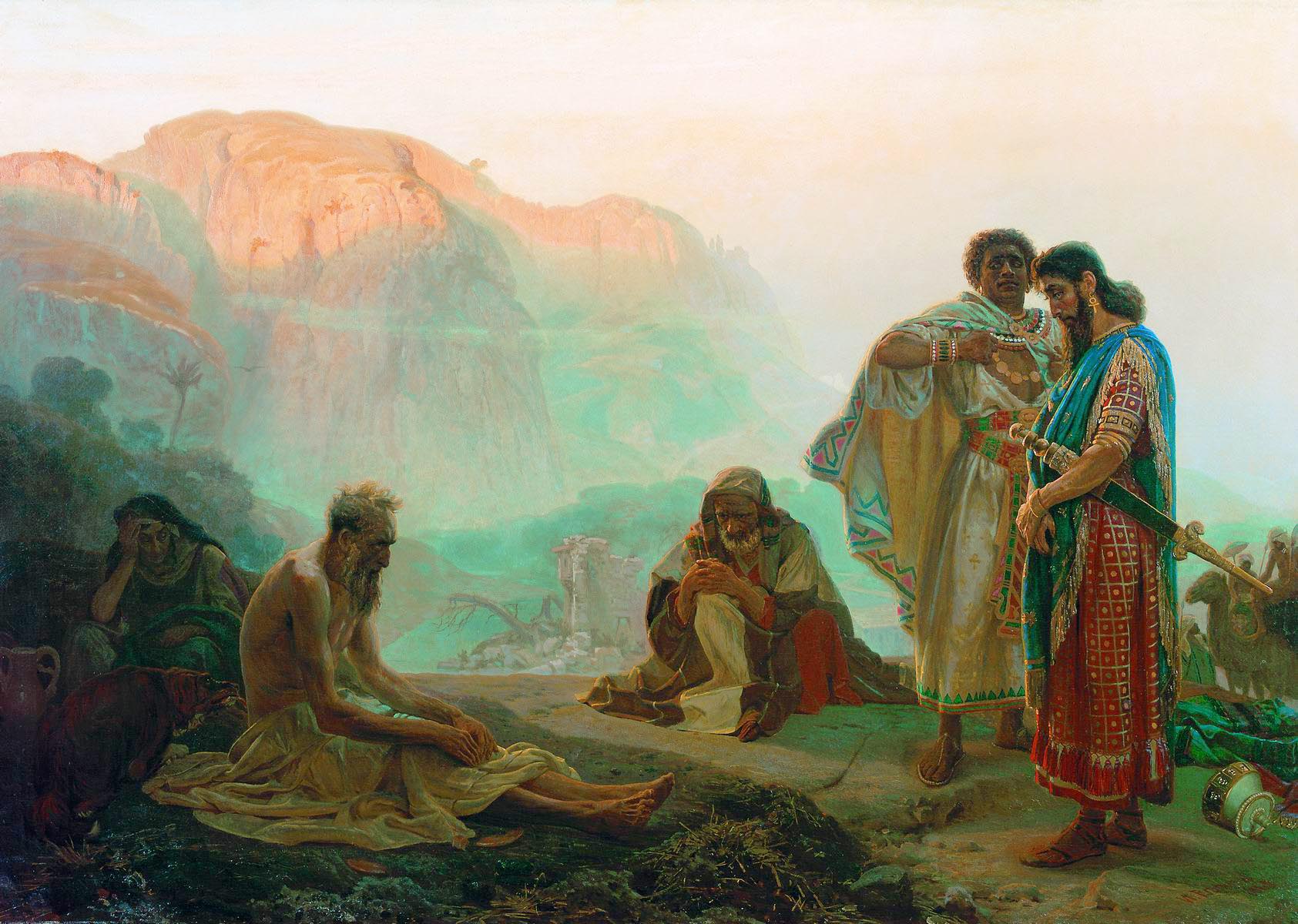
All Grace is Incarnation

Ilya Yefimovich Repin [Public domain], via Wikimedia Commons
"You're sufferning." Todd Hunter said to me across the table at Dick Church's this morning.

Ouch. Yeah, that's it, I'm suffering. It's funny how sometimes when someone puts words to what you're feeling it can have such an impact. Much that I hoped on has been stripped away, people that I care about are in pain. I am suffering. It's not that I'm Job, I still have food on my table, I still have my family and friends who love me, and my body is not covered in boils.

But I am hurting. I am longing to hope, but afraid to in the face of disappointment. So, it's hard to see grace right now, in my life. Friends of mine have pointed to some grace, but it remains hard to see. It's also frightening to point to one thing or another and say, "that's grace." It seemed like grace when I got into Trinity College, it seemed like grace when I couldn't pay for my visa and my church did, it seemed like grace when I found a place to stay in the weeks before I was supposed to move into school. Yet, after all those things, something came up that meant I couldn't go. Of course, that doesn't mean those things weren't grace, it's just hard to see now. Still, I believe God is with me. I believe there is grace.

My aunt sent me a blog post entitled "So all is Grace?" She said it made her think of me, that they were things I might say, though in different words. I think that's true, one or to things aside, and I think it gives at least something of a picture of how I can find comfort now.

In the face of suffering, it's easy to try and explain how it exists in God's world. That's what we in the philosophy world call a theodicy. Yet, as I've said before, theodicies all too often do violence to the reality of human suffering, they strip the raw pain away, abstracting it to an intellectual problem to be solved. Likewise, they often fail pretty miserably at being specifically Christian (or Muslim, or Jewish, etc), relying rather on a generic notion of God that is often far different from the one which has been revealed to us.

I honestly don't know what the reason for suffering is. I believe, ultimately, that God is in control. I believe that He is good. But why do we suffer? Is it because of free will? Perhaps some larger plan? Is it to teach us? To punish?

I don't know. I have my theories, but they're just that -theories, and in the face of real suffering they will always ring hollow.

But there is something that does not ring hollow. God became man. God incarnated Himself into the world of suffering, and in that very same incarnate Self He gave us the first fruits of the New Creation. I know that whatever the reason for suffering is, I can trust the God who stand over that suffering because He was willing to enter into it.

God the Father, in His eternal and unbreakable bond with Christ through the Holy Spirit, is with us in our suffering. And He is making everything new. I don't know why it hasn't come into its fullness yet, but I trust Him, for I once was blind, but now I see.

All is grace. Yes.

And all grace is incarnation.

Thursday, August 18, 2011

Earthen Vessels: Why Our Bodies Matter to Our Faith by Matthew Lee Anderson

Image taken from  Mere Orthodoxy
Matthew Lee Anderson, author of Earthen Vessels, has been told through Twitter than I am terribly mean and know only how to bruise and destroy. Thankfully, the person who told Anderson this was joking, since I don't think I could live up to that reputation - most of what I have to say about Earthen Vessels is good.

In the first half of the book, Anderson lays out a basic picture of what he thinks the body is, and who he thinks his audience is. None of his reflections on the body should be earth-shattering to any biblically informed Christian who has spent time reflecting on the body, but that's okay because his audience probably hasn't. His audience is Evangelicals, who many have accused of being Gnostic, while Anderson, in defense of us, can at best call us inattentive.

If Anderson is right that Evangelicals have merely been inattentive, then this book will do a lot of good if its read. He establishes that the body is our place of personal presence in the world, the temple of God and the vessel of our worship, and then goes on to explore specific question in reflection of this anthropology. Should Christians get tattoos? What should Christian sexuality look like? What about homosexuality? Anderson approaches all of these questions carefully, and he's clearly given them a lot of thought. Unfortunately, the sheer breadth of the material he's trying to cover means his arguments are often rather thin. He seems to be touching on the topics rather than giving them the thorough analysis they deserve. In the end, the approach seems perhaps more blog-like than book-like. Once again, however, I don't think this is really a problem, because I rather think the point of these chapters is, in the end, a plea to at least think about these things. Think about the body and worship, think about tattoos and the Christian body.

Throughout the book, I found myself at times agreeing with Anderson, at other times disagreeing. Occasionally his critiques of liberal theological positions seemed to me to rather miss the point of those positions. Then again, he, like myself, is a conservative, and its hard to understand the opposing mindset if you haven't spent time immersed in it. There was only one point in the text where I was seriously bothered by anything Anderson said, which was when he discussed yoga. I am not a practitioner of yoga, but I found his view to be narrow and perhaps a bit reactionary even (I plan on writing a separate post on the subject, though, so I won't go into more detail here).

In the end, if you're an Evangelical Christian, or count any Evangelicals as friends, I recommend you read this book. It's true that if you've given much thought to the body nothing here will surprise you, but at the very least it should spark some ideas in your head, and it will probably give you some ideas as to how to approach the Evangelical community with this topic. If you haven't given much thought to the body, then this book is an absolute must read.

Tuesday, August 16, 2011

Is Doubt Faith's True Method?: A Lesson for Michael Patton from Aristotle

By After Frans Hals [Public domain],
via Wikimedia Commons
Michael Patton over at Credo House Ministries recently wrote a post that's been getting a lot of attention in the biblioblog sphere. In it, he argues that Roman Catholic scholarship is fundamentally an oxymoron.

Patton argues that Descartes method of doubt, though flawed, provides the basis for what constitutes scholarship. We doubt that we might know better. Since Roman Catholics, apparently, aren't allowed to doubt, they're simply going to end up defending preconceived notions. This, Patton says, is not scholarship, and if anyone who identifies as a Roman Catholic doubts, they obviously aren't a true Roman Catholic.1

There's plenty of critiques to be made of his argument, and indeed many have already been made. Rod at Political Jesus has critiqued the notion of intellectual freedom inherent in Patton's definition of scholarship. Jeremy of Unsettled Christianity criticizes his view of what Roman Catholicism is, and Brian of Near Emmaus argues that if Patton's notion of scholarship would also condemn Evangelicals. My friend James Arnold will also being discussing the post on Evangelical Outpost later today discussing Patton's notion of scholarship.

I'd would also like to discuss the notion of scholarship expressed here, specifically his application of Cartesian doubt. I will also explore an Aristotelian notion of sciences and apply it to the subject at hand.

I am no fan of Descartes, but Patton has, like many of his peers, misunderstood Descartes project. Yes, Descartes set out to doubt in order to find a firm foundation, but once that foundation was located, he felt secure in trusting it that he might build further upon it. Doubt for him was a tool, not a way of life as it was for the skeptics. This meant that doubt would eventually be left behind. Further, doubt only played a role in building up Descartes epistemology and metaphysics. It was not, for example, the driving force when he studied anatomy.

Descartes doubted everything he thought he could, came to the conclusion that he could not doubt his own existence, and using a very strange ontological argument moved from there to the existence of God. Once God was secure, Descartes felt he could securely believe in the existence of the outside world. On the basis of that security, Descartes could then rely on the apparatuses of that world (such as senses) without continuing to doubt them. Likewise, a Roman Catholic (like, say, Descartes) could begin by doubting the church, but after testing it come to believe in papal infallibility. Once that was done, papal infallibility could then be used as a firm basis for making other decisions about truth. I'm not saying anyone would be right to come to this position, nor that it could even be done. What I am willing to say is that we all do this in a myriad ways throughout our lives. The vast majority of things any of us hold to be true, we hold to be true on the warrant of others whose testimony we trust.

This brings me to the Aristotelian notion of science. Aristotle believed that there is a series of sciences, not just one, and that each had its own principles. The science of logic, for example, would depend on certain basic principles such as the law of non-contradiction2, while physics would depend on certain presuppositions about physicality. No science can critique its own principles, instead these are set by other sciences higher than it. For Aristotle these sciences existed in a strict hierarchy. At the top of all of these would stand metaphysics, and from that science you would derive the primary principles of the lower sciences. We might very well doubt the strict hierarchy of sciences affirmed by Aristotelian, but the basic principle seems firm. Good literary critique follows very different laws than good astrophysics.

We can even see the basic sense of how one science takes as givens what another asks as questions in modern physical science. A chemist, for example, will take as given the basic principles of modern physics, making use of them in doing his chemical work. Indeed, a given chemist will assume most things about chemistry to be true except the very specific things he is testing for.

So how does this apply to Roman Catholic Scholarship? For the Roman Catholic scholar, the major area of scholarship upon which his being a Roman Catholic could have any bearing would be theology. Theology, like logic or physics, is its own science and will have its own principles. But what are those principles? The fact of the matter is there's no easy answer to that question, and different faiths and denominations will have different answers to it. For the Protestant Evangelical, the primary principles for good theology will be sound exegesis of infallible scripture, likely coupled with certain basic Evangelical traditions and experience. The Evangelical can of course question these principles, but one can't rightly call him an Evangelical unless he accepts them. It is only once he does accept them that he is doing Evangelical Biblical scholarship. Likewise, the Roman Catholic confession comes with certain principles underlying its interpretation of the science of theology. This includes scripture, but also includes tradition and papal authority. The Roman Catholic can of course doubt these principles, but once he has accepted them he can freely use them, just as Descartes could freely use God in his philosophy once he was convinced of the existence of the divine. The Roman Magesterium leaves many questions in theology unanswered, and the Roman Catholic scholar can explore these questions freely, his method will simply be different and rely on dogmas established by the church (rather than scripture alone). This is a different scholarly method than the pseudo-Cartesian Evangelical one Patton favors, but it is no less scholarly than it. At least, it cannot be shown to be less scholarly unless we can discover a higher science that can show us definitively what the best principles are for theology.
_________________________________________________
1. Based on what he says in the comments, Patton's notion of what makes one a true Roman Catholic (or a true Evangelical, or a true atheist) is the specific propositional content of your beliefs. A Roman Catholic, on his view, has to believe everything the Magesterium teaches to be Roman Catholic. The problem is that this imports an Evangelical Protestant view of identity into Roman Catholicism. However, what makes one a member of the Roman Catholic faith is a much more ecclesial matter. If you are baptized as a Roman Catholic (in fact, if you're baptized in a Trinitarian format) you are a Roman Catholic. You may not be in perfect communion with the church, but your identity is set by the sacrament, not by the propositions you affirm.
2. An proposition cannot be both true and false at the same time.

Friday, July 29, 2011

Deconstructing Theodicy: Why Job Has Nothing to Say to the Puzzle of Suffering by David B. Burrell

Image taken from Tower Books
I love this book. Let me just get that out of the way since this is going to be a quite lengthy review and exposition of David B. Burrell's Deconstructing Theodicy: Why Job Has Nothing to Say to the Puzzle of Suffering. I love it first and foremost because it is a beautiful exposition of one of my favorite books of the Bible and an adept exploration of an age old theological question.

In the text, Burrell does precisely the kind of theology that I strive to do - devoted to scripture while using the resources of philosophy, and even some outside literary and religious sources,1 to illuminate the text.2 Ultimately, Burrell perhaps strays further from the base text than I would want (always a danger with this approach) but in clinging to orthodoxy he avoids any egregious errors.

The central thrust of the book, as revealed by the title, is to show how the book of Job deconstructs the impulse to provide theodicies. A theeodicy, for those unfamiliar with the term, is the act of trying to "justify the ways of God to us" and explain "how there could be evil in God's world" (Burrell 13, 108).

Burrell begins with a detailed textual analysis of the structure of Job. The primary goal here is to show the contrast between Job's friends, who construct theodicies about God, with Job who directly addressed Him. From here, Burrell moves to an examination of the parallel figure of Ayyub in the Qur'an. This is ultimately a weak point in the text, since it proves to be almost entirely a tangent.3 His next step is to roughly outline Medieval commentaries on the text by Sadiah, Maimonides, Aquinas and Gersonides. Finally, Burrell uses arguments by Terrence Tilley and Marilyn McCord Adams to draw out the central thesis of the text.

Using the Medieval commentaries, Burrell builds up a picture of God I've discussed on this blog before. God is transcendent, yet immanent. God is in many ways a different order of being from His creatures, one who experiences eternity directly and can only be discussed analogically. Yet, precisely God's role as willing creator and conserver means He is also always present to His creatures. Because of this, we can always address Him, and the human mode of address is linguistic.

The arguments of Tilley and Adams then serve to do the titular deconstruction of the work.4 Tilley and Adams point out the emptiness, and indeed frequent cruelty of theodicies. Adams, for example, points out that the very act of theodicy can oftentimes miss the vibrantly real nature of people's suffering. The actual horrendous torment that human beings undergo becomes reduced to an abstract lesson. As Hume famously pointed out in response to the Augustinian explanation that evil is not an actual thing, but mere privation of the Good - that's a nice turn of phrase, but it does little to alleviate the reality of the pain experienced by sufferers, which is really the heart of the problem.5

Burrel then uses Adams's argument for his reconstruction. The very metaphysical immanence brought out by the Medievals, making God present to His creatures, provides the solution - the direct address and solidarity with the creator. This Burrell thinks, is what the structure of the dialectic in Job shows. As he puts it, 'even if Eliphaz and his companions are castigated for 'not having spoken of [God] what is right as [his] servant Job has'‎ (42:7), God cannot be commending Job for 'getting it right,' as we might say. For his cumulative outbursts are a far cry from attempts to explain his plight, never pretending to be more than bewildered complaints - despite the ways his "friends" often construed them.What the voice from the whirlwind commends is rather the inherent rightness of Job's mode of discourse: speaking (however he may speak) to rather than about his creator" (109).

The only major flaw with this argument is that at times in comes dangerously close to the infamous theodicy that waves off the problem by saying that "God moves in mysterious ways." As I once heard an atheist put it, this amounts to saying God is a "cosmic asshole". This is definitely not what Burrell is arguing however. Yes, God's movement is mysterious, and attempts to reduce it to simplistic theodicy will fall short, but we are not left with the distant jerk-God of mysterious movement. Instead, God is shown to be in sharp solidarity with us, and the correct theodicy is understanding that we can (and ought to) call on God and He will answer us.

The potency of this deconstructed theodicy is that it renders action, turning us away from the merely selfish explanation (read: excuse) of Job's friends. For the case of Job's friends is the case of many who engage in theodicy, it's motive ultimately selfish. Job's friends do not seek to aid him, they seek to justify the system as it is - the system which has (and continues to) benefited them. Rarely do theodicies do much for those in the midst of suffering, and often they do not even care to hear them. Yet when Job turns to God, crying out to his creator and even demanding an audience with him, excuse is turned to action. Evil is not explained away, it is confronted head on. Finally, it is radically personal, as Burrell shows in a denouement to his argument that traces out explanatory parallels between the central thesis of Job and Augustine's Confessions.6 

I will say that, while I do love this book, it is not without its flaws, the biggest of which is structure. If you follow through to the end, the whole picture of the book will become clear, the approach will seem haphazard until you get there. Part of this is that the central thesis of the book is only vaguely stated at the beginning and you have to wait to the end to get a clear picture of where Burrell is going. The other major flaw, of course, is the superfluous Ayyub chapter. Other than these flaws, the book is well worth a read, especially for students of theology and philosophy.

I would, finally, like to conclude where Burrell himself concludes, in a quotation from a sermon by Leo the Great for the feast of the transfiguration of Jesus (because I think it's beautiful):
The writings of the two testaments support each other. The radiance of the transfiguration reveals clearly and unmistakably the one who had been promised by signs foretelling him under the veils of mystery. As Saint John says: "the law was given through Moses, grace and truth came through Jesus Christ." In him the promise made through the shadows of prophecy stands revealed, along with the full meaning of the precepts of the law. He is the one who teaches the truth of prophecy through his presence, and makes obedience to the commandments possible through grace. In the preaching of the holy gospel all should receive a strengthening of their faith. No one should be ashamed of the cross of Christ, through which the world has been redeemed. No one should fear to suffer for the sake of justice; no one should lose confidence in the reward that has been promised. The way to rest is through toil, the way to life is through death. Christ has taken upon himself the whole weakness of our lowly human nature. If then we are steadfast in our faith in him and in our love for him, we win the victory that he has won, we receive what he has promised. When it comes to obeying the commandments or enduring adversity, the words uttered by the Father should always echo in our ears: "This is my Son, the beloved, in whom I am well pleased; listen to him." (Sermon 51, 3-4, 8, Patrologia Latina 54, 310-11, 313). 
_________________________________________________

1.  There is a bit at the conclusion of the text where I think Burrell gets a little too close to collapsing the transcendent but eminent God of Aquinas into Hindu pantheism, though he does ultimately relieve this by stressing the uniqueness of God.
2. This is not to say that this is the only, or even the best, avenue with which to approach scripture, but simply the one to which I feel called, and sadly one that is hard to find today. One could certainly get to Burrell's ultimate conclusion by way of reading Job purely through the rest of scripture. The very fact of the incarnation creates the solidarity between God and creation that Burrell reaches through Medieval metaphysics and paints much the same picture of the text. The attempts to explain suffering in the way of Job's friends is fruitless, it is in calling on God, and in His answering in solidarity, that a kind of answer is found.
3. Using another literary or religious text to gain a fresh perspective on a scriptural text often mired in centuries of traditional interpretation seems laudable (the long tradition of trying to turn Job into a theodicy, for example). However, that isn't what Burrell ultimately does. Rather, he presents a condensed version of an essay on the quranic character he found illuminating. While I think its great that Burrell enjoyed the essay, and that he values respecting the central religious text of another faith, the chapter seems to me to add nothing to his argument and so does not belong here.
4. Deconstruction, as my friend Fernando would be eager to point out at this juncture, is not mere destruction. Deconstruction, rather, takes something apart in order to reveal something new.
5. I actually happen to agree with Augustine that evil is not a thing but a privation - I just think its rubbish as a theodicy.
6. This bit also motivates me to want to try and write a confession of my own some day, though one that would have quite a different view of sin, and especially bodies, from Augustine.

Wednesday, July 6, 2011

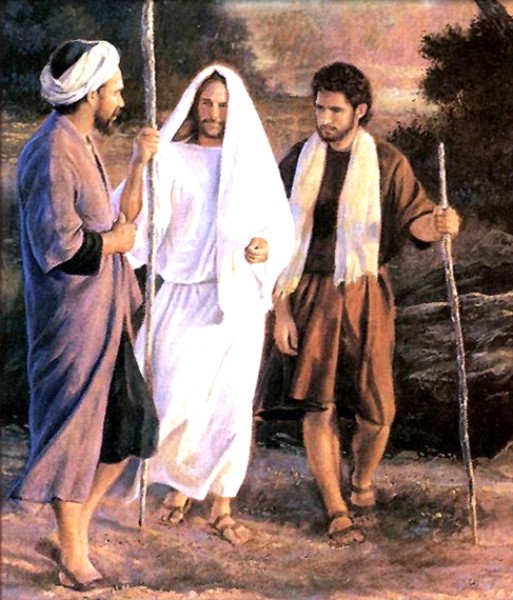
The Road to Emmaus

Image taken from MariaKumar.org
The Incarnation, Resurrection and the Eucharist are three of my great theological passions. All of them are about Christ's presence, the affirmation of Creation through the joining of the glory of God to the world. They are beautiful. This morning, I was reading the Lectionary readings, and the gospel was Luke 24:12-35. The story here is that of the disciples on the road to Emmaus, a story which brings all three of these elements together.

Two disciples, unnamed, are going down the road to Emmaus, when Jesus joins them on their way. They do not recognize him, perhaps because His Resurrection body has changed Him so, perhaps because He chose to hide Himself from them. Who knows?

They tell Him about the death of Jesus, astonished that He has apparently not heard of it, and go on to tell Him that some of the women reported that He was missing from His tomb, and that angels had reported Him raised from the dead. Jesus, His identity still hidden, goes through the Scriptures and reveals to them all the prophecies revealing that the Messiah would have to die, but would be raised again. They then invite Him, still a stranger, into their home.

It is then, when the meal is being shared, and Christ breaks the bread, that He is revealed to them.

What I find fascinating here is that the presence of Christ in their lives is not revealed to them when He walks and talks with them, it is not revealed to them when He shows himself to them in scripture, but it is instead revealed when He breaks the bread. Christ's bodily presence is revealed to them by the Eucharist.

Now, I do not think that the Eucharist alone could have revealed Him. Christ first had to be Incarnate, and, of course, having died had to be Resurrected. What is more, to know His nature they had to be shown His presence in scripture. The Ministry of the Word and the Ministry of the Table had to come together to reveal the Lord, and both of these ministries had to be joined together by the incarnate God. It is almost as if, the Eucharist is here Christ-Fully-Man and the Word is Christ-Fully-God, and when both are revealed to the disciples, then they know Him as He is.

Tuesday, July 5, 2011

The Rage Against God: How atheism led me to faith by Peter Hitchens

From Tower Books
Peter Hitchens, the brother of famed atheist polemicist Christopher Hitchens, tells the story of his personal journey to faith in the pages of The Rage Against God: How atheism led me to faith. This story is a fascinating and brilliantly written one, and well worth reading.

That is not to say it is a perfect book. Far from it. It strikes me that Peter is definitely of the same seed as his brother, and at times The Rage Against God can certainly descend into polemic mirroring his brothers, though always filled with more charity. I do not think this book is the sort that would persuade anyone to faith, nor, in fact, does Peter. This is his story, and when it focuses on that it is at its strongest. As such, the beginning section where Peter tells his own story, and the final section where he reflects closely on the case of Soviet Russia (a world he lived in for quite some time as a reporter) are the best parts of the book. In the middle, Peter goes through a rapid-fire examination of some of the more famous arguments of the "New Atheists," and while it is interesting I doubt it could change anyone's mind.

The personality that comes across in the book also varies. At times, Peter seems the compassionate prophet, concerned deeply with the decay he has seen progress in his society during his lifetime, targeting genuine problems and weeping for his nation. At other times, Peter can come across as an old cranky man complaining about this new-fangled modern art.

But in the end, reading this book, I find myself quite likely Peter, and his command of prose is to be envied. I also share with Peter his largest concern, the fear over the totalitarian nature of the New Atheist rhetoric. On my good days, I like to think the best of Richard Dawkins, Christopher Hitchens, and their ilk. I don't believe they have any desire to harm the religious, though they certainly seem to fear us. Yet, their language carries with it the seeds of just such injustice. The world is broken, they rightly say, and it could be made better if only religion were gone. Of course, religion is not something that stands on its own, religion is only there because of the religious, and so they are the ones in the way of utopia. That is, as Peter points out, always the language of bloody revolutions, "the world would be perfect if only these people were gone." Again, I do not think Dawkins or the elder Hitchens want this, nor do I think Peter believes they do, but it's only a matter of time until the language they use inspires someone to think in just such a way.

 So, pick up this book if your interested in the heart and journey of a man so close to one of the vanguards of the New Atheist movement. In many ways, Peter is man Christopher might have been had he taken a different road. Don't expect to be persuaded one way or another on the questions he addresses, but enjoy the exploration of the man's heart and his skill with words.

Friday, July 1, 2011

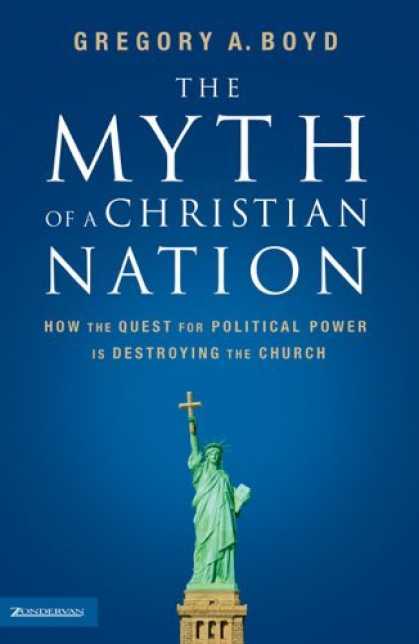
The Myth of a Christian Nation by Greg Boyd

Image taken from Cover Browser
It's no secret that the "evangelical voter" is a big ticket in American elections. I have no idea how much money is spent trying to win them over, but I'd bet quite a bit that it's a large sum. A large part of the rhetoric employed in this campaign involves the notion that America is, or was, a Christian nation. Of course, lots of ink has been spilled arguing that this neither is nor ever was the case (the founding fathers were deists, America was founded to be a secular nation inspired by the writings of Locke and Montesquieu, etc.) In many ways, Greg Boyd's book The Myth of a Christian Nation is yet another text of this sort. However, Boyd is not only arguing that America is not and has never been a Christian nation, he is arguing that it can never be a Christian nation.

The center of Boyd's argument is that Christianity is centered around living the example of Christ. Christ did not conquer through power or force, but instead overcame through the crazy, irrational act of submitting himself to death on a cross. Christians, Boyd argues, are to follow in his footsteps, changing others lives through the "power under" force of sacrificial love, instead of the "power over" force of the sword.

Boyd's argument here is strong. It is certainly true that all governments are held up by the sword, even those governments that use it sparingly necessarily have it. It also seems equally true that Christ commanded us not to resist evil, to love our enemies, etc.

It is important to note that Boyd doesn't think we, as members of a democratic nation, to refrain from participating (except in wars it seems), but that we should clearly understand the difference between the good work our government does, and the work of the kingdom. This is, perhaps, were things become less clear. I'm simply not sure how one is supposed to play both involve oneself in government, and yet treat it as something totally different than one's Kingdom calling. Ultimately, the Kingdom of God is supposed to be a redeeming power, making everything new, including, I would think, nations.

There are a few other places where I find his arguments to be problematic, if for no other reason than the tactics he takes. For example, he falls into the obnoxious tendency of seeing the pre-Constantinian church as some sort of idyllic model of what he thinks Christians should be - ignoring both its flaws and the possibility that the Church is a maturing entity.2

It is important not to conflate what Boyd is arguing for here with a simple notion of "separation of church and state." Yes, in the end, that seems to the practical import of it, but what drives it is quite a different matter. This is not about political or religious freedom, but about the nature of God's Kingdom.

In the end, I think much of what Boyd draws out here is true, and should be taken seriously. Governments are violent, nations are tribal. However, in the end, we think we should interact with them, we should never conflate them with the mission of God in this world. Doing so leads to the commitment of all kinds of atrocities. The job of the Church is not to preserve the moral fiber of an immoral world, but instead to love directly. And that, in the end, is I think the most important lesson of this book. It's far to easy to judge from a distance, to do "moral work" through the proxy of government. Of course, governments are moral agents, since laws are inevitably moral in nature, but our job as Christians isn't necessarily to police that agent. Instead, our job as Christians is to get into the trenches, to be there with the sick, the dying, the prisoners, the widows, the prostitutes and the tax collectors in face to face relationship. It is only when you know people face to face that you can even begin to know how to act.

So, I recommend picking up this book, if for no other reason that to shake up some of your perceptions of the world. It's certainly not timeless, and should be read with a critical eye, but it has some good lessons to teach.
_____________________________________________________
1. While this is generally seen as a conservative problem, it can just as much be a problem for liberal Christians who seek to make the world more "Kingdom-like" through, say, wielding the power of government to crush corporations.
2. Which it quite clearly is, if you pay any attention to the development of things like the scriptural canon, or orthodoxy theology (Christology, Trinitarianism, etc).