Showing posts with label book review. Show all posts

Tuesday, September 18, 2012

The Orthodox Way

I've always been an ecumenist. I believe in one holy, catholic and apostolic church, and believe that every creed professing person is a member of Christ's Church. A few years back, however, I had a few realizations that changed the form of my ecumenism.

The first was the realization that sola scriptura, when seen in the ahistorical way many modern Evangelicals view it, is an untenable position.

Second, I realized that the sort of ecumenism I had developed bordered dangerously on consumerism. Denominations don't really matter, they're like fashion. I put on liturgy, you put on anabaptism and none of it matters substantially. I truly believe that ecumenism is good, but when it reduces to matters of taste, it becomes dangerously individualistic.

These two realizations led me to the third. If I am to be a serious ecumenist, and not merely one who considers the diversity of the church merely a matter of fashion, then I need to take seriously the identity and claims of the branches of the Church. Moreover, since I could no longer hold to simplistic sola scriptura, I could no longer dismiss out of hand the claims of those branches of Christianity, namely the Roman Catholic and Eastern Orthodox churches, that depended upon the authority of tradition. At the same time, I was also reading much Medieval Philosophy, and beginning to see the coherence of some of the views of Roman Catholicism.

I had always thought that Roman Catholics and Eastern Orthodox believers could very well be real Christians, just as easily as any Protestant could. However, this had always amounted to thinking they could in virtue of the fact that the core of what they believed matched what I believed. It was, in other words, a kind of patronizing ecumenism. They got in because, despite all their weird additions, they were in essence like me. Yet, both these churches claim for themselves the identity of being the one true holy, catholic and apostolic Church. The rest of us might be Christians, but we are so in virtue of being, as it were, accidental members of their faith. That's a serious claim, and I decided that if I would be a serious ecumenist, then I should give it genuine consideration.

So, on and off for the last couple of years I have been giving Roman Catholicism and Eastern Orthodoxy a serious look. This has not, necessarily, been with an eye towards converting, and I highly doubt I will. On the one hand, there is something about the two churches I find highly aesthetically compelling. At times I feel like Protestantism looks like a sketch of Christianity, while Roman Catholicism looks like a detailed Renaissance painting and Eastern Orthodoxy like one of its Ikons, with all the colour and symbolism it brings. Yet, there's too much about Rome and the East that doesn't sit easy with me, their absolute rejection of a female priesthood for example, so that even if some of their claims compel me, I'm not sure I could ever align myself with them.

Still, in the end I want to seek Jesus where He may be found, and I at times I think there is something of Him in the Old High Churches that we have lost, so I continue to look at them and learn from them, and only God knows what will happen.2

Researching Roman Catholicism has been relatively easy. They have many books that clearly lay out their views and apologetics, including their very detailed catechism. Searching the East, however, has proved more challenging. I have long desired to find a kind of Mere Christianity of Eastern Orthodoxy, and had so far come up empty. I was, thus, understandably excited to see The Orthodox Way in the list of extra readings for one of my classes, and quickly picked it up.

I am extremely happy with the book. It is beautifully written and clearly exposits the Eastern faith not merely propositionally, but as a living faith. I find that much written here I can wholeheartedly agree with, and those things that I don't agree with I at least find compelling. Most of all, the book fills me once again with wonder at God's glory and excitement about the future of my faith here on Earth, leading me in turn to fervent prayer. I have not been so wholly captivated by a work of theology since I read N.T. Wright's Surprised by Hope several years ago.

As I said in my long preamble, I do not expect that I will ever go over to the East, but I am deeply grateful for this book, and it certainly gives me food for thought. If you are a Christian of any stripe, but especially one with questions about our brothers and sisters in the East, I heartily recommend a look at this book.

There is much more I could say about this book, and I may indeed write more posts on it in the future weeks reflecting on what I have read within its pages. For now though, I simply want to leave you with a glowing recommendation.

The peace of the Lord be always with you.
________________________________
1. This is why I am so opposed to re-baptism. If there is "one Lord, one faith, one baptism," (Ephesians 4:5) by which "we were all baptised into one body" (1 Corinthians 12:13), then to re-baptise is to declare the other baptism unreal, and thereby to declare that all baptised in that other church aren't members of the body.
2. I certainly hope you will pray for me as I ask these important questions. I don't want my decision to be based on fashion, the sexiness of a certain theological view, or even my own limited reasoning, but on the guidance of God's Spirit.

Sunday, September 9, 2012

Retrieving the Tradition and Renewing Evangelicalism Review

Something is wrong with Free Church evangelicalism, or so D.H. Williams (I would say accurately) claims in Retrieving the Tradition and Renewing Evangelicalism: A Primer for Suspicious Protestants. The Christian Church has gone through splits before, first in the Great Schism between East and West, and again in the Protestant reformation, yet the massive proliferation of splinter groups in recent memory is unprecedented. The Free Church isn't going away though, in fact, it's growing with incredible rapidity. Almost any Christian would say the growth of the Christian faith is a good thing, but the divisions D.H. Williams rightly finds troubling. The problem isn't just divisions either, but the theological free-for-all that feeds them. When it's every man for himself in theology, then every man's convictions can become a cause for division. Treating the Bible as an authority certainly doesn't seem to be enough either, as the long history of Christian heresies bears out.

So how to solve the problem? Williams doesn't think the end of the Free Church is likely, or even desirable (he is a Baptist after all), but he does think the Free Church can be revitalized and given a theological center. The key, Williams claims, is to reclaim the early Tradition. He does not mean by the Tradition the Roman Catholic Magesterium, but rather the guides to theology, such as the Creeds, that act as lenses through which to read the Bible. What Williams wants to argue in his book is that Protestants, even Free Church Protestants, don't need to fear the tradition. The Reformers were right to emphasize scripture, but they also saw the place of Tradition as an aid in understanding and interpreting it. Indeed, they even used the early Tradition as weapons in their battle against the Roman Catholic church. There is no reason, Williams thinks, that the Free Church cannot lay hold of the benefits of the Tradition and still remain the Free Church.

The argument of the book is certainly unique and definitely compelling, but I'm not sure it's entirely successful. I'm not, of course, the audience of this book, as I'm a high church Anglican with a pretty positive view of the role of the Church's Tradition in Christian orthodoxy, but I'm entirely sure how persuasive the argument laid out in the book would be to his audience. Moreover, I'm not sure that the Free Church really can be what it is and at the same time respect the Tradition. I don't know the answer to that quandary, as my own understanding of the relationship between Christian orthodoxy, Scripture and the Church's Tradition is still something I'm definitely wrestling with, but I'm suspicious. For one thing, while the Tradition is a valuable thing, it too can be open to interpretation, so I'm not sure it solves the hermeneutical puzzle that troubles Williams. If all he wants to do is encourage Free Church protestants to at least converse with the Tradition, more power to him, but it hardly seems likely to solve, in and of itself, the individualism that plagues that expression of our faith.

Perhaps the biggest problem I see is a lack of clarity on the part of Williams as to what he means by Tradition. He makes the distinction, often made in certain circles, between Tradition and traditions, but I felt he did a rather poor job explaining what he saw as a difference.

Neverthless, not all is bad with this book. Certainly, Williams is bringing an important part of the Christian faith to the attention of those in the Free Church, and he is doing it as an insider. He does succeed in arguing that Protestants don't need to fear the Tradition, and successfully dismantles Anabaptist myths of the "fall of the Church" after Constantine.

So, there's certainly plenty of good material to be had here, but it's certainly not the earth-shattering book I was hoping for. Worth a read if your a Protestant, especially a Free Church Protestant, with questions about the Tradition, but it probably won't settle things for you.1
_________________________________________
1. Another more detailed review of the book can be read over at First Things.

Thursday, August 16, 2012

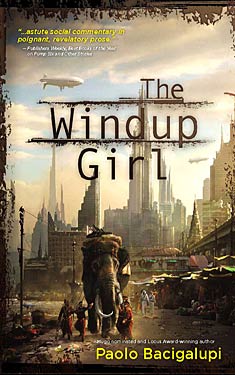
The Windup Girl Review

Worlds Without End
The Windup Girl by Paolo Bacigalupi 
2010 Hugo Award Winner for Best Novel and 2009 Nebula Award Winner for Best Novel 

 I'm a sucker for a good setting. After all, I was raised up on a steady diet of The Lord of the Rings and learned early that a well built setting is a wonderful compliment to a good story, and can even be a pleasure all its own. When you come down to it, that's probably why I love science fiction and fantasy - they're the only genres were I can indulge in the pleasure of world building. Well, The Windup Girl is an absolutely fantastic bit of world building, and I'll waste no more time in giving it high praise.

Rather than being set on some far off planet or in a gritty metropolitan future, The Windup Girl takes place in a Thailand of the future, one that exists in a radically different, but utterly believable, political and economic world from our own. It's that believability that's so incredible about Bacigalupi's world. Our world has gone through many economic shifts, from agrarian to industrial and beyond. But who from an agrarian society could have pictured an industrial world? Of course, there's no guarantee the world will go the way of Bacigalupi's vision (hopefully it won't) but one can readily imagine it, and that makes it a wonder to behold.

Without giving too much away, since so much of the pleasure of The Windup Girl is the slow unraveling of its setting, the world Bacigalupi builds is one of a post-industrial crunch. Well before the time of the book, the petroleum that fuels our world's economy ran out, without any comparable alternative being found, and the global economy quickly became a thing of the past. The world couldn't just go back to being agrarian though, because industry had changed the world forever. Alternative technologies provide for some of what petroleum provided before, though with nowhere near the power, and the world is slowly inching back towards a global economy. Maintaining these technologies is crucial, because during the industrial age the agro-businesses had created genetically engineered crops and plagues that guaranteed humanity would need to continue to rely on advanced technology to keep itself alive and fed.

In the midst of this world of economic isolation and genetic disaster, the city of Bangcock is a boiler plate of political and economic tensions. Two major forces jostle for power within the city, as those who seek to protect the city from the outside world, the "White Shirts" of the environmental ministry, butt heads with those of the Trade Ministry who see salvation for Thailand in the recovering global economy. The Windup Girl is the story of one genetically engineered Japanese girl who becomes caught up in these forces.

This book certainly won't be for everyone, however. It is a story about politics, and so naturally it moves at a lumbering pace. Mind you, I enjoyed nearly every minute of it, but it was certainly not a page turner and took me awhile to finish.  Also, the exploitation which the titular Windup Girl Emiko faces throughout the story is not easy stuff, so if you've got a queasy stomach you should probably stay away. It's also not a book without it's flaws. The prose is perfectly serviceable, but not incredible, and the characters that inhabit it, while not flat, fail to really jump off the page.

It's also not a book whose message I can get on board with, though that certainly doesn't mean its poorly done, or that I can't enjoy it. Without giving too much away, the books overall slant seems to be something of a Buddhist Transhumanism. Which, when you come right down to it, is a very interesting worldview, just one dramatically opposed to my own.

So, if you love world building, and enjoy political stories, I can highly recommend The Windup Girl. If that's not your style, then this book is definitely not for you.

Also, fantastic cover.

Thursday, August 18, 2011

Earthen Vessels: Why Our Bodies Matter to Our Faith by Matthew Lee Anderson

Image taken from  Mere Orthodoxy
Matthew Lee Anderson, author of Earthen Vessels, has been told through Twitter than I am terribly mean and know only how to bruise and destroy. Thankfully, the person who told Anderson this was joking, since I don't think I could live up to that reputation - most of what I have to say about Earthen Vessels is good.

In the first half of the book, Anderson lays out a basic picture of what he thinks the body is, and who he thinks his audience is. None of his reflections on the body should be earth-shattering to any biblically informed Christian who has spent time reflecting on the body, but that's okay because his audience probably hasn't. His audience is Evangelicals, who many have accused of being Gnostic, while Anderson, in defense of us, can at best call us inattentive.

If Anderson is right that Evangelicals have merely been inattentive, then this book will do a lot of good if its read. He establishes that the body is our place of personal presence in the world, the temple of God and the vessel of our worship, and then goes on to explore specific question in reflection of this anthropology. Should Christians get tattoos? What should Christian sexuality look like? What about homosexuality? Anderson approaches all of these questions carefully, and he's clearly given them a lot of thought. Unfortunately, the sheer breadth of the material he's trying to cover means his arguments are often rather thin. He seems to be touching on the topics rather than giving them the thorough analysis they deserve. In the end, the approach seems perhaps more blog-like than book-like. Once again, however, I don't think this is really a problem, because I rather think the point of these chapters is, in the end, a plea to at least think about these things. Think about the body and worship, think about tattoos and the Christian body.

Throughout the book, I found myself at times agreeing with Anderson, at other times disagreeing. Occasionally his critiques of liberal theological positions seemed to me to rather miss the point of those positions. Then again, he, like myself, is a conservative, and its hard to understand the opposing mindset if you haven't spent time immersed in it. There was only one point in the text where I was seriously bothered by anything Anderson said, which was when he discussed yoga. I am not a practitioner of yoga, but I found his view to be narrow and perhaps a bit reactionary even (I plan on writing a separate post on the subject, though, so I won't go into more detail here).

In the end, if you're an Evangelical Christian, or count any Evangelicals as friends, I recommend you read this book. It's true that if you've given much thought to the body nothing here will surprise you, but at the very least it should spark some ideas in your head, and it will probably give you some ideas as to how to approach the Evangelical community with this topic. If you haven't given much thought to the body, then this book is an absolute must read.

Friday, July 29, 2011

Deconstructing Theodicy: Why Job Has Nothing to Say to the Puzzle of Suffering by David B. Burrell

Image taken from Tower Books
I love this book. Let me just get that out of the way since this is going to be a quite lengthy review and exposition of David B. Burrell's Deconstructing Theodicy: Why Job Has Nothing to Say to the Puzzle of Suffering. I love it first and foremost because it is a beautiful exposition of one of my favorite books of the Bible and an adept exploration of an age old theological question.

In the text, Burrell does precisely the kind of theology that I strive to do - devoted to scripture while using the resources of philosophy, and even some outside literary and religious sources,1 to illuminate the text.2 Ultimately, Burrell perhaps strays further from the base text than I would want (always a danger with this approach) but in clinging to orthodoxy he avoids any egregious errors.

The central thrust of the book, as revealed by the title, is to show how the book of Job deconstructs the impulse to provide theodicies. A theeodicy, for those unfamiliar with the term, is the act of trying to "justify the ways of God to us" and explain "how there could be evil in God's world" (Burrell 13, 108).

Burrell begins with a detailed textual analysis of the structure of Job. The primary goal here is to show the contrast between Job's friends, who construct theodicies about God, with Job who directly addressed Him. From here, Burrell moves to an examination of the parallel figure of Ayyub in the Qur'an. This is ultimately a weak point in the text, since it proves to be almost entirely a tangent.3 His next step is to roughly outline Medieval commentaries on the text by Sadiah, Maimonides, Aquinas and Gersonides. Finally, Burrell uses arguments by Terrence Tilley and Marilyn McCord Adams to draw out the central thesis of the text.

Using the Medieval commentaries, Burrell builds up a picture of God I've discussed on this blog before. God is transcendent, yet immanent. God is in many ways a different order of being from His creatures, one who experiences eternity directly and can only be discussed analogically. Yet, precisely God's role as willing creator and conserver means He is also always present to His creatures. Because of this, we can always address Him, and the human mode of address is linguistic.

The arguments of Tilley and Adams then serve to do the titular deconstruction of the work.4 Tilley and Adams point out the emptiness, and indeed frequent cruelty of theodicies. Adams, for example, points out that the very act of theodicy can oftentimes miss the vibrantly real nature of people's suffering. The actual horrendous torment that human beings undergo becomes reduced to an abstract lesson. As Hume famously pointed out in response to the Augustinian explanation that evil is not an actual thing, but mere privation of the Good - that's a nice turn of phrase, but it does little to alleviate the reality of the pain experienced by sufferers, which is really the heart of the problem.5

Burrel then uses Adams's argument for his reconstruction. The very metaphysical immanence brought out by the Medievals, making God present to His creatures, provides the solution - the direct address and solidarity with the creator. This Burrell thinks, is what the structure of the dialectic in Job shows. As he puts it, 'even if Eliphaz and his companions are castigated for 'not having spoken of [God] what is right as [his] servant Job has'‎ (42:7), God cannot be commending Job for 'getting it right,' as we might say. For his cumulative outbursts are a far cry from attempts to explain his plight, never pretending to be more than bewildered complaints - despite the ways his "friends" often construed them.What the voice from the whirlwind commends is rather the inherent rightness of Job's mode of discourse: speaking (however he may speak) to rather than about his creator" (109).

The only major flaw with this argument is that at times in comes dangerously close to the infamous theodicy that waves off the problem by saying that "God moves in mysterious ways." As I once heard an atheist put it, this amounts to saying God is a "cosmic asshole". This is definitely not what Burrell is arguing however. Yes, God's movement is mysterious, and attempts to reduce it to simplistic theodicy will fall short, but we are not left with the distant jerk-God of mysterious movement. Instead, God is shown to be in sharp solidarity with us, and the correct theodicy is understanding that we can (and ought to) call on God and He will answer us.

The potency of this deconstructed theodicy is that it renders action, turning us away from the merely selfish explanation (read: excuse) of Job's friends. For the case of Job's friends is the case of many who engage in theodicy, it's motive ultimately selfish. Job's friends do not seek to aid him, they seek to justify the system as it is - the system which has (and continues to) benefited them. Rarely do theodicies do much for those in the midst of suffering, and often they do not even care to hear them. Yet when Job turns to God, crying out to his creator and even demanding an audience with him, excuse is turned to action. Evil is not explained away, it is confronted head on. Finally, it is radically personal, as Burrell shows in a denouement to his argument that traces out explanatory parallels between the central thesis of Job and Augustine's Confessions.6 

I will say that, while I do love this book, it is not without its flaws, the biggest of which is structure. If you follow through to the end, the whole picture of the book will become clear, the approach will seem haphazard until you get there. Part of this is that the central thesis of the book is only vaguely stated at the beginning and you have to wait to the end to get a clear picture of where Burrell is going. The other major flaw, of course, is the superfluous Ayyub chapter. Other than these flaws, the book is well worth a read, especially for students of theology and philosophy.

I would, finally, like to conclude where Burrell himself concludes, in a quotation from a sermon by Leo the Great for the feast of the transfiguration of Jesus (because I think it's beautiful):
The writings of the two testaments support each other. The radiance of the transfiguration reveals clearly and unmistakably the one who had been promised by signs foretelling him under the veils of mystery. As Saint John says: "the law was given through Moses, grace and truth came through Jesus Christ." In him the promise made through the shadows of prophecy stands revealed, along with the full meaning of the precepts of the law. He is the one who teaches the truth of prophecy through his presence, and makes obedience to the commandments possible through grace. In the preaching of the holy gospel all should receive a strengthening of their faith. No one should be ashamed of the cross of Christ, through which the world has been redeemed. No one should fear to suffer for the sake of justice; no one should lose confidence in the reward that has been promised. The way to rest is through toil, the way to life is through death. Christ has taken upon himself the whole weakness of our lowly human nature. If then we are steadfast in our faith in him and in our love for him, we win the victory that he has won, we receive what he has promised. When it comes to obeying the commandments or enduring adversity, the words uttered by the Father should always echo in our ears: "This is my Son, the beloved, in whom I am well pleased; listen to him." (Sermon 51, 3-4, 8, Patrologia Latina 54, 310-11, 313). 
_________________________________________________

1.  There is a bit at the conclusion of the text where I think Burrell gets a little too close to collapsing the transcendent but eminent God of Aquinas into Hindu pantheism, though he does ultimately relieve this by stressing the uniqueness of God.
2. This is not to say that this is the only, or even the best, avenue with which to approach scripture, but simply the one to which I feel called, and sadly one that is hard to find today. One could certainly get to Burrell's ultimate conclusion by way of reading Job purely through the rest of scripture. The very fact of the incarnation creates the solidarity between God and creation that Burrell reaches through Medieval metaphysics and paints much the same picture of the text. The attempts to explain suffering in the way of Job's friends is fruitless, it is in calling on God, and in His answering in solidarity, that a kind of answer is found.
3. Using another literary or religious text to gain a fresh perspective on a scriptural text often mired in centuries of traditional interpretation seems laudable (the long tradition of trying to turn Job into a theodicy, for example). However, that isn't what Burrell ultimately does. Rather, he presents a condensed version of an essay on the quranic character he found illuminating. While I think its great that Burrell enjoyed the essay, and that he values respecting the central religious text of another faith, the chapter seems to me to add nothing to his argument and so does not belong here.
4. Deconstruction, as my friend Fernando would be eager to point out at this juncture, is not mere destruction. Deconstruction, rather, takes something apart in order to reveal something new.
5. I actually happen to agree with Augustine that evil is not a thing but a privation - I just think its rubbish as a theodicy.
6. This bit also motivates me to want to try and write a confession of my own some day, though one that would have quite a different view of sin, and especially bodies, from Augustine.

Thursday, July 28, 2011

Robopocalypse by Daniel H. Wilson

Image Taken from io9
Disclaimer: I received Robopocalypse as an advanced review copy. 


I didn't really enjoy Robopocalypse, which is strange. The truly terrible title aside, the book is honestly a well-crafted tale of a robot uprising. I suppose that, at the moment, I simply don't care about robot uprisings very much - I just find my own life more interesting. So, it took me awhile to read the book.

An initial hurdle for me in reading this book is that it is written in first-person present-tense, a narrative format I have great difficulty getting into. I'm not entirely sure why the author chose this format, as the story is actually being told after the events, but he does it well and eventually I was able to get into the flow of it. 

The actual story itself is driven mostly by a couple of big ideas, twists on the typical robot uprising story. I won't spoil them for you, though there's one at the beginning I wish the author had spent more time on. The book is also largely built upon a theme - humans triumph through adversity. It's not a new idea, but it receives a pretty good treatment at the hands of Daniel Wilson. Unfortunately, the general picture he paints is a very utilitarian one. 

All in all, I'd recommend this book only to people interested in the subject matter. It is well written, and there's plenty of action and drama, but if you're not concerned with how humanity might handle near-genocide at the hands of sentient machines, well... I'd give it a pass. 

Tuesday, July 5, 2011

The Rage Against God: How atheism led me to faith by Peter Hitchens

From Tower Books
Peter Hitchens, the brother of famed atheist polemicist Christopher Hitchens, tells the story of his personal journey to faith in the pages of The Rage Against God: How atheism led me to faith. This story is a fascinating and brilliantly written one, and well worth reading.

That is not to say it is a perfect book. Far from it. It strikes me that Peter is definitely of the same seed as his brother, and at times The Rage Against God can certainly descend into polemic mirroring his brothers, though always filled with more charity. I do not think this book is the sort that would persuade anyone to faith, nor, in fact, does Peter. This is his story, and when it focuses on that it is at its strongest. As such, the beginning section where Peter tells his own story, and the final section where he reflects closely on the case of Soviet Russia (a world he lived in for quite some time as a reporter) are the best parts of the book. In the middle, Peter goes through a rapid-fire examination of some of the more famous arguments of the "New Atheists," and while it is interesting I doubt it could change anyone's mind.

The personality that comes across in the book also varies. At times, Peter seems the compassionate prophet, concerned deeply with the decay he has seen progress in his society during his lifetime, targeting genuine problems and weeping for his nation. At other times, Peter can come across as an old cranky man complaining about this new-fangled modern art.

But in the end, reading this book, I find myself quite likely Peter, and his command of prose is to be envied. I also share with Peter his largest concern, the fear over the totalitarian nature of the New Atheist rhetoric. On my good days, I like to think the best of Richard Dawkins, Christopher Hitchens, and their ilk. I don't believe they have any desire to harm the religious, though they certainly seem to fear us. Yet, their language carries with it the seeds of just such injustice. The world is broken, they rightly say, and it could be made better if only religion were gone. Of course, religion is not something that stands on its own, religion is only there because of the religious, and so they are the ones in the way of utopia. That is, as Peter points out, always the language of bloody revolutions, "the world would be perfect if only these people were gone." Again, I do not think Dawkins or the elder Hitchens want this, nor do I think Peter believes they do, but it's only a matter of time until the language they use inspires someone to think in just such a way.

 So, pick up this book if your interested in the heart and journey of a man so close to one of the vanguards of the New Atheist movement. In many ways, Peter is man Christopher might have been had he taken a different road. Don't expect to be persuaded one way or another on the questions he addresses, but enjoy the exploration of the man's heart and his skill with words.

Friday, July 1, 2011

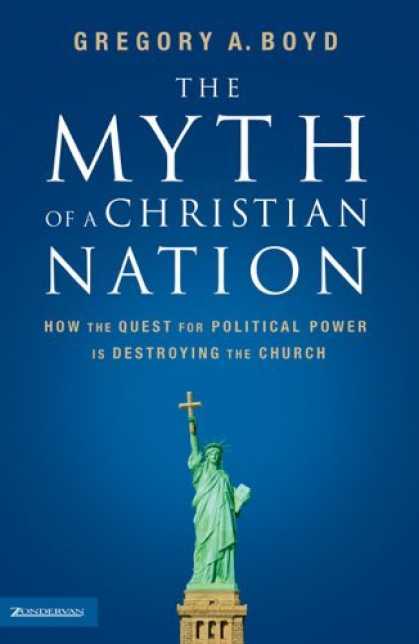
The Myth of a Christian Nation by Greg Boyd

Image taken from Cover Browser
It's no secret that the "evangelical voter" is a big ticket in American elections. I have no idea how much money is spent trying to win them over, but I'd bet quite a bit that it's a large sum. A large part of the rhetoric employed in this campaign involves the notion that America is, or was, a Christian nation. Of course, lots of ink has been spilled arguing that this neither is nor ever was the case (the founding fathers were deists, America was founded to be a secular nation inspired by the writings of Locke and Montesquieu, etc.) In many ways, Greg Boyd's book The Myth of a Christian Nation is yet another text of this sort. However, Boyd is not only arguing that America is not and has never been a Christian nation, he is arguing that it can never be a Christian nation.

The center of Boyd's argument is that Christianity is centered around living the example of Christ. Christ did not conquer through power or force, but instead overcame through the crazy, irrational act of submitting himself to death on a cross. Christians, Boyd argues, are to follow in his footsteps, changing others lives through the "power under" force of sacrificial love, instead of the "power over" force of the sword.

Boyd's argument here is strong. It is certainly true that all governments are held up by the sword, even those governments that use it sparingly necessarily have it. It also seems equally true that Christ commanded us not to resist evil, to love our enemies, etc.

It is important to note that Boyd doesn't think we, as members of a democratic nation, to refrain from participating (except in wars it seems), but that we should clearly understand the difference between the good work our government does, and the work of the kingdom. This is, perhaps, were things become less clear. I'm simply not sure how one is supposed to play both involve oneself in government, and yet treat it as something totally different than one's Kingdom calling. Ultimately, the Kingdom of God is supposed to be a redeeming power, making everything new, including, I would think, nations.

There are a few other places where I find his arguments to be problematic, if for no other reason than the tactics he takes. For example, he falls into the obnoxious tendency of seeing the pre-Constantinian church as some sort of idyllic model of what he thinks Christians should be - ignoring both its flaws and the possibility that the Church is a maturing entity.2

It is important not to conflate what Boyd is arguing for here with a simple notion of "separation of church and state." Yes, in the end, that seems to the practical import of it, but what drives it is quite a different matter. This is not about political or religious freedom, but about the nature of God's Kingdom.

In the end, I think much of what Boyd draws out here is true, and should be taken seriously. Governments are violent, nations are tribal. However, in the end, we think we should interact with them, we should never conflate them with the mission of God in this world. Doing so leads to the commitment of all kinds of atrocities. The job of the Church is not to preserve the moral fiber of an immoral world, but instead to love directly. And that, in the end, is I think the most important lesson of this book. It's far to easy to judge from a distance, to do "moral work" through the proxy of government. Of course, governments are moral agents, since laws are inevitably moral in nature, but our job as Christians isn't necessarily to police that agent. Instead, our job as Christians is to get into the trenches, to be there with the sick, the dying, the prisoners, the widows, the prostitutes and the tax collectors in face to face relationship. It is only when you know people face to face that you can even begin to know how to act.

So, I recommend picking up this book, if for no other reason that to shake up some of your perceptions of the world. It's certainly not timeless, and should be read with a critical eye, but it has some good lessons to teach.
_____________________________________________________
1. While this is generally seen as a conservative problem, it can just as much be a problem for liberal Christians who seek to make the world more "Kingdom-like" through, say, wielding the power of government to crush corporations.
2. Which it quite clearly is, if you pay any attention to the development of things like the scriptural canon, or orthodoxy theology (Christology, Trinitarianism, etc).

Tuesday, March 8, 2011

Book Review: The Accidental Anglican

The Accidental Anglican by Bishop Todd Hunter


I have some bias in reading this book. Todd is my pastor and my bishop, and I love and admire him in both roles, so am inclined to appreciate what he brings to the table. Still, his other books, while very good, have not stood out to me. This one, however, as an account of Todd's journey into the Anglican communion stands above the rest. Todd's story is a unique and beautiful one, going from Cavalry Chapel roots, through the Vineyard and the emerging church, Todd has accumulated a lot of church experience. What I love most of all is his willingness to sing the praises of where he came from, even has he has moved beyond it. There is no bitterness here. Truly, Todd is representative of the "sweet reasonableness" he praises Anglicanism for.

Book Review: How Should We Then Live? The Rise and Decline of Western Thought and Culture

How Should We Then Live? The Rise and Decline of Western Thought and Culture by Francis Schaeffer


In some ways this isn't a fair review. It isn't fair because I simply skimmed through the book (how I came to do that is a story for another time). Still, I feel that skimming gave me a pretty good idea of the book, and it's not a very positive one.

There's no denying that Schaeffer is intelligent, in that he attempts to tackle all of Western civilization, and has obviously tried to gain a vast knowledge of it. The problem is that most of his understanding of what he has approached is wrong.

His analysis is also reductive. He seems to see all of human history as some sort of battle between placing God at the center of our worldview, or putting Man there.

The problem with this is that's it's horribly reductive. Things are far more complicated than this, and in forcing them into this mold they often become terribly distorted. For example, the question of the relationship between particulars and universals that was of great importance in Medieval Philosophy is somehow made into a quest to find meaning (i.e. purpose) for particulars, when it was a linguistic and metaphysical inquiry.

Also, God became man. This destroys his paradigm.

Friday, November 26, 2010

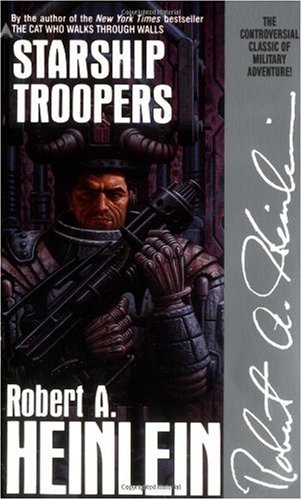
Book Review: Starship Troopers

Starship Troopers by Robert A. Heinlein 1960 Hugo Award Winner for Best Novel 


After finishing The Forever War, it seemed appropriate to pick up and read the book which, in many ways, had been its precursor.  Starship Troopers is considered by many to be the origin of the "space marine" genre (though the titular troopers are actually army) and also criticized by many as being, supposedly, favorable to fascism.


I can't speak for it's views on fascism, but I can see how it started a genre. The book is a fascinating piece of world creation, and chock full of ideas. It's important to know coming in that these ideas are the point of the book. Certainly, Juan Rico, the narrator, is a definite character whose fate you care about, but the narrative is not about an exciting story, and at times gets bogged down in long philosophy or history lectures on the part of his instructors. The first time I picked up this book a few years ago I ended up getting bored with it while Rico was still in training because I'd been expecting an exciting war story. 


 I really don't see fascism in the book, though it was decidedly pro-military and critical of free democracy.  Heinlein dedicates the story "to all sergeants everywhere who have labored to make men out of boys." And that, ultimately, seems to be the theme of the story. Juan Rico begins as a young man, unsure of himself, mediocre in school and unthinkingly following his friends, and bit by bit the military takes him away from this. 


Finally, it should be noted that the mobile infantry of Starship Troopers is a voluntary corps. The book is critical of conscription armies, and in many ways this is what sets it apart from The Forever War. It's not as simple as Starship Troopers being pro-military and The Forever War being anti-military. The one is about a volunteer army fighting to defend its homeland, the other about a conscript army fighting for reasons unknown. One is Vietnam, the other World War 2. Both authors have interesting perspectives (though I don't agree fully with either) and, though Haldeman did criticize the book for being too pro-military,  both share a mutual respect.


This is another one I recommend to pick up. Oh, and I'm told it's nothing like the film. 

Wednesday, November 24, 2010

Book Review: The Forever War

The Forever War by Joe Haldeman1
1976 Hugo Award Winner for Best Novel and 1975 Nebula Award Winner for Best Novel 


Awhile back I did a review of another Haldeman book, Camouflage, another award-winning novel which I found extremely underwhelming. Needless to say, I was somewhat worried in approaching The Forever War. At the same time, all the summaries of the book I'd heard made it sound extremely interesting. The basic concept is this - a physicist, William Mandella, is drafted into the military to fight an alien race which has attacked human vessels, but who no one has ever seen. The war begins, and due to time dilation, a few years of war time for Mandella become thousands of years back home. As Mandella returns home, he must deal with the isolation the war has brought on him. 


Haldeman himself is a physicist and a veteran of the Vietnam war, so I also thought his experience should add well to the story. So how would things turn out? On the one hand, an interesting concept and a writer who knows his subject; on the other hand, a very underwhelming book by the same author.
When the book first started the worst seemed confirmed. The military training the characters went through was absurdly over the top in the lack of care showed by the soldiers's superiors (live ammo training, etc.) and the book looked like it was going to sink into the juvenile use of sex so many sci-fi authors seem to fall into. 


Thankfully, I stuck with the book, and my initial impressions were completely wrong. With this story, Haldeman undoubtedly knows what he's doing. Even the sex that initially worried me was, as my friend pointed out to me when I was half-way through, far too deliberate to be "juvenile" and ended up playing an extremely important role in the alienation experienced by the characters. 


I'm still not sure what I think about the stories ending, but either way it's not really important.  The book isn't so much about a narrative, but about the effects of the Forever War on Mandella and the Earth. We follow him closely, and in many ways experience with him the disillusionment and alienation of the war. 


This is an excellent book, and in many ways it feels like a science fiction book ahead of its time. I recommend it to those interested in creative uses of science fiction tropes and in a soldier's perspective on war. 
__________________________________________________________
1. I actually listened to this one as an audiobook and the reader was quite excellent. 

Tuesday, October 19, 2010

Book Review: Dresden Files, Book 1, Storm Front

Storm Front by Jim Butcher

Harry Blackstone Copperfield Dresden is a very manly man. He takes hits like the rest of them, then he takes some more. He could give up, but people are counting on him, the women are beautiful, and Harry Blackstone Copperfield Dresden is a manly man.

That, I think, provides a fairly adequate summary of the two (really one-and-a-half) Dresden Files books I've read so far. As you may be able to tell from my sarcastic introduction, this formula has begun to wear a bit half way through the second book, but I shouldn't be too harsh on on these books. After all, they're fun, page-turning, and drenched with enough testosterone to make Daniel Craig weep with inadequacy.

But where was I? Oh yes, Storm Front. This is the first book in a rather long series, and sets the tone of manly manliness and magic that seems like its going to be the blueprint for the series. The main character is a private detective of a very special sort operation out of Chicago. He's special because he happens to be a wizard (a manly wizard). In this first adventure, Harry helps the police department to solve a very mysterious murder, whilst dealing with threats from a magical council, and another small case on the side that, well, don't want to spoil too much...

So, like I said, the books fun and should keep you turning the pages. Though, of the people I know who've read this book, reactions have varied quite a bit. My sister thinks they're silly, my friend Fernando seems to think them fairly average, and they are my ex-girlfriend's favorite series. Nobody, at any rate, thinks them terrible.

Give it a read if your in the mood for some pulp. And manliness.

Tuesday, April 20, 2010

Book Review: Giving Church Another Chance

Late last year I read my pastor and Bishop Todd Hunter’s first book, Christianity Beyond Belief in which he argued for the importance of entering into God’s story and living as Christians not merely for cleansing from sin, but further for the sake of touching the lives of others with Christ’s love. That is, being a people set apart by God for the sake of the rest of the world, just as Israel was intended to be.

Recently, he released his second book, Giving Church Another Chance: Finding New Meaning in Spiritual Practices and it is a book well worth picking up. There is a large group in our society, even within Christianity, who have become disenchanted with church. Todd was one of these, he went through a “de-churched” phase, experimenting with various alternative forms of Christian worship, but then, at the end of this journey, he found himself as an Anglican Bishop. For those of you who don’t know, Anglicanism, which has its roots in the Church of England, is a high liturgical church, with bishops, priests, and formal organized prayers. What happened? Well, you’ll have to read the book to get the full story, but in short Todd discovered the role of the liturgical church as a tool for spiritual formation. He came to realize that church is not “what it’s about” but rather a place of spiritual refreshment for Christians, a center for our lives from which we go forth to bless the world.

I still have some of the problems I had with Christianity Beyond Belief, namely the stylistic simplicity (especially the use of quotations from The Message paraphrase of the Bible) but as before, I feel these aesthetic complaints do not reflect on the importance of the content.

Ultimately, I don’t think this book is as important as Surprised by Hope but it’s a wonderful tool for understanding Todd’s vision and I truly believe that the “re-practicing” of church advocated by Todd in this book should at the very least be examined by all Christians (especially the section on the Eucharist), but especially those who would tear down centuries of tradition on the basis of their own limited experience and personal interpretations of scripture.

Thursday, January 28, 2010

Book Review: Camouflage

Camouflage by Joe Haldeman
2005 Nebula Award Winner for Best Novel 


My review of this will be short, because really I don't have that much to say. The basic premise involved to alien shapeshifters who had spent millions of years on Earth. So long, in fact, that both had forgotten their origins. In the near future, however, a team of scientists unearth an alien artifact that draws them both to it - the one because he is trying to discover his origins, the other because he is driven to kill any beings like him. 


 It was a fairly interesting set up, with aliens that were moderately alien in their psychology (though not enough so if you ask me). The pacing was also quite good, and I kept turning the pages waiting to find out who these aliens were, why they were on Earth, and why the one was driven to kill the other. There was too much of that modern science-fiction impulse to have frequent and pointless sex scenes. I find it all rather juvenile, but can look past it for a riveting story.


*SPOILER (mouse over to read)
Unfortunately, all that excited page turning went entirely unrewarded. The book ends with an anti-climactic battle between the two aliens, followed by the "good" one giving us exposition on who he is that only tells us information we (as the readers) already knew, and explaining that he doesn't know who the other alien is. Then he flies away.

That's it.


*END SPOILER*


This actually seems to be a chronic problem with science fiction writers. They're often brilliant at set up, but totally fall on their faces when it comes to execution.


Oh well.


Ultimately, Camouflage was neither particularly spectacular, nor entirely terrible, and so my concluding thoughts on the book are... "meh". 


Tuesday, September 22, 2009

Book Review: Red Mars

Red Mars by Kim Stanley Robinson 
1993 Nebula Award Winner for Best Novel

 
Hold on for a second while I catch my breath.

...

Okay, thanks. Well, I finally arrived at the end of Red Mars and has it ever been a journey. I can't even remember when I started the book, but I know I've been reading it for a long time. Reading Red Mars has been, really, quite an exhausting effort. The book is long, heavy and slow, but also rich with character, sociology and science (real science). Usually, when I actually picked up the book and read it I thoroughly enjoyed myself, but I never felt like reading it when I wasn't. Because of this, I spent a great deal of time reading other books while I crawled through this one.

Robinson's work has been called "literary science fiction" and it's easy to see why, he deals well with the issue.  In many ways, modern science fiction has a lot of similarities to Victorian literature, and Robinson embodies this to the fullest in its obsession with detail, its desire to portray a whole society, and its interest in the effect of environment on the individual and vice versa. Indeed, Robinson's long and detailed descriptions of the Martian landscape reminded me very much of George Elliot's description of the English countryside in The Mill on the Floss.

There was a long stretch of time where I wasn't sure if I liked this book. The pace is plodding and most of the characters are not very likable. Also, this piece is hard science fiction in the truest sense of the term and can get bogged down in technical details (there's even a section where Robinson has a chart showing the Martian calendar). Still, on the whole his portrayal of the science is effective and not boring, and it helps to ground the story. Also, the above-mentioned descriptions of Mars really help to make the setting come alive, and really portray the wonder and the alien nature of the planet. While Robinson takes a long time to get things moving, this allow him to make a convincing portrait of a human society developing on Mars, and the ultimate payoff is worth it (unlike, for example, the payoff in Dune). 

Still, the book is not perfect and I really wish there were more characters I liked. Perhaps it's a weakness of mine, but I really have trouble with fiction that lacks people I can admire (this was the problem I had with the new Battlestar Galactica). I'm also not a fan of the fact that the only Christian character in the book is a particularly nasty person, and it is too some extent stated that this is because of her beliefs. Of course, bad Christian beliefs can lead to nasty people, and the belief that this is the cause of her nastiness is in the mind of someone with a bias, so the writer is not necessarily portraying this as cold hard fact. Particularly painful was the discussion early on in which the Christian character and an atheist have an argument about the merits of faith and the Christian's retort is a pathetic straw man. I also have a distaste for the sexual morality of the characters. Of course, many people have this kind of morality, but, as I've said before, I tire of it being the norm in all of the fiction I like.

Ultimately, Red Mars is a very solid book and a worthwhile read for those who like science and sociology, and who have an unusual amount of patience.

Thursday, September 17, 2009

Book Review: Christianity Beyond Belief

Christianity Beyond Belief: Following Jesus For the Sake of Others by Todd Hunter

We’ve all heard the message, it says that we’re sinners separated from God, in desperate need of grace. Thankfully, Jesus came and died and through Him we can have forgiveness and go to heaven when we die, if only we accept him into our hearts. Questions hang in the air, however, why do we stay here? Why the incarnation? What are we saved for? The answer, really, is that this is an anemic view of the gospel (so too, really, is the so called “Social Gospel,” but for other reasons). It is these questions, and a deeper view of the gospel, that are addressed in Todd Hunter’s Christianity Beyond Belief: Following Jesus for the Sake of Others.

Fundamentally, what Todd develops is a theology of coming to orthodoxy as a result of a life lived in an environment of spiritual formation. Throughout the work, Todd draws heavily on the work of Dallas Willard and N.T. Wright, which naturally sets the theology on very solid ground. He advocates, as any good Christian theology should, the making of disciples who live their lives for the sake of others and thereby usher in the presence of God’s Kingdom in the here and now.

Todd also understands the importance of imagination and story in the shaping our lives, and he emphasizes the importance of understanding the true story of the gospel if we are to really live the lives Christ calls us to live. This understanding, coupled with a deep awareness of the love and grace of God, means that Todd firmly avoids the pitfalls of guilt-ridden legalism that believers all too often fall into, but still maintains that there is something more to Christianity than mere intellectual agreement to right doctrine. As he himself has said, “Anything you can do with guilt, you can do better without it.”

There were a few places were Todd’s theology seemed to come uncomfortably close to that of the emergent church. Really, that’s only natural as part of what he’s seeking to do is to address the needs of the postmodern generation, which is the same thing the emergent church has sought to do. I think, however, that Todd does it better, because he meets the postmodern where it is, but he does it without losing the anchoring of tradition and orthodoxy.

If I had one complaint about the book, it would be the prevalent use of The Message paraphrase of scripture. I respect Eugene Peterson and the intention behind The Message, but as a writer I find the loss of poetry in that version frustration. This is, however, only and aesthetic complaint and it in no way dampens the important of the message of this book.

Ultimately, Christianity Beyond Belief is a fantastic book that paints a clear, graceful picture of the Gospel and the vibrant promise of life promised by Christ. I recommend that Christians pick up this book and soak in Todd’s expression of the vision of the Gospel. Also, at the risk of repeating myself too much, if you’re in the Orange County area and looking for a church, I strongly suggest you check out Holy Trinity, the church Todd Hunter is launching in Costa mesa at the end of September.

Saturday, September 12, 2009

Review: On Christian Doctrine

On Christian Doctrine by St. Augustine of Hippo


On Christian Doctrine is the first work of Augustine’s I’ve ever finished. The reading group I’m in read the first two sections as a launching point for our discussion of myth and symbol, and I decided to finish the whole thing. The book is essentially a primer on how to read the Bible and then, in the fourth section, how to present the knowledge attained therein.

All in all, On Christian Doctrine is a very solid, though basic, examination of symbol, hermeneutics and eloquence. I like Augustine’s principle exegetical rule (partially, I must confess, because I’ve thought of a similar thing myself) which states that the interpretation of scripture should always be one that leads to the love of God and/or others since Jesus said “You shall love the LORD your God with all your heart, with all your soul, and with all your mind.’ This is the first and great commandment. And the second is like it: ‘You shall love your neighbor as yourself.’ On these two commandments hang all the Law and the Prophets” (Mathew 22: 37-40).

However, I found myself occasionally annoyed and distracted when Augustine chose to voice his opinions on sexuality (it is only for procreation in his mind) and am indeed not a fan of his general asceticism. Mind you, I do believe there is a place for ascetic practices (I’m a fan of Dallas Willard after all) but I think they are always for training. It seems to me that Augustine believes in asceticism because of some platonic aversion to creation, but I could be wrong.

I also found the last section difficult at times because it relied very heavily on Greco-Roman theory about rhetoric, and thus frequently used terms with which I am not familiar. Of course, were I wanting to do a more in depth study of that section, I could easily do some reading on that theory, and it’s certainly not a fault of the book itself. In essence though, Augustine says that eloquence is good, but wisdom is better. If you can have both, than do, but if you have to choose, choose wisdom.

All in all, this book is a good introduction to the reading of scripture and those interested in the thoughts of the church fathers should pick it up.

Monday, September 7, 2009

Book Review: Fear and Trembling

Fear and Trembling by Søren Kierkegaard


Abraham is the greatest, says Kierkegaard, and “the highest passion in a human being is faith”(Kierkegaard 144). This is wrong. Christ is greatest, and though faith, hope and love endure, “the greatest of these is love”(1 Corinthians 13:13). For this reason, I find Kierkegaard’s method in Fear and Trembling for building a Christian ethic utterly puzzling. Kierkegaard starts from the wrong place, taking signs that point towards Christ and love and making them the point. Fear and Trembling is an interesting book in many ways, but it certainly will not, as my friend promised, completely alter my understanding of morality.

I do not pretend that I fully understand Fear and Trembling. Much of what Kierkegaard has to say is put into Hegelian terms, and since I’ve never read Hegel this makes understanding difficult. I can gather from context the general terms of what is being said, but I ultimately feel like I’ve come away with an outline of what Kierkegaard said, and not the full depth of it. Furthermore, Kierkegaard also relies on Hegelian conclusions, and uses them as givens in his argument. Unfortunately, since I don’t know Hegel’s arguments, these premises are hardly givens to me. Like I said though, to my thinking he starts from the wrong place so thoroughly that his conclusions cannot help but miss the mark.

What I do understand of Kierkegaard I find immensely disturbing. The highest life, that of faith, is one of dread, horror and isolation. What is more, the Knight of Faith (as Kierkegaard calls him) must do whatever God asks of him without testing to see if it really is God asking, without seeking the wisdom of others, and without any reference at all to universal morality. The man of faith then, in Kierkegaard’s terms, is the monster my atheist friends think him to be.

I should say, however, that I am not completely disdainful of Fear and Trembling. Kierkegaard starts the book with several retellings of the story of Abraham and Isaac, subtly altering the story in ways that thereby change the meaning. This part of the book is enjoyable, and he does the same with various stories and myths throughout the book.

Ultimately, any student of philosophy should read this book because it is of such massive importance historically. Kierkegaard in many ways fathered the existential movement, and he certainly gave birth to Christian existentialism. This was one of the reasons that I read the book, because as much as I disagree with existentialism, I find it intriguing. Also, I have a friend who is a firm Christian existentialist, and I’d really like to understand where his ideas come from. Thankfully, I think I’m one step closer to that point now.

Book Review: Children of the Mind

Children of the Mind by Orson Scott Card

When I finished Card’s excellent book Speaker for the Dead, I was looking forward to reading Children of the Mind more than Xenocide. The reason for this, is that Card introduced in Speaker a monastic order called the Children of the Mind of Christ . They intrigued me, and I assumed that Children of the Mind would be about them. It’s not. What it is about is all the weird, cheap and stupid ideas introduced at the end of the last book. These ideas are not very interesting, they allow for all kinds of dues ex machina moments and simultaneously create countless plot holes.What is more, these ideas don't really fit in the universe established in the first two books, making the reader feel cheated.


Children of the Mind is far from being the worst book ever, but it’s definitely the worst of Card’s books I’ve read. The book was, more than anything else, entirely uninspiring, and oftentimes rather boring. Most of the characters I really cared about were pushed to the side, and the plot drags on in melodramatic concern for an issue you know from the start is going to be resolved. It’s also incredibly annoying that one of the two major dilemmas of the book was already resolved in the last one, and Card simply chose to ignore that fact.

The one side plot I found interesting was one involving the search for and interaction with a new alien race. What Card did best in his first two books was making his aliens truly alien and interesting (actually, another one of the problems with Xenocide and Children of the Mind both is that they spend too much time in the minds of the aliens, to the point where they really become less alien and less interesting). Unfortunately, this search is something that he leaves hanging at the end of this book, though he’s promised another one to resolve it and I’ll probably end up reading it when it comes.

Ultimately, Children of the Mind rather crashes and burns and, combined with Xenocide, makes for a disappointing follow up to two excellent novels. Xenocide might be worth reading for the characters, but there’s really no reason to read Children of the Mind. If you take my advice, you’ll skip this book.