Showing posts with label liturgical calendar. Show all posts

Saturday, November 3, 2012

All Saints vs Reformation Day

from WikiPaintings
On October 31st, 1517 Martin Luther nailed his Ninety-Five Theses to the door of All Saints Church in Wittenberg, Germany. For many, this marks the beginning of the Reformation, and the end of Roman dominion in the western church. Because October 31st marked the beginning of Protestantism, it is celebrated by many as Reformation Day.

It is fine for those of us not in fellowship with the Holy See to celebrate what we see as the end of many abuses perpetrated by the Church of Rome. Yet, there is an even more important holiday that we should not forget to celebrate. For October 31st is the eve of All Saints. Last year, I wrote a blog post commending the celebration of Halloween over the celebration of Harvest Festivals, since in the celebration of All Saints we celebrate "the holistic communion between all the saints extended throughout history and geography - the catholic communion."

This year, for the same reason, I want to commend the celebration of All Saints over the celebration of Reformation Day. As I said, it is fine to celebrate what we see as being gained in the Ninety-Five Theses, but we should not loose sight of the fact that Protestantism is an expression of a faith older and larger than it. The final reality we should all point to is the eschatological reality of union in Christ. The Church, despite her broken outward appearance, is spiritually one. To celebrate the communion of Saints is thus a much more noble thing than to celebrate any particular expression of that communion. Especially, it is greater than celebrating an event which, however important, was also responsible for the most serious visible fracturing of that Church since the Great Schism.

Therefore, with all the Saints let us give glory to God the Father, through Jesus Christ, in the unity of the Holy Spirit, for the Passion and Resurrection of His Son by which we have been called from all peoples into one family. 

Wednesday, February 22, 2012

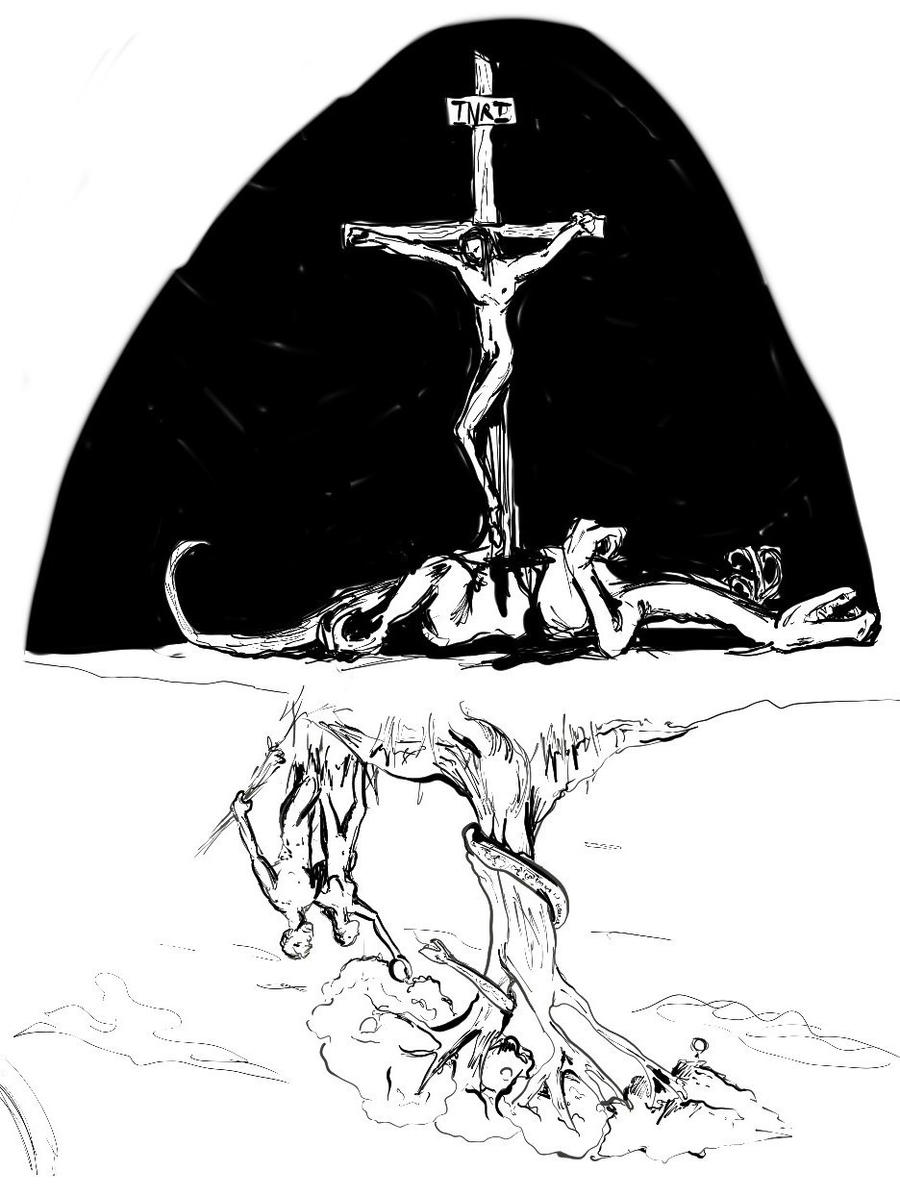
That Cursed Tree


Death came by a tree, in the deception of the serpent, by the First Adam
Life came by a tree, in the destruction of the serpent, by the Last Adam 

Wednesday, November 2, 2011

Your Harvest Festival is Pagan

By Neznani slikar [Public domain],
via Wikimedia Commons
So after a long period away, dealing with my day to day life, I'm finally back to the blogosphere.

This post itself is slightly delayed, but I'm sure you'll forgive me. I want to talk to you about Halloween. Specifically, I want to talk to you about a certain trend that's been around for quite some time. The trend goes like this, a church wants to have celebrations for kids that are safe and fun on the night of the year that Halloween happens. This church, however, believes that Halloween is pagan and decides instead to have a "Harvest Festival."

The practices of these Harvest Festivals are, on the whole, not much different from Halloween, except children and adults might be discouraged from wearing monster and witch costumes.

There's a problem with this though. The problem is they have it all backwards. It's true that Halloween has its roots historically in a pagan festival of the dead, specifically that of Samhain. The latter was a Celtic festival of the dead, and it literally means "summer's end."

The old church, with the understanding they applied to the creation of many of their holidays, used the summer's end festival to create a different and distinctly Christian holiday. This holiday would celebrate a distinctly Christian doctrine - namely that of the communion of all saints (which is one of those creedal doctrines that is essentially core to the faith). This day, November 1st, was All Saints Day, and celebrates the holistic communion between all the saints extended throughout history and geography - the catholic communion. There was another name for this day - All Hallows Day. The night before, then, was All Hallows Eve, which shortened is Halloween. Of course, the separation wasn't perfect, pagan rites did make their way into the celebration, and Halloween itself became a festival for the memory of those in purgatory. Naturally we Protestants wouldn't care for that part.

Call it a Harvest Festival, though, and at least in your name you get rid of the distinctly Christian element, and go straight back to the pagan celebration of seasons. To call it "harvest festival" is to be more pagan than to call it Halloween.

Don't get me wrong, what is pagan isn't necessarily bad. After all, to use a Medieval analogy, the gold of the Egyptians was pagan, but the Hebrews were able to take it and put it to better use in the service of God. To take a time of year dedicated to the celebration of the dead spirits, and baptize it towards the celebration of the communion of Saints is a beautiful and characteristically Christian activity. There is also, as I've talked about before, a sacramental quality to the macabre.

So celebrate Halloween. If you want to call it a Harvest Festival, fine, but don't think you're somehow making it less pagan if you do so. Most of all, if you call it a Harvest Festival, don't forget what it's about. Don't miss celebrating the communion of saints for a secular candy gorge (though don't forget to gorge on candy either, bodies are important and the celebration of the good material things in this world is also a very Christian thing).

Sunday, April 24, 2011

Alleluia! He is Risen!

The king who was dead now lives forever. He reigns incorruptible. And now we, who have through the sacrament of baptism died in Him now live with Him, and at the last day we shall be raised. As my friend said on Twitter, You are risen!

I will have more to say on Easter later, but I wanted to put up this shout of celebration. Below is a song I have always loved as a beautiful celebration of this day.


Go, you who were dead, and celebrate that you now live.

Alleluia! He is Risen!

Saturday, April 23, 2011

Sitting in the Dust

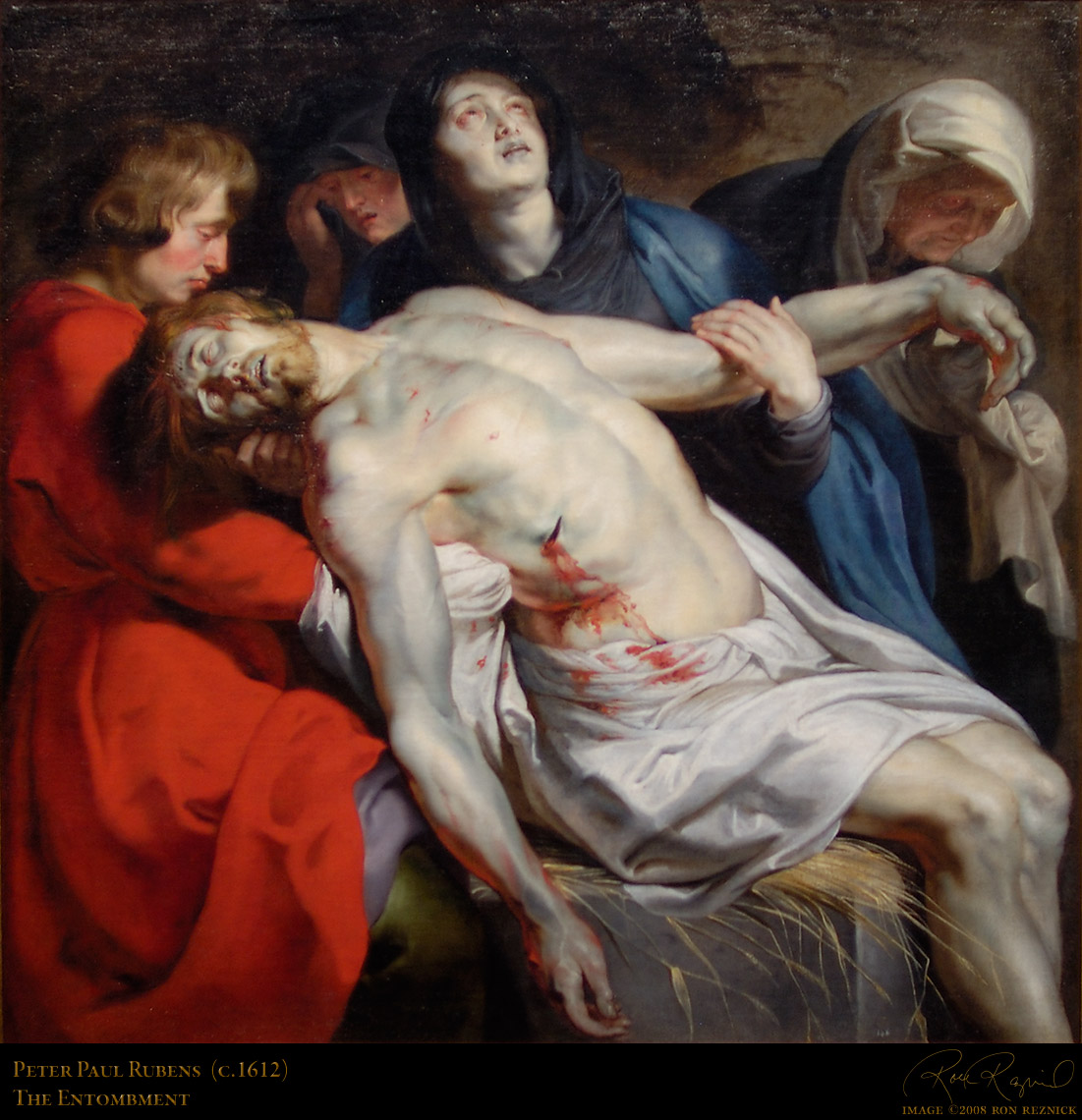
The Entombment by Peter Paul Rubens
from Digital Images
Today is the day we call Holy Saturday. We call it so, because it is a remembrance of the day Christ body lay in the tomb, and His spirit "descended into hell." For us, this is a day of hope, for we know what is just around the corner.

But we must not forget the gravity of this day. We must not forget what Holy Saturday was for the disciples, whose hopes had been dashed. We must not forget what it was for his mother. God gave me this child, He told me He was the child of promise. How can this be? 

Holy Saturday is the day of Job, where we all lie in the dust of our lives, covered in boils, having lost all that is dear to us. 

We must not forget the gravity of this day, because it is in this day that many in the world live. They live day today only with death their only certainty, and hope but a memory. Even for many in the church, it is easy to forget the promise of the Resurrection when we see the horror of suffering in our world. 

Holy Saturday is important, because it is the day in which God sits in the dust with us in our despair. On Holy Saturday, God did not come in a whirlwind and speak of the wonders of creation. Instead, He was pulled down to the very depths of Hell. "I am in fidelity with you in your suffering" declares God. This is the first answer to the problem of evil. 

Let us never forget to sit with those that suffer, to be with them in the reality of what they face. If God did not see fit to trivialize suffering, but instead to take it upon Himself, let us do no less. 

Friday, April 22, 2011

Three Good Friday Meditations

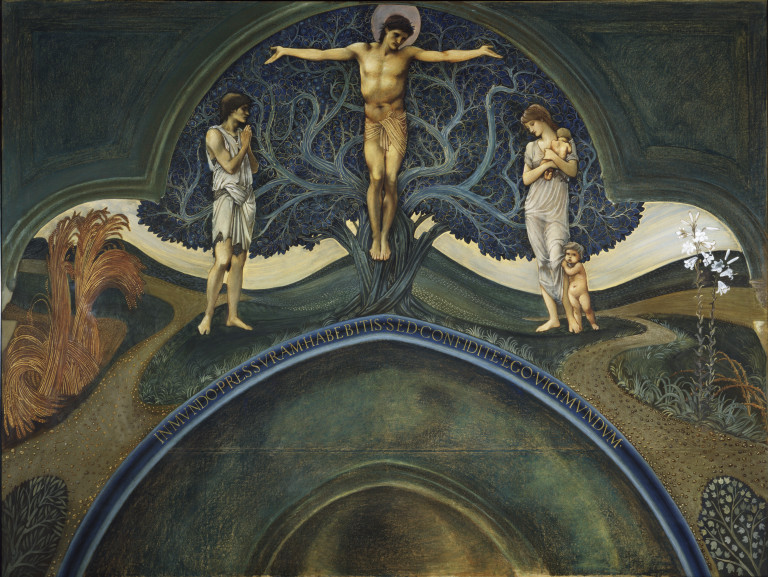
Tree of Life by Burne Jones
from V&A

Death

In the beginning God created the heavens and the earth.

And it was good.

And He walked with man in the garden.

And in the middle of the garden stood a tree, its fruit pleasant to the eye. God told man not to eat of the tree, but the serpent whispered to man "You will be like God."

So man took the fruit of the tree that day in the garden.

And man died.

Wherever he went, death followed in his wake. The earth did not give up food without toil, and the food bought with sweat would just as quickly rot away. Birth came with suffering and pain, and the children lived their lives in the valley of the shadow of death.

Then a Man came, a Man who was also God. This God-Man walked the wasteland of death. He knew His purpose, and with resoluteness He walked towards it. The God-Man took the wine, born of the rot and the bread born of toil, and declared it to be His body.

Then the God-Man went to the tree.

And God died.

Desecration
Piss Christ (Vandalized) by Serrano
from Art Observed

They did not know what it was they were doing. They beheld a man, a dirty carpenter from Nazareth, and he called himself God.

Could you imagine? The Holy God of Israel coming into the world of dirt and blood and flesh. It would be as if the most holy found itself submersed in piss.

So they did what any one who honored God would do, the scarred that which desecrated their God.


Black Box
From Wiki Answers
Darkness

God died, and darkness covered the land. 

God died, and the veil was torn. 

In time, we would come to see this for what it was. The death of death itself. The end of the separation between God and man.

But it was not this yet. The veil was torn, and it showed the holy of holies. It showed the place where God had once dwelt in His glory. 

It tore and it showed the temple which for hundreds of years had stood empty of His glory. 

Sunday, April 17, 2011

Liturgical Colors

If you actually read my blog on this site (as opposed to a feed reader) you've noticed that I've changed the design template to a red and purple one. These are the colors of Holy Week, and it seemed appropriate to reflect that on this blog. Depending upon how I feel about the change, I may create a template that reflects the Easter season, or I may return to my regular template.

Palm Sunday: The Duality of Holy Week

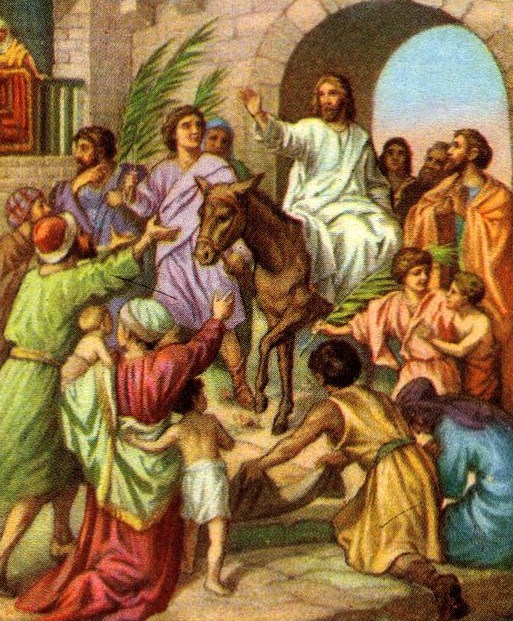
Today Holy Week begins. Today we are on the road to Easter, but first we must go through the cross. This is the most intense week in the Christian year. Not only in terms of the business of those who work in the church, though that is certainly true. This is the most intense week because this is the week when it all comes together. All the symbols of the Christian narrative are pulled together this week as the rhythm of the liturgy reaches its climax.

This is the week of Christ's death, mere days before his Resurrection. Sorrow and rejoicing, bitterness and light, wedded together by a mere span of days.

Today, Palm Sunday, is a sort of second Christmas. Today Christ is born, not to flesh, but to the people of Jerusalem. Today the people adore him as the shepherds and the magi adored his birth. Today we welcome him in, singing praise to him.

"Hosanna! Blessed is he who comes in the name of the Lord."

But soon we will cry "crucify him," indeed many of us already have in the Palm Sunday liturgy.

Let us, then, approach the cross in silent reverence.

Friday, March 25, 2011

Hail Mary, Full of Grace

Annunciation by Carvagion
Wikimedia Commons


Mary the Mother of God. Today is the Annunciation. Today is her day. As someone still feeling his way into the world of the liturgical church, this is something very new to me. But I think it's important, so I asked my friend Fernando, who has always been better at sacrament than me, to do a guest post. This post is for me, and for all those like me who don't get Mary. So, without further ado, Fernando:


During the Lenten season, it’s important that — in addition to praying for the end of suffering in the world — we focus our attentions on the work of Christ. While Easter may be proof of his divinity, the Passion seem evidence of his humanity. Indeed, it was necessary that Christ be human, for it is humans who suffer. And one cannot contemplate Christ’s humanity without contemplating the Annunciation. I’ve already posted some thoughts on the Annunciation on my own blog, but those were focusing on Gabriel’s role. This time, I turn to Mary.

I’ve long been persuaded of the belief that the acts of Christ is best though of as a single, whole work; in my mind the Incarnation, Baptism, Teaching, Miracles, Crucifixion, Resurrection, and Ascension of Jesus are as intertwined as the persons of the Trinity are. But also intertwined with those, are the sorrows and joys of Mary: hearing the angel announce the pregnancy. The pain of childbirth. The rejection of her son by the people he was trying to reach. Seeing him after the resurrection. Being present at Pentecost.

Protestants are bad at Mary. Too often Christians just don’t know what to do with her. In response to the abuses that lead to the Reformation, we have become so afraid of Mariolatry that instead we say nothing at all about the Mother of God. Even that phrase, “Mother of God,” has a bad reputation among some circles for being idolatrous.

But it’s true.

We cannot separate Jesus’s humanity from his divinity. God became a man. God fasted and was hungry. God suffered and was cold. God’s feet hurt. God was whipped and beaten and nailed to a tree.

God died.

For Christianity to be true, all of those statements must be said. It’s the essential core of our faith, that God became flesh and dwelt among us as emmanuel. So here’s one more necessary truth: if God died, God was born. Therefore, if God was born, God had a mother. Yet even this simple title is denied by some. As a child, I was told that Mary was not the mother of God: she was the mother of Jesus’s human part, but not of God. As though they were separate! Or “human Jesus” and “God Jesus” had different beings instead of one person! I think people are uncomfortable with the title because they think it implies that Mary is the mother of the Father: Mary can be the mother of Jesus, sure, but not the mother of God. But this is a problem too: the Father is God. The Son is God. The Son is not less God than the Father. The Son became human, in becoming human, the Son has a mother. And so, whatever the reason may be, denying the Theotokos flirts dangerously close to any number of Trinitarian heresies.

In all our post-Reformation hesitation about Mary, we should remember that the words —
Hail Mary, full of grace,
the Lord is with thee.
Blessed art thou among women,
and blessed be the fruit of thy womb,
Jesus —
all come from the gospel of Luke. It is not the Roman Catholic Church, but from the Bible that we hear that all generations will call Mary blessed (St. Luke i.48). The Word of God, from the very cross itself, commands us to behold our mother (St. John xix.27).

How then do we honor Mary, without worshiping her?

God became a human. As I said, that is the heart of Christianity. And mysteriously, Mary is integral to that. In contemplating her relationship to the Godhead, we realize many things about the faith itself — or realize, at least, how little we can understand.

Dante, naturally, stated the mystery best:

“Virgin Mother, daughter of your Son,
      humbler and loftier past creation’s measure,
      the fulcrum of the ever lasting plain,
You are she who ennobled human nature
      so highly, that its Maker did not scorn
      to make Himself the Creature of His creature”
                                                  (Paradiso 33, 1-6)

There is so much paradox in Mary, but then there is so much paradox in the Incarnation as a whole. Dante can see it, even in the familiar paradox we hardly even notice anymore. Virgin mother. But also the more subtle position of Mary before God. Mary is necessary for God to enter this physical, temporal, fleshly reality. The walls of her womb are the first thing Jesus sees. Consequently, Mary becomes something like the firstfruits of Christianity, the first human to represent humanity before the God-man. Up to the Ascension, Mary was the penultimate priest of humanity.

And in her position standing before God, there’s another truth about Mary that is the simplest, but hardest to wrap our heads around: Mary loves God more than you or I do, maybe more than is possible.

All of us can say with the apostle Thomas, “My Lord and my God!” when we contemplate Christ. We can even say along with John that we are the one Jesus loved. At our most holy, perhaps we can even dare to say of Jesus that we are our Beloved’s, and our Beloved is ours.

But none of us, ever, will be able to say of Christ, “my son.” If we could witness the Crucifixion, as life-shatteringly painful as it might be for us, it could not compare with the real pain she felt. When the nails pierced his skin, a sword pierced her heart.

And — making the hopefully uncontroversial assumption that Jesus was a good son — God has a special love for Mary. We are the Father’s children and Jesus’s siblings, by adoption, but few among us can claim to be Christ’s family by blood. We can only imagine what Jesus sees when he looks at her.

Not that we should be jealous. Faith is as important as blood, and we must remember we have our own special place in Christ’s heart: and it’d be very immature for any Bride to be jealous of the Bridegroom’s love for his mother.

She is one of us, too, after all, a witness to the resurrection and present at Pentecost.

Friday, January 28, 2011

Liturgy: The Feast of St. Thomas Aquinas

It's a little cliche, but I'm inclined to think that the greatest philosopher the world has yet seen is St. Thomas Aquinas, that brilliant fat man. Today, in the liturgical calendar, is his feast. His thoughts, along with Aristotle's have been one of the strongest influences on my own philosophy. I encourage all of you to read him, or at least read about him, and may your minds be lifted up to God. In the words of the liturgy for today's feast:

Almighty God, you have enriched your Church with the singular learning and holiness of your servant Thomas Aquinas: Enlighten us more and more, we pray, by the disciplined thinking and teaching of Christian scholars, and deepen our devotion by the example of saintly lives; through Jesus Christ our Lord, who lives and reigns with you and the Holy Spirit, one God, for ever and ever. Amen.

Thursday, January 6, 2011

Liturgy: Two Meditations on Epiphany

Today is the Feast of Epiphany. As Fred Clark over at Slacktivist pointed out, this seems like a strange name for a holiday. How does one schedule an epiphany? The answer is that epiphany, in this sense, does not mean precisely deep revelation in the sense it means today. Rather, it derives from a term which signified the appearance of a god to men. Thus, Christ's appearance and His revelation as the incarnate Deity was an epiphany. Of course, it was also an epiphany in the current sense, since in Christ "dwells all the fullness of the Godhead bodily"(Colossians 2:9)  and so the mystery of God was made known to the world. Here are some meditations on what this glorious day symbolizes.

The Suffering of Job

Job is a confusing book. All to often, individuals try to reduce it to a theodicy - an explanation of why there is suffering in the world, but I think it resists that move. Job's friends and the youth Elihu offer explanations of Job's suffering, but then God shows up... and He doesn't give an answer. He says, "hey Job, I'm God, I made stuff."

It's awfully confusing.

Fred Clark, who is perhaps one of my favorite bloggers, recently did a post about Epiphany. In that post, he discusses an idea that God learned something from His incarnation. As often with Clark, I disagreed with his primary premise, but he made a very interesting connection in his post I don't think I ever would have made.

Job suffered, and God appeared. Yet, despite His revelation He remains mysterious, He doesn't give an answer to Job's suffering.

Then God became man, Jesus died on the Cross, and Job's suffering was answered.

The Last Shall Be First 


One of the events celebrated on Epiphany is the the visit of the Magi. Three wise men from faraway lands came, and bowed before the baby Jesus, demonstrating His kingship, the manifestation of God to men. Wealthy men came from faraway lands and bowed before the Nazarene son of a carpenter. The poorest of the poor lifted up above all mankind.

Truly, the last shall be first.

Monday, April 5, 2010

Theology/Life: He is Risen!

Happy Easter! He is Risen!

Now, I know what at least some of you are probably thinking - Easter was yesterday genius, it's Monday. However, thankfully, that's actually not quite correct. You see, the traditional, liturgical churches divide up the year into a series of seasons, each structured around a part of the Christian story, each speaking to an important part of our journey as believers. The most famous of these seasons is probably Lent, or perhaps Advent (Christmas, though I doubt most people think of the season as a whole as a religious event). However, the whole year has its seasons, and Easter is a full season of its own, lasting from Easter Sunday until the Day of Ascension, as long as the season of Lent before it.

Easter is Lent's mirror. Lent is a time of mourning and reflection, a time of quite contemplation and fasting. As most of you know, it is traditional to give up something we love for Lent, it is an act of submission, a way of realigning oneself with God's story. Lent, Holy Week included, stands as the road to the cross, to the day when (as the wonderful song "In Christ Alone says" ) " in the ground His body lay/ Light of the world by darkness slain."

But Easter season stands on the other End of Christ's Passion, it is the celebration of life, of the fact that the Grave could not hold the King. What is more, Easter proclaims God's promise that He is making everything new, that one day the old order of things, of death, decay, oppression and sin, will pass away and be resurrected in Christ a glorious New Creation. This promise celebrates the goodness of what God has made, from the majestic mountains, to the simple things in life like chocolate, and, yes, even wine.

Because of this fact, N.T. Wright in his wonderful book Surprised by Hope suggests that we start a new tradition. Just as in Lent we gave things up, rejecting the old order of the world, in Easter we should, at least for that season, take up something new as an affirmation of the goodness of what God has made, and an anticipation of what is to come. Of course, this can be something you'd label "spiritual" like a special quite time for prayer, or a regular Bible reading schedule... but it doesn't have to be. The new thing can be a new hobby (maybe you might want to take up drawing like you've always wanted to), a new habit (greeting strangers on the street) or maybe even just learning to appreciate a form of art or food you've never before enjoyed.

Easter is a season of feasting, of celebration, so I challenge you, take up something new. Feast in the goodness of what God has made. I for one am taking up guitar, and I'm also going to let my friend try and infect me with his love of poetry.

Go live and flourish!

HE IS RISEN!

Tuesday, September 22, 2009

Liturgy: Introduction to the Calendar

I grew up in the Assemblies of God church, a charismatic denomination within the evangelical protestant tradition. While I have never agreed with all of AoG theology, I value it as a genuine expression of faith in Christ.

My own journey, however, has taken me in a different direction, as I have in recent years found myself enamored of the forms of worship and spiritual development embodied in the Anglican Church. Among these expressions is the high church concept of a Liturgical or Church Calendar, which structures the years and months around a rhythm of faith. These include seasons of faith (the most famous of which being Lent) as well as numerous feast days celebrating important events and people in the history of the Christian faith. Used properly, the Liturgical Calendar is a wonderful way of focusing the mind on important areas of faith and creating a pattern of discipline towards spiritual formation.

As I explore Anglican worship, I hope to share with you what I learn along the way. As part of this, I plan to post up reflections on the Liturgical Calendar as the seasons and interesting feast days come along.