Showing posts with label ethics. Show all posts

Tuesday, November 1, 2016

Hold Your Nose and Vote?: On the Wickedness of Voting for "The Lesser of Two Evils"


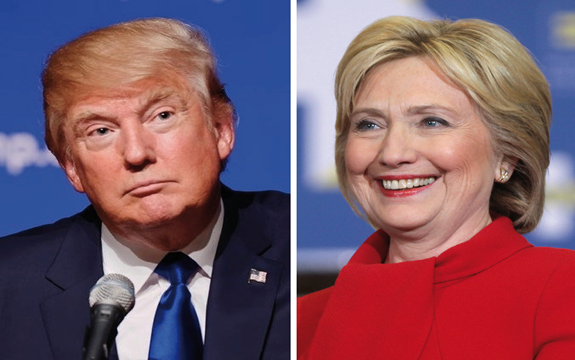
Most Americans are disgusted with the primary candidates this year. If you're a conservative like me, you've probably seen your fellow conservative Christian friends and relatives squirm while they tell you that we simply must "hold our nose" and vote for Donald Trump. They tell you, “Trump is awful, but I have to vote for him, I have to because the alternative is Hillary Clinton, and that's worse!” The fear is obvious, and understandable. Leaving aside issues of personal evil, Hillary Clinton supports values that stand at odds with the values of politically conservative Christians.

“Perhaps,” you suggest, “there’s another alternative. We could always vote for a third party.”

“No,” your friends and relatives tell you, “A vote for a third party is a vote for Clinton.”

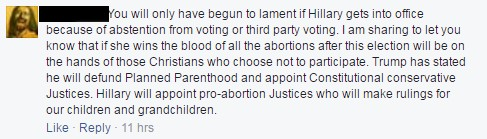
The force of this argument, as far as I can tell, rests on two concerns. The one is pragmatic—a third party candidate eats into votes that might have gone to Trump and so means that Clinton is more likely to win the majority and therefore the presidency. The reasoning here is that Trump is bad, but if he wins our values might at least get a seat at the table. If Clinton wins we’re cut out from power. A particular crux of this fear rests in the appointment of Supreme Court justices. The other crux of the argument though, and the one I think really drives people, is its moral force. We are citizens in a democracy. We are morally responsible for the course of our society, and the fear is that if we vote for a third party candidate we are morally responsible for a Clinton presidency. I have even seen one extreme example of this in a Facebook comment (in response to this post on Vox) that argued that Christians who choose to not vote for Trump will have “the blood of all the abortions after this election” on their hands.


It’s undeniable that some who present themselves as social conservatives want power for its own sake. However, I believe that most want a seat at the table because they believe in their cause and they are convinced that they are morally on the line for the likely Clinton victory if they don’t vote for Trump. I should pause here to say that while I am focusing in this post on the conservative viewpoint, these same principles apply its liberal mirror. Even Michelle Obama has told liberal voters that if they vote for a third party liberal candidate they are voting for Trump, and as with the conservative side, I believe the force here is both pragmatic and moral. Michelle Obama is pointing to Trump and asking liberal voters, "Do you want to be responsible for that?"

However, the moral force of this argument does not hold up under closer scrutiny, and when that crumbles I believe that any case for voting for Donald Trump (or Hillary Clinton if you're a liberal who finds her reprehensible) crumbles with it.

Before I get to the reasoning behind this argument, however, I need to make a point of clarification. I am convinced that both Hillary Clinton and Donald Trump are evil candidates. There’s been plenty of ink spilled on why that’s the case. Matt Anderson has a great post arguing that point on Mere Orthodoxy. So, I’m taking the evil of Clinton and Trump as an assumption for the purposes of this post. I know there are plenty of people who disagree and think either Clinton or Trump admirable. I am not writing to them. I’m writing to those who want to “hold their nose” and vote for Trump.
Voting for the Lesser Evil to Save Your Soul
With that out of the way, let’s get to the idea that if you vote for a third party candidate you are morally culpable for the ultimate election of Hillary Clinton, and that we should therefore vote for Trump. Put formally, the argument looks like this:
  1. A vote for Trump is a vote for an evil candidate.
  2. A vote for Clinton is a vote for an evil candidate.
  3. I am morally responsible for the evil of the candidate I vote for.
  4. A vote for a 3rd party conservative candidate is a vote for Clinton for which I am morally responsible.
  5. Clinton is more evil than Trump because her ends are more evil than his. ∴ I will vote for Trump.


I obviously agree with premises a) through c). I am convinced that we, as citizens in a democracy, have a duty to vote and share a responsibility in the direction of our society. I’ve already laid my cards on the table regarding how I feel about Trump and Clinton (personally, I think the premise that Clinton’s ends are more evil that Trump’s is debatable, but that isn’t my concern today). The real crux of the argument, I think, is the notion that if I vote for a candidate other than Trump, I am morally culpable for the evils of a Clinton presidency.

To understand the morality of this from a Christian perspective, we need to take a step back and consider the basic anatomy of a moral action. In the classical Christian tradition, moral action rests on the free human will working itself out in the world. An actions moral content rests both on the ends sought and the means taken to reach that end. Various Christian philosophers, from St. Maximus the Confessor to St. Thomas Aquinas, have broken up the process of willing in different ways, but the general principles remain the same. Human beings have wills. These wills are free, but not arbitrarily so. Rather, we see ends that we wish to bring about, contemplate some action to accomplish those ends, and then engage in that action. Moral goodness and moral evil are both possible at any point along this spectrum. If I plan to kill someone, think up the means, and try and implement those means, I have committed moral evil even if I fail to kill them. By the same token, if I will to bring about world peace but choose as my means the eradication of people who stand in the way, I have also committed moral evil.

At no stage in this process can I be morally culpable for things which happen outside of my will and the means I take to engage that will. To give an example, suppose one of my neighbors decides he very much wants my roommate’s television set. He has an end in mind (acquiring the TV), and has decided on means (burglary) which he engages in one night when no one is home. In this case, both the means decided on and the act actually engaged in are morally evil. That I happen to be out having dinner with my girlfriend when the crime occurs, (which makes it easier for him to commit the crime) in no way makes me culpable for his crime. I am not involved in the chain of cause and effect resulting from his will and ending in the burglary of a television.  In the case of the burglary, the person committing the crime is responsible for their own action. I am responsible for burglary only if I choose to burglar someone myself.  Even if a lot of people in my area decide to start burglarizing other people so that my area becomes an “unsafe neighborhood,” I am only morally responsible for the direct actions I take. Even the choice to go out for dinner with my girlfriend (despite the fact that I live in an unsafe neighborhood and there is a possibility my house will be burglarized) does not make me in any way morally complicit in the burglary.

So what about voting? Does my vote for someone like Evan McMullin count morally as a vote for Clinton if she wins? It should be fairly obvious that I am not  directly responsible for the votes other people cast. Imagine that my best friend loathes NAFTA and decides that the best way to get rid of it is to vote for Clinton, who he judges to have more political savvy. He has an end in mind (NAFTA getting abolished), means (the election of Clinton), and an act he engages in to bring about his end (voting for Clinton). At no point in this process is my will engaged, nor can I do anything directly (short of criminal interference) to prevent him from voting for Clinton.

The possibility remains, however, that by voting for someone other than Trump I could be engaging in a sin of omission. We can be responsible to act to stop a moral evil being committed, and if we don't act we are doing something wrong. For example, if I came home to find my neighbor stealing my roommate’s TV and fail to call the police or otherwise interrupt the burglary, I bear some responsibility for the evil that results. Yet, the reason I bear some guilt is that by coming home during the burglary I become directly involved in the cause and effect chain. As a witness to the crime, I therefore either engage my will to stop the crime or to consent to it.
I would argue that in the case of voting, no similar sin of omission is possible. When we vote, we engage in a very isolated moral scenario. We do not know for a fact how anyone else will vote. Individual voters decide indepently who they would like to represent them as the leader of their nation. When each individual voter has made their decision as to who to vote for, these votes are then added together state-by-state to determine who the States’ electoral votes go to. The electoral decision itself is thus not, strictly speaking, a moral one. No agent is, in and of themselves, choosing the state of affairs that come about. The electoral decision is like the case of the unsafe neighborhood. It is the result of many actions taken by individuals. As with the case of the neighborhood, I am responsible for the direct actions I choose to take. I am not morally responsible for the moral decision other voters make when they cast their vote, because there is no direct cause-effect relationship between my voting for, say Evan McMullin; three other people voting for Trump; and five more voting for Clinton. The fact that the outcome is an electorate that goes to Clinton is not a direct result of my vote, but of the combined results of our independent actions. As such, my action in that case can only rightly be construed as a vote for McMullin, not a vote for Clinton. Because the vote is blind, I act without direct knowledge of how anyone else is going to act. I can at best estimate based on past trends, but that’s not the same kind of moral action as directly intervening to stop a crime (the crime is an event occurring; the predicted statistical outcome of an election is a projection—a likely but still imaginary scenario). My action in voting for a third party candidate is more like that of the choice to go out to dinner with my girlfriend despite the possibility of a burglary. It is at worst imprudent. It is certainly not morally evil.

The Prudential Vote
The question of prudence, then, brings us to the possibility of voting for Trump for merely pragmatic reasons. I may not think I am morally responsible for the election of Clinton if I vote for someone other than Trump, but I may think that the ends I have (ending abortion, for example) are better served by a Trump presidency, and so the most pragmatic means to bring about my end is to vote for Trump. It is possible that some who argue that a vote for a third party is a vote for Clinton are simply saying so as shorthand for this kind of pragmatic reasoning and intend to imply no moral culpability in the election of  Clinton for those who vote for third party candidates. This pragmatic reasoning could be formalized as follows:
  1. A vote for Trump is a vote for an evil candidate.
  2. A vote for Clinton is a vote for an evil candidate.
  3. Trump is more likely to support the causes I agree with.
  4. It is pragmatic to vote for a candidate who will support the causes I agree with. ∴ I will vote for Trump.

Yet, this kind of reasoning runs afoul of the classical Christian understanding of moral action described above. Moral evil is not merely relative to the ends I have in mind. The plans I come up with to reach that end and the means by which I engage those plans in the real world also have moral content. Going back to our example of burglary—if I stumble upon the burglary in progress and decide to stop it by torturing the burglar, I am guilty of moral evil. Indeed, the bulk of the Christian tradition would say that if torturing the burglar were somehow my only way to stop the burglary, then it would be better for me to allow the crime to take place than engage in evil to stop evil. In the case of voting, if Trump is evil and I intend to use him to reach the end I desire, my means are evil. Even if my end is something laudable, such as ending abortion, I am culpable for moral evil if I choose evil means to bring it about.

Indeed, this ultimately makes the point that even if the information available to me, such as polling data, so involves me in the chain of cause and effect that a failure to stop the election of Clinton by voting for Trump is something I would be morally culpable for, I could still never be justified in choosing the evil means that a vote for Trump represents.
Conclusion
So, to summarize, you are responsible for the decision you make in voting, not the decisions others make, and choosing an evil candidate simply to stop a worse one is operating in a utilitarian mode that is at odds with Christian ethics. As such, the only real option for Christian voters is to vote for the candidate they consider to be the best potential leader for our country, not to vote for the lesser of two evils. As far as I’m concerned, that means voting for a third party candidate. This is true even though the moral decisions of others will probably mean a candidate. Which candidate is best, of course, still remains for you as the voter to judge.

Monday, April 4, 2011

You Ought to Ask Nicely: The Moral Core of Etiquette

Image from Legal Juice
Etiquette is a funny thing. We all act according to rules of etiquette, and are often somewhat offended if someone breaks them in our presence. At the same time, we've all run up against rules of etiquette foreign to us, and these often seem utterly alien, at times even offensive. I'll often eat with my elbows on the table, but from time to time I do so in the presence of someone brought up in a context in which that is not done. This experience of something being a thing we ought to do, combined with the realization of great variance in codes isn't something exclusive to etiquette.

On the one hand, the rules of etiquette seem to function something like a game. In games there are rules, you follow those rules so that the game is a good one, and infractions are a great offense. If I'm playing chess and I try and move my bishop forward horizontally, I'm breaking the rules of chess (at that point it might be questionable if I'm even playing chess anymore). Yet, etiquette seems importantly different than a game. Games have fixed points of beginning and ending. Outside of the game, one isn't held to their rules. No one forces the chess-playing Bishop to always move diagonally. Conversely, etiquette is a game all society plays.1

Yet, we generally seem to think etiquette is quite different on the other end from morality. There is a huge gap between "You ought to ask nicely" and "You ought not kill strangers." Though we vary on this, most people think that a prohibition against murder or slavery goes beyond society. If a society institutionalizes slavery, it has committed a moral infraction. It hardly seems possible for a whole society to breach etiquette.

So etiquette seems bigger than a game, and smaller than a moral law. It tells us things we should do, but those things often seem utterly arcane. To some, this means etiquette is at best a nuisance and at worst tyrannical fraud.

Why should we be polite?

I believe that there is a moral core to etiquette. Etiquette is a kind of language, specifically, it is a language that says "I respect you." This can work itself out in all kinds of ways, from not swearing to not putting your elbows on the table. The "grammar" of this language is always changing. You do violence to etiquette when you refuse not to swear in front of grandma, but you also do violence to it when you put it in a book and insist that these are the rules of polite society that you must always follow.

There's a darker side to etiquette though. The language of respect can become a language of despotism. Etiquette is good when the respect is equal, but it can set up one individual to be inherently over the other. It is this kind of etiquette that says the southern black man must always sit in the back of the bus. When etiquette becomes this it has subverted its purpose, it has become a moral monstrosity instead of a sign of respect.

You ought to follow etiquette, but do so only insofar as it shows respect. If etiquette in turn becomes a tool for bondage, throw it off. 
____________________________________________________
1. There are "mini societies" that have their own etiquette, such as clubs. 

Friday, November 26, 2010

Philosophy: Freedom as Limits

We are only free in that we have limits.


What do I mean?

A little over a month ago, I wrote a post on homosexuality, and on what I see as a mistake in how the debate about it is usually conducted. I got many responses to that post (protip: if you want your blog to get a lot of hits, write on something controversial) and, in response to one of those, I wrote a comment about the relationship between genetics and choice. 


As I said in that comment, genetics are, in one sense, predetermining of the kind of people we will be. It might seem, then, that where genetics controls us, freedom is absent. Yet, I contend, there is a much more complicated relationship here, and, speaking more broadly, a much more complicated relationship between limits in general and freedom. 


Typically, we think of freedom, and consequently choice, as the ability to be free from constraints. Often, this is a metaphysical reflection on a political reality. A person held back by the law from driving 100mph down a busy street is not, in one sense, free to perform that action. And there is some truth in this, an utterly predetermined being, with no choice whatsoever in its course of action (for example, a rock) would in no sense be free.


However, there is a flipside to this. In having limits, I have something to act against, and that in turn actually gives me choice. Take the above mentioned case of genetics - genetics gives me a certain sort of body, and that body gives me limits (I can't fly or run faster than a locomotive), yet at the same time it is only in terms of that body that I can make many of my choices (whether to type and this computer or go for a jog for example). Without the limits of a body, the choices of physical actions would be meaningless. Likewise, the law may prevent me from going 100mph (without consequences) but this in turn means I'm free to cross the busy street without fearing a car barreling over me at 100mph. 


This last case also relates to a further point, that limits not only make us free, but they make us free to flourish. This is particularly true in the case of morality. Whatever your views to the objectivity of morality, anyone would agree that a person who feels protected from murder will be more likely to thrive (even though the choice of murdering another is thereby cut off to him). 


Further, if we have in mind any view of human nature in which men are fallible and liable to fall into grave immorality, whatever system or training helps that nature to take hold of its passions and become thereby better able to follow morality, even though it blocks off the former bad choices, creates in the man another kind of positive freedom.


Thus, freedom, at least for humans, seems to always exist in light of limits. Limits are a precondition for genuine choice1. 
_______________________________________________________________
1. I cannot claim these ideas as my own, though the specific expression of them, especially in terms of embodiment, is. I'm not sure exactly where I've picked up these notions, but I am aware that I have heard similar views advocated at various times and do want to give those individuals due credit to the best of my ability. It seems to me that Kant espouses something like this view in the last section of the Groundwork of the Metaphysics of Morals, though typical of Kant it is written in very obscure language that makes it hard to be sure. I've further heard a discussion of the difference between negative freedom (freedom from restraints) and positive freedom (freedom for a kind of action) given at certain times. One case was a Mars Hill Audio discussion, and another was in a discussion of the ideas of Phillip Blond. Finally, my wonderful Bishop and pastor Todd Hunter espoused a similar idea in a sermon while talking about training in virtue. This in turn, I am told, comes from Aristotle and can also be found in Anselm (and no doubt Aquinas). 

Saturday, November 13, 2010

Philosophy: The Insolubility of Moral Dilemmas

In the law department at UCLA, they have a saying that says "hard cases make bad law," or so I'm told.1 The general idea, as I understand it, is that if you try and tailor-make laws to fit the bizarre borderline cases, you'll end up with laws that fit almost no one. This principle notwithstanding, modern moral philosophy seems to go straight to thorny cases2 to test any moral theory. The thinking behind this seems to be based on the idea that a moral theory is higher than mere legal issues, and should be able to handle all problems.

However, while I am definitely a believer in the objectivity of morality, I'm not sure any good moral principle can handle any and all cases. The reason for this, I think, is the fallen nature of the world3. Specifically, the current world, the Old Creation, is broken. Things happen in the world that, if it were as it was meant to me, shouldn't happen. Morality, on the other hand, is in alignment with the New Creation, the world as-it-should-be. Since these two principles are in conflict, the fallen nature of the world simply will result in cases in which no moral decision can be made4.

This doesn't mean we shouldn't test moral theories at all, but it does mean we should not expect them to have definite answers to the tough questions - these aren't what they are built for.
_____________________________________________________________
1. A lawyer friend of mine has assured me that no such thing was said at her law school.
2. An example case - you are in control of a train that is out of control. The only option open to you is to switch the train onto another track. On the track you're currently on, twenty people are tied down and will die if you continue. However, there is a single individual on the other track that you will kill if you switch over (who is often made into Gandhi, Einstein or your true love to make things interesting). Which action is right?
3. My reasoning here is intimately tied into a Christian world view, and also likely very influenced by an Aristotelian picture. However, I'm fairly certain this principle could at the very least be expanded to a materialist world view. i.e. since the world is not fundamentally a moral reality, any moral system will inevitably come into conflict with it at times.
4. This is where law becomes important. Societies built with good laws help to build an environment where such cases are less likely to arise (you're less likely to have to kill to protect yourself from a bully, or to get a meal, etc.) and people are then able to act more in accordance with the Good. 

Thursday, October 14, 2010

Philosophy: Metaethics - What is Morality?

A few days ago, I made a post regarding what I considered to be a confusion in the public debate over homosexuality. Since then, that post has gotten quite a few comments, and things recently drifted into the area of metaethics.

Wait. Metaethics? 

Yes, nice term. What does it mean? Within philosophy, analytic philosophy in particular, definition is an important part of the game. For example, defining the question, as I discussed in my last post, is a very important task. "Metaethics," is the field within philosophy that aims to "define the question" of ethics. It asks questions like "What is morality in the first place," "Generally speaking, what makes an action wrong or right," "Is morality absolute?" 

For example, our culture tends to have three metaethical theories in mind when it talks about morality. The first, the one you usually see associated with conservatives. Wrong and right are objective features of the world, written laws in some book. For every moral question, there is a definite answer. It is, on this view, our duty to follow the law.

In contrast to this, there's a utilitarianism, by way of some muddled existentialism and romanticism, that holds that what is right is tied into happiness - specifically the greatest happiness for the greatest number. This usually takes some form of the maxim "do what you want as long as it doesn't hurt others" - though often phrased in more nuanced ways. This view is usually also mixed in with a relativism that holds morality to have no absolutes. Of course, that isn't necessarily the case, and most hold at least the "no harm" maxim to be an absolute.  

Finally, there's those out there who are simply metaethical nihilists. There is no morality, no right and wrong, not even any harm principle. One make act morally, but it's simply out of convenience. 

Unfortunately, the fact that most people don't think about metaethics can also lead to a lot of confusion. Those in the first category, for example, will often confuse those who hold to the harm principle with nihilists, thinking them to literally have no morals.

And actually, those in the second camp sometimes make a similar mistake. Namely, they come to think that morality is only what the other side is talking about - a code of specific rights and wrongs, and they conclude that that's really a matter of personal choice (thus "morality is a matter of personal choice"). The actual utilitarian morality they hold to isn't thought by them to be morality at all, but simply a fact. 

There are actually been quite a few other metaethical theories of importance, among them contractualism and virtue ethics. The latter of the two may actually get discussion in an upcoming post, because it's at the very least historically important. For now though, I just wanted to outline the field of metaethics, and lay out what seem to be the two most dominate views today. I also hope this might get you thinking about what metaethical assumptions you might be making - both about yourself and about those with whom you disagree. 

Wednesday, October 13, 2010

Philosophy: Asking the Wrong Questions (About Homosexuality)

When faced with a difficult philosophical quandary, it is often important to investigate whether or not the right question is even being asked. All too often, it seems to happen that two sides of a debate end up talking past each other, or arguing on an issue that isn’t actually relevant to the question at hand.

One such irrelevant questions has become central in the debate about homosexuality in the public sphere – whether or not homosexuality is “natural.” By natural, I take most people to mean genetically determined, while the opposite camp would call it a choice.

But what are we trying to get at here? There is, of course, a purely scientific question of whether or not homosexuality is genetic, but that is not the question as it appears in public debate. Rather, it seems to me clear that what is being investigated is of a moral nature. In the end, what people are fighting about is whether homosexuality is wrong or right.

Given that this is really what the debate is, the question arises – is the genetic “naturalness” of homosexuality even relevant? It seems to me that both sides of the issue have assumed it is, but might they be making a mistake?

There are many “natural” things most people would still judge to be wrong. There are genetic diseases, for example, and it even seems that there are born sociopaths. Both of these things are genetically “natural” and both are things we would eliminate given the chance.

Conversely, many “unnatural” things are quite good. I think, for one, that most Americans think government is ultimately a good thing , yet government could hardly be called natural, and a cure for cancer, if we developed one, would similarly be “unnatural.”

So, let us imagine homosexuality is, in fact, simply a matter of choice. Would the game be up? Would gay-rights activists throw up their arms in despair and admit they were wrong all along? Of course not, because the question of whether it is right or wrong still stands.

Or imagine the opposite case – homosexuality is proved to be genetic beyond any shadow of a doubt, so thoroughly that no one thinks it can be disputed. Again, those who oppose homosexuality would continue to do so, because the question of right would still not be answered.

I have mostly avoided this particular topic on my blog, and, for the most part, I plan on continuing this policy, as I’m not much of a fan of being flamed. However, I wanted to, without coming down on either side of the issue, air my thoughts on this confusion.

Thank you, and have a good night. 

Thursday, January 28, 2010

Philosophy: Animal Experimentation

It's been some time now since I've published a blog, what with one thing and another (insert excuse here).  Regardless, the time has come for me to get back in the saddle, and ride valiantly into the bloggosphere. To start up, I thought I might begin with a light and cheerful subject - animal experimentation.

This quarter I've been taking a class on Rationality and Emotion, which includes lots of readings (mostly written by the teacher) that, among other things, talk about a variety of experiments done on animals in the area of cognitive research.

I'm not sure what I think of this.

Now, let me be clear, I think animals (and nature in general) should be treated with respect and cared for as much as possible, but I do not think they have priority over humans. As such, I really have no problem with experiments designed to, say, search for cures for cancer... or even for the common cold (though I do think we should do our very best to do as minimal damage in the process as possible).

On the other hand, I'm very strongly against experimentation for frivolities - makeup, for example. I don't think there's anything wrong with makeup per se, but I think it's terribly wrong to test makeup on animals to make sure it doesn't irritate eyes or cause blindness. If that's the cost, makeup can go (or, you know, we could just use the formulas we already have that work fine). 

But what about pure research? Certainly, such research is not a frivolity like makeup, but then neither is it directed towards any specific good. Some of the experiments I've read about recently have included creating lesions in bird brains to test if a certain cognitive function still worked, removing parts of monkey brains to find out where the anticipation response lies, and subjecting rats to painful electrical shocks to test how strong their curiosity is. At least on the face of it, this strikes me as unjustified cruelty, yet it's not as straight forward as the makeup case.

 For one thing, while such pure research is not directed at any sort of cure, it often results in accidental beneficial side effects. In testing what part of the brain controls a certain cognitive function, we may in fact discover how to restore that function in humans who have lost it.

I think, in general, I'm leaning towards thinking this sort of research is unethical, but I am certainly not totally decided. Thoughts?

Thursday, October 1, 2009

Philosophy: Our Lack of Moral Imagination

In the thought experiments we create for the purposes of ethics, we show a disturbing lack of moral imagination. Indeed, this utterly famished faculty might itself be called immoral, and it certainly has the potential to lead to horridly evil acts on our part. Let me give an example. 

One question that gets brought up to challenge any moral system is rather, if given the chance, you would kill Hitler as a child to prevent the Holocaust. Now, apart from any consideration of the grim consequences that might arise from this act, this simply shows a disturbing trend in our philosophy. Note that the question does not say "What would you do if you had access to Hitler as a child?" No, it simply asks would you kill him. The thought experiment jumps straight to murder. The problem creates a dichotomy, a strict dichotomy, and teaches us to think in fixed terms, making it out that there are only two, utterly grim options. But how often does life really boil down to this kind of simplicity? How often are there really only two choices? I suggest, that with a better developed moral imagination we might think of far richer solutions.

So what if you had access to Hitler as a child? Why not redeem him? Why not do the things necessary to make the man Adolf Hitler grow up to be a good man? A man of justice and equity. Imagine a man of Hitler's charismatic powers working to make the world a better place. Now, you might think this impossible, you might say that evil was Hitler's innate nature, and that he could have been nothing other than what he had been. That may be the case, and I'm not going to get into an argument here about determinism, that's beside the point. What is the point is that we didn't even think of it, and that is a moral problem on our part.