Showing posts with label eucharist. Show all posts

Wednesday, July 6, 2011

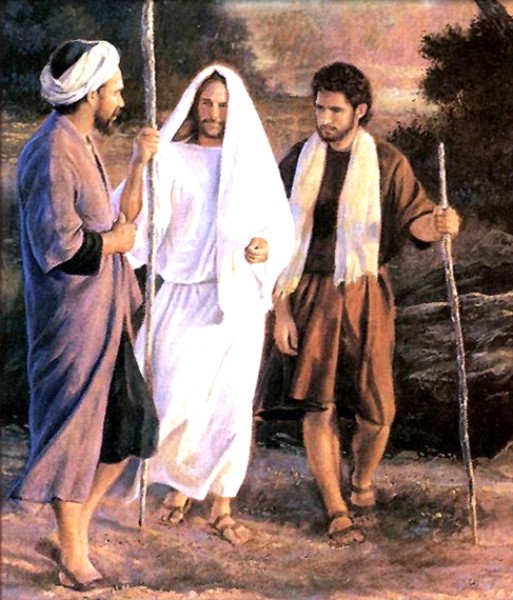
The Road to Emmaus

Image taken from MariaKumar.org
The Incarnation, Resurrection and the Eucharist are three of my great theological passions. All of them are about Christ's presence, the affirmation of Creation through the joining of the glory of God to the world. They are beautiful. This morning, I was reading the Lectionary readings, and the gospel was Luke 24:12-35. The story here is that of the disciples on the road to Emmaus, a story which brings all three of these elements together.

Two disciples, unnamed, are going down the road to Emmaus, when Jesus joins them on their way. They do not recognize him, perhaps because His Resurrection body has changed Him so, perhaps because He chose to hide Himself from them. Who knows?

They tell Him about the death of Jesus, astonished that He has apparently not heard of it, and go on to tell Him that some of the women reported that He was missing from His tomb, and that angels had reported Him raised from the dead. Jesus, His identity still hidden, goes through the Scriptures and reveals to them all the prophecies revealing that the Messiah would have to die, but would be raised again. They then invite Him, still a stranger, into their home.

It is then, when the meal is being shared, and Christ breaks the bread, that He is revealed to them.

What I find fascinating here is that the presence of Christ in their lives is not revealed to them when He walks and talks with them, it is not revealed to them when He shows himself to them in scripture, but it is instead revealed when He breaks the bread. Christ's bodily presence is revealed to them by the Eucharist.

Now, I do not think that the Eucharist alone could have revealed Him. Christ first had to be Incarnate, and, of course, having died had to be Resurrected. What is more, to know His nature they had to be shown His presence in scripture. The Ministry of the Word and the Ministry of the Table had to come together to reveal the Lord, and both of these ministries had to be joined together by the incarnate God. It is almost as if, the Eucharist is here Christ-Fully-Man and the Word is Christ-Fully-God, and when both are revealed to the disciples, then they know Him as He is.

Wednesday, April 27, 2011

A Bit of (Unintentional) Evangelical Propaganda

Recently, I found myself reading the TV Tropes article on Christianity. Within the article, quite a few mistakes were made regarding Protestant sacrementology, particularly with regards to the frequency of belief in the Real Presence of Christ in the Eucharist (the errors have been corrected, I couldn’t help myself). The particular error is question is the claim that a belief in Real Presence is largely a Roman Catholic phenomenon largely unheard of in the Protestant church. That TV Tropes made this error is not particularly troubling, it is after all a wiki without any particular checks on correctness. However, I find that this particular mistake is very common within Evangelical Protestant circles. I recently had a conversation with a friend (and not by any means an unintelligent friend) who was completely unaware of the fact that Luther had argued vehemently for the actual presence of Christ in the Eucharist. It seems to me that it is a piece of unintentional and very successful propaganda we have told ourselves.

The fact of the matter is that even if we leave aside the Eastern Orthodox church (whose existence many Evangelicals seem to be unaware of), the doctrine of Real Presence is far from rare. According to Wikipedia, there are 752 million Protestants (if we include Anglicans in that number1) in the world. Of those, 337 million are Anglican, Lutheran, Methodist or Reformed, all of whom profess some sort of belief in Real Presence.2

I would imagine that this misunderstanding arises for two reasons. First, because almost all Protestants do, in fact, reject the particular formulation of Real Presence confessed by the Roman Catholic church – namely transubstantiation. This is not, however, the same thing as rejecting Real Presence and being a mere memorialist. Second, because the "lower" church Christians who reject Real Presence tend to have a greater number of denominations as a result of the fact that they tend to be more fundamentalist.3

This mistake is serious because Protestants, whether they should do so or not, will oftentimes reject doctrines seen as mainly Roman Catholic without even giving them consideration merely because they are “romish.” However, if they take seriously the fact that a huge number of Protestants, who uphold the sole authority of scripture, affirm Real Presence, then they should give the doctrine a real look.
_____________________________________________________
1. Wikipedia does not, but I will.
2. This isn’t a scientific study, it’s quite possible that some of the sub-denominations of these groups don’t profess Real Presence. Regardless, the point is that around half the Protestants in the world profess Real Presence.
3.  It seems that the more fundamentalist a church, the more frequently it fragments.