Showing posts with label liturgy. Show all posts

Friday, January 20, 2012

The Good Side of Prayers to the Saints

by Fra Angelico [Public domain] via Wikipedia
It's been quite a while since I've written a post. As I've hinted at, I've been in a time of great transition, but that doesn't excuse the disservice I've done to you my readers. I thank you for your grace and your patience. I've started grad school now, and am settling into my new home in Vancouver quite well. This, of course, means I'll be quite busy, but it also means that I'm going to have a good deal of fuel for this blog. Already today, after being remonstrated by one of my fellow grad students for the lack of new postings on my blog, I have thought of two subjects to blog on. Hopefully this will continue.

The second post will becoming soon, as well as (hopefully) an update on my life for those of you interested. First, however, I thought I would address again the topic I left you with last time - the saints. Specifically, I want to address the topic of prayers to the saints, and something I think we may have lost in giving them up.

Before I do that, however, let me stress that I am not advocating that we pray to the saints, I certainly do not. I am, as a protestant, well aware that such prayers, particularly in their form as patrons of certain areas, walks dangerously close to paganism. Indeed, while the doctrine surrounding the practice is most emphatically not worship, it all do often degenerates into syncretistic worship in practice. This is certainly the case where my sister and brother-in-law minister in central Mexico, where the feast of the Virgin of Guadalupe is a more important celebration than Easter. Worse though, the practice in its actual application often puts a wall of separation between the people and Christ, denying that we can approach the throne of Grace boldly (Hebrews 4). Again, to my Roman Catholic and Eastern Orthodox brothers and sisters, I must stress that I understand this does not represent the practice at its best, but is a corruption of it.

However, I do not think the practice is, at least in it's general form (i.e. not in the form of patronage) as out of left field as many of those who share my confession might think. We are, as I talked about in my last post, a catholic church. Moreover, that catholicity is not merely geographical but also temporal. In Baptism we are joined under the headship of Christ to all the saints, both those living (Militant) and dead (Triumphant). Furthermore, I believe that prayer is first and foremost communal and only afterwards individual (that would have to be discussed in more detail in another post). In the communal nature of prayer, we both join together liturgically, and intercess for one another. When we do this, we join in with the Church Triumphant who forever stands before the throne of God giving Him glory and praise.  If then, I can ask my friends or family to pray for me, it seems to me not insane that we could ask those now asleep for prayers as well. Of course, this begs further questions about temporality, the state of souls before the Resurrection and much much more.

There is, of course, the question of just who stands in the Church Triumphant, which makes the patronage system of further dubiousness in my mind (though I understand that's the entire point of Canonization of Saints on the basic of attributed miracles). Nevertheless, I believe that this is largely why prayers to the Saints can be effective, because the saints are praying and (forgive me) God meets us in our weakness.

However, I think by and large the Protestant restraint on this issue is a correct move. What I want to stress to those in my tradition, however, is that in emphasizing our direct access to Christ (which we are right to do) we do lose the constant awareness of the Church Triumphant which prayers to the Saints brings. I therefore think that we, as children of the Reformation, need to be extra careful not to loose that creedal truth. In light of that, it is I think important for us to emphasize or implement liturgical practices which bring to us an awareness of that truth. Thus, for example, the Anglican Church as part of its liturgical calendar recognizes feast days for saints without and the same time praying to saints. This, as I understand it, is traditionally put forward as a way of lifting up examples of good Christians past who we can emulate. That's a worthy goal, insofar as it goes, but I think we should moreover take those times to emphasize that these Saints are (insofar as we can know) with us in our worship of God.

That, of course, is just one idea, and I'm sure there are many other ways Anglicans could express this truth liturgically, as well as ways in which other traditions might do the same.

The Lord be with you.

Sunday, April 24, 2011

Alleluia! He is Risen!

The king who was dead now lives forever. He reigns incorruptible. And now we, who have through the sacrament of baptism died in Him now live with Him, and at the last day we shall be raised. As my friend said on Twitter, You are risen!

I will have more to say on Easter later, but I wanted to put up this shout of celebration. Below is a song I have always loved as a beautiful celebration of this day.


Go, you who were dead, and celebrate that you now live.

Alleluia! He is Risen!

Saturday, April 23, 2011

Sitting in the Dust

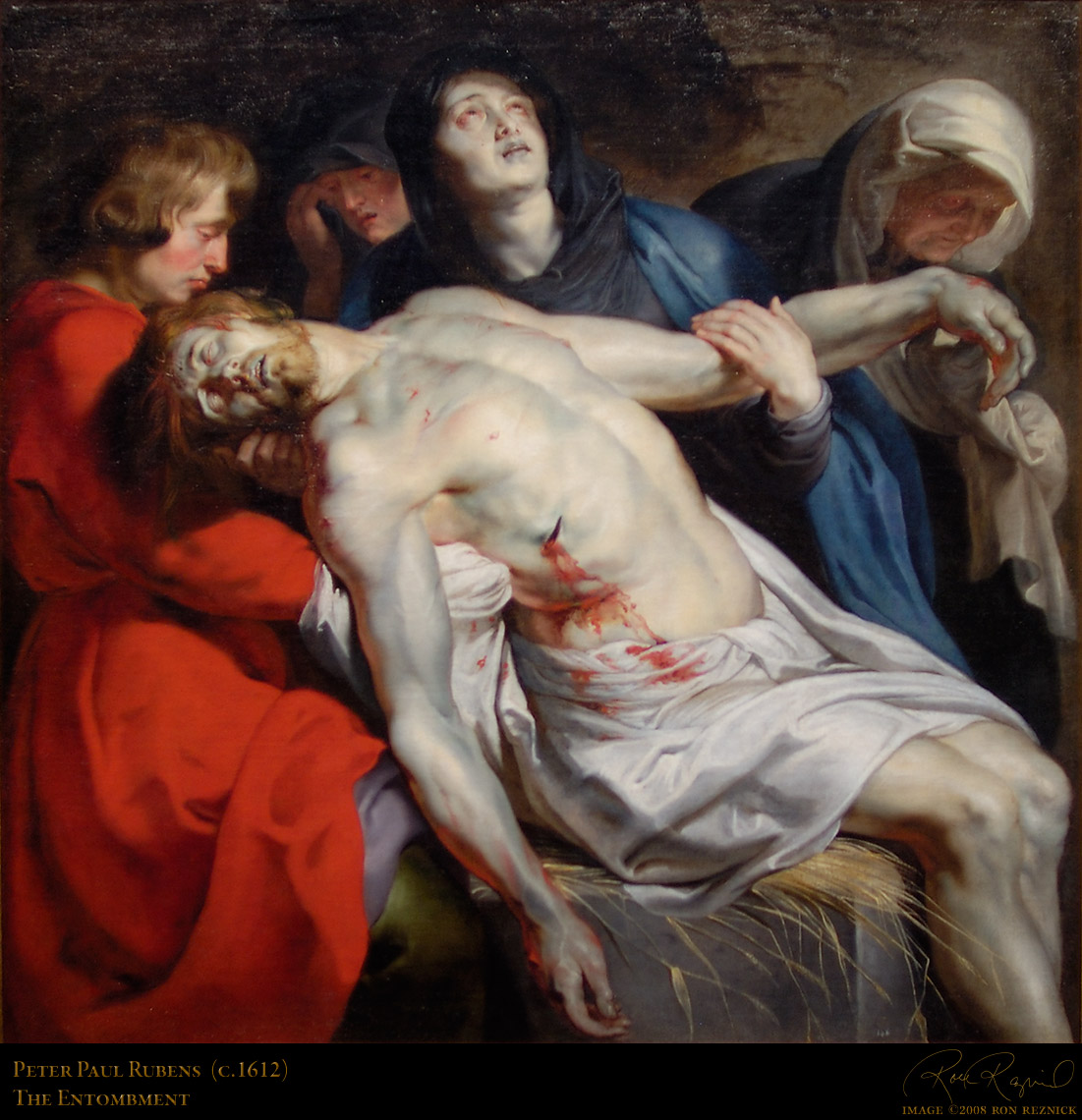
The Entombment by Peter Paul Rubens
from Digital Images
Today is the day we call Holy Saturday. We call it so, because it is a remembrance of the day Christ body lay in the tomb, and His spirit "descended into hell." For us, this is a day of hope, for we know what is just around the corner.

But we must not forget the gravity of this day. We must not forget what Holy Saturday was for the disciples, whose hopes had been dashed. We must not forget what it was for his mother. God gave me this child, He told me He was the child of promise. How can this be? 

Holy Saturday is the day of Job, where we all lie in the dust of our lives, covered in boils, having lost all that is dear to us. 

We must not forget the gravity of this day, because it is in this day that many in the world live. They live day today only with death their only certainty, and hope but a memory. Even for many in the church, it is easy to forget the promise of the Resurrection when we see the horror of suffering in our world. 

Holy Saturday is important, because it is the day in which God sits in the dust with us in our despair. On Holy Saturday, God did not come in a whirlwind and speak of the wonders of creation. Instead, He was pulled down to the very depths of Hell. "I am in fidelity with you in your suffering" declares God. This is the first answer to the problem of evil. 

Let us never forget to sit with those that suffer, to be with them in the reality of what they face. If God did not see fit to trivialize suffering, but instead to take it upon Himself, let us do no less. 

Friday, April 22, 2011

Three Good Friday Meditations

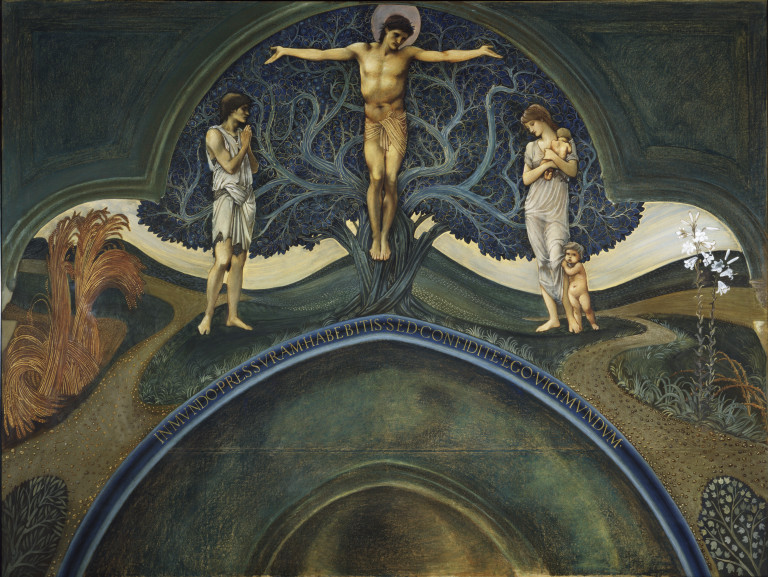
Tree of Life by Burne Jones
from V&A

Death

In the beginning God created the heavens and the earth.

And it was good.

And He walked with man in the garden.

And in the middle of the garden stood a tree, its fruit pleasant to the eye. God told man not to eat of the tree, but the serpent whispered to man "You will be like God."

So man took the fruit of the tree that day in the garden.

And man died.

Wherever he went, death followed in his wake. The earth did not give up food without toil, and the food bought with sweat would just as quickly rot away. Birth came with suffering and pain, and the children lived their lives in the valley of the shadow of death.

Then a Man came, a Man who was also God. This God-Man walked the wasteland of death. He knew His purpose, and with resoluteness He walked towards it. The God-Man took the wine, born of the rot and the bread born of toil, and declared it to be His body.

Then the God-Man went to the tree.

And God died.

Desecration
Piss Christ (Vandalized) by Serrano
from Art Observed

They did not know what it was they were doing. They beheld a man, a dirty carpenter from Nazareth, and he called himself God.

Could you imagine? The Holy God of Israel coming into the world of dirt and blood and flesh. It would be as if the most holy found itself submersed in piss.

So they did what any one who honored God would do, the scarred that which desecrated their God.


Black Box
From Wiki Answers
Darkness

God died, and darkness covered the land. 

God died, and the veil was torn. 

In time, we would come to see this for what it was. The death of death itself. The end of the separation between God and man.

But it was not this yet. The veil was torn, and it showed the holy of holies. It showed the place where God had once dwelt in His glory. 

It tore and it showed the temple which for hundreds of years had stood empty of His glory. 

Sunday, April 17, 2011

Palm Sunday: The Duality of Holy Week

Today Holy Week begins. Today we are on the road to Easter, but first we must go through the cross. This is the most intense week in the Christian year. Not only in terms of the business of those who work in the church, though that is certainly true. This is the most intense week because this is the week when it all comes together. All the symbols of the Christian narrative are pulled together this week as the rhythm of the liturgy reaches its climax.

This is the week of Christ's death, mere days before his Resurrection. Sorrow and rejoicing, bitterness and light, wedded together by a mere span of days.

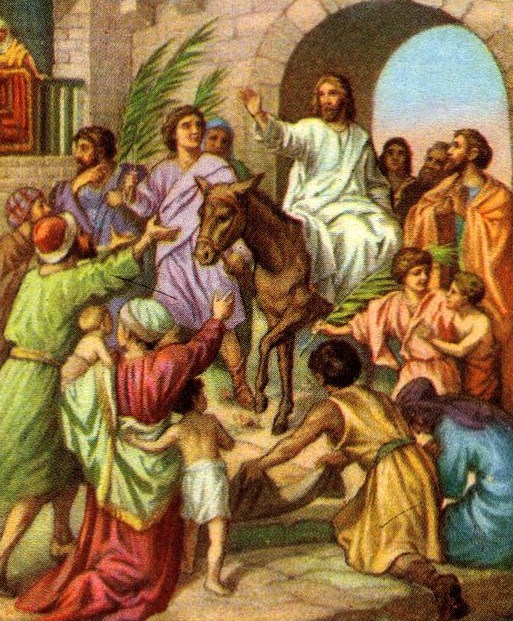
Today, Palm Sunday, is a sort of second Christmas. Today Christ is born, not to flesh, but to the people of Jerusalem. Today the people adore him as the shepherds and the magi adored his birth. Today we welcome him in, singing praise to him.

"Hosanna! Blessed is he who comes in the name of the Lord."

But soon we will cry "crucify him," indeed many of us already have in the Palm Sunday liturgy.

Let us, then, approach the cross in silent reverence.

Monday, March 28, 2011

I Am: Identity in Submission

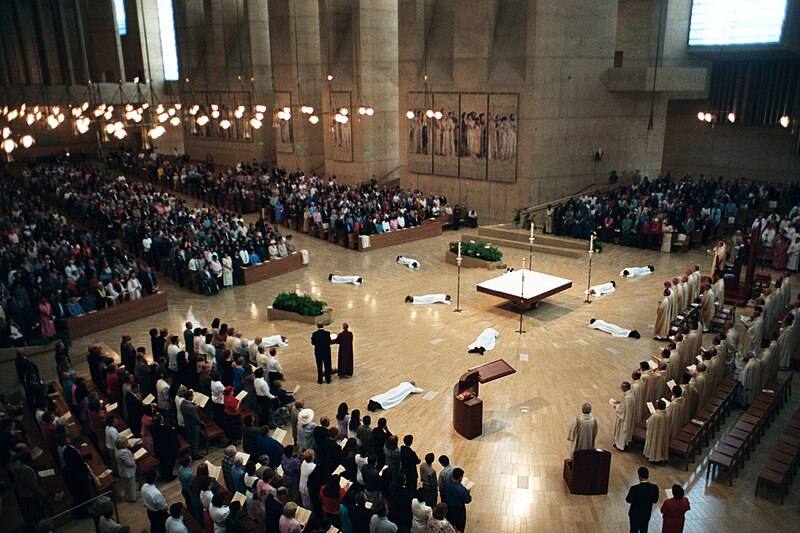
Deacon Ordination by Eric Stoltz
Used under CC BY-SA 2.5 (Wikipedia)
Over at Political Jesus, Rod wrote a fantastic post entitled In Christ, neither Mainline or Sectarian: On Ecumenism & Identity: Towards a Postcolonial Orthopraxis of Reconciliation. In the post, Rod grounds the catholic nature of the church in Christ's physical resurrected body, saying, "Our unity in Christ is not the denial of bodily existence, but about the participation in the life of God Incarnate." I would add to this, as I have discussed before, that we come into this unity through the confession of the creed.1

However, a potential problem was raised by Rod himself in the comments, how do we avoid catholic Christianity becoming "another form of consumerism." That is, how do we avoid our choice of denomination becoming merely a form of branding? I wear Nike, you wear Adidas. I'm an Anglican, you're a Lutheran. If this is our approach, then our ecumenism, in attempting to affirm the unity and community of the Christian faith, becomes instead an affirmation of individualism and appetite.

The question itself came up when another writer at Political Jesus, Amanda, questioned hybrid terms of Christian faith "Bapti-costal; Congre-costal; Anglo-Lutheran; Pente-Catho; Cal-minian, etc. It’s like dogs. Once you have to hyphenate what they are, just call them a 'mutt.'"

In other words, how is a mixed denominational identity any identity at all? To a very great degree, I sympathize with this view, and the reason for that sympathy is tied into why I think we can have ecumenism without Christianity becoming pure commercialism.

I think that the answer to this lies in submission. As Christians, we submit ourselves to streams within the catholic tradition. So, example, I am an Anglican. In our submission, we take both the good and the bad of our stream. We take on its practices, it accomplishments and even its guilt. Thus, I can be proud of the fact that C.S. Lewis is an Anglican, but I also take on the responsibility for the martyring of Roman Catholic brethren at the hands of Anglicans.

Even if I do not understand a position of my stream, in entering into the denominational body I submit to it. For example, I do not understand the Anglican position that only a priest in the apostolic succession can bless the Eucharist, I nevertheless submit to it in praxis. I am an Anglican and I am not a priest, so I will not consecrate the elements.

It is because of this submission that consumeristic individualism is avoided. Because I have to take the good with the bad, it is not all about me. My identity becomes part of another identity.

This isn't to say the individual is completely subsumed by his denominational identity. Any individual is going to have things on which they differ from their denomination, and that's fine to a point.

For one, I think an individual is always free to critique her denomination, and seek change in it, so long as she remains in reasonable submission to its traditions while she remains a part of it. Tradition is a thing always in flux, and one should not think of submission to it in a static manner.

To bring Wittgenstein in again, any term is going to have "fuzzy" areas around the edge. At the same time, there is a point at which a thing can no longer be sensibly referred to by that term. A Roman Catholic who uses birth control is still Roman Catholic, but one who takes communion at a protestant church, rejects transubstantiation, apostolic succession, and the authority of the Pope, cannot rightly be called Roman Catholic.

Thus, there is a point at which one breaks with submission to one's denomination, though remaining part of the creedal body of which it itself is a part. I especially think this should be done if one comes to see some of its practices as grossly immoral (see for example Sinéad O'Connor's call for a new Roman Catholic Church).

What, then, of hybrids? Again, my first inclination, along with Amanda, would be to call them mutts. However, I think there is an answer to this, and the answer lies in why we submit to a denomination. The goal is always Christ. The Christian life is to seek fidelity to Christ, and to try and bring others as close to Him as we are able. We all do this, ultimately, by joining into His body by way of the creed. As part of this process we inevitably submit to a tradition, but that tradition can be that of the independent Christian. That is, we can come to think the best way to be in fidelity with Christ is actualizing ourselves through our own understanding of scripture, and acting what we think to be the best example of Christian life. We can decide that being a Pentecostal Presbyterian, as Eugene Peterson calls himself, is the best way for us to seek fidelity with Christ.2 I don't necessarily think this is the best tradition to submit to, but it is a tradition within our faith nonetheless.

In summary, we are Christians by our participation in His body, through our affirmation of the creed and in submission to a tradition, the end of which is always fidelity to Christ. It is in our submission to a tradition that consumeristic individualism is avoided, though paradoxically that tradition can be one of individual judgment.
__________________________________________________________

1.More specifically, it is the capacity to recite the creed. Not all orthodox Christians actively recite the creed as part of their tradition, but all can affirm the creed.
2. Another interesting thing, though not what I'm dealing with in this post, is the overlap of different descriptors in Christianity. There's high church or low church, apostolic or non-apostolic, various denominations, etc. and these don't necessarily seem to me to fulfill the same grammatical "space."

Friday, March 25, 2011

Hail Mary, Full of Grace

Annunciation by Carvagion
Wikimedia Commons


Mary the Mother of God. Today is the Annunciation. Today is her day. As someone still feeling his way into the world of the liturgical church, this is something very new to me. But I think it's important, so I asked my friend Fernando, who has always been better at sacrament than me, to do a guest post. This post is for me, and for all those like me who don't get Mary. So, without further ado, Fernando:


During the Lenten season, it’s important that — in addition to praying for the end of suffering in the world — we focus our attentions on the work of Christ. While Easter may be proof of his divinity, the Passion seem evidence of his humanity. Indeed, it was necessary that Christ be human, for it is humans who suffer. And one cannot contemplate Christ’s humanity without contemplating the Annunciation. I’ve already posted some thoughts on the Annunciation on my own blog, but those were focusing on Gabriel’s role. This time, I turn to Mary.

I’ve long been persuaded of the belief that the acts of Christ is best though of as a single, whole work; in my mind the Incarnation, Baptism, Teaching, Miracles, Crucifixion, Resurrection, and Ascension of Jesus are as intertwined as the persons of the Trinity are. But also intertwined with those, are the sorrows and joys of Mary: hearing the angel announce the pregnancy. The pain of childbirth. The rejection of her son by the people he was trying to reach. Seeing him after the resurrection. Being present at Pentecost.

Protestants are bad at Mary. Too often Christians just don’t know what to do with her. In response to the abuses that lead to the Reformation, we have become so afraid of Mariolatry that instead we say nothing at all about the Mother of God. Even that phrase, “Mother of God,” has a bad reputation among some circles for being idolatrous.

But it’s true.

We cannot separate Jesus’s humanity from his divinity. God became a man. God fasted and was hungry. God suffered and was cold. God’s feet hurt. God was whipped and beaten and nailed to a tree.

God died.

For Christianity to be true, all of those statements must be said. It’s the essential core of our faith, that God became flesh and dwelt among us as emmanuel. So here’s one more necessary truth: if God died, God was born. Therefore, if God was born, God had a mother. Yet even this simple title is denied by some. As a child, I was told that Mary was not the mother of God: she was the mother of Jesus’s human part, but not of God. As though they were separate! Or “human Jesus” and “God Jesus” had different beings instead of one person! I think people are uncomfortable with the title because they think it implies that Mary is the mother of the Father: Mary can be the mother of Jesus, sure, but not the mother of God. But this is a problem too: the Father is God. The Son is God. The Son is not less God than the Father. The Son became human, in becoming human, the Son has a mother. And so, whatever the reason may be, denying the Theotokos flirts dangerously close to any number of Trinitarian heresies.

In all our post-Reformation hesitation about Mary, we should remember that the words —
Hail Mary, full of grace,
the Lord is with thee.
Blessed art thou among women,
and blessed be the fruit of thy womb,
Jesus —
all come from the gospel of Luke. It is not the Roman Catholic Church, but from the Bible that we hear that all generations will call Mary blessed (St. Luke i.48). The Word of God, from the very cross itself, commands us to behold our mother (St. John xix.27).

How then do we honor Mary, without worshiping her?

God became a human. As I said, that is the heart of Christianity. And mysteriously, Mary is integral to that. In contemplating her relationship to the Godhead, we realize many things about the faith itself — or realize, at least, how little we can understand.

Dante, naturally, stated the mystery best:

“Virgin Mother, daughter of your Son,
      humbler and loftier past creation’s measure,
      the fulcrum of the ever lasting plain,
You are she who ennobled human nature
      so highly, that its Maker did not scorn
      to make Himself the Creature of His creature”
                                                  (Paradiso 33, 1-6)

There is so much paradox in Mary, but then there is so much paradox in the Incarnation as a whole. Dante can see it, even in the familiar paradox we hardly even notice anymore. Virgin mother. But also the more subtle position of Mary before God. Mary is necessary for God to enter this physical, temporal, fleshly reality. The walls of her womb are the first thing Jesus sees. Consequently, Mary becomes something like the firstfruits of Christianity, the first human to represent humanity before the God-man. Up to the Ascension, Mary was the penultimate priest of humanity.

And in her position standing before God, there’s another truth about Mary that is the simplest, but hardest to wrap our heads around: Mary loves God more than you or I do, maybe more than is possible.

All of us can say with the apostle Thomas, “My Lord and my God!” when we contemplate Christ. We can even say along with John that we are the one Jesus loved. At our most holy, perhaps we can even dare to say of Jesus that we are our Beloved’s, and our Beloved is ours.

But none of us, ever, will be able to say of Christ, “my son.” If we could witness the Crucifixion, as life-shatteringly painful as it might be for us, it could not compare with the real pain she felt. When the nails pierced his skin, a sword pierced her heart.

And — making the hopefully uncontroversial assumption that Jesus was a good son — God has a special love for Mary. We are the Father’s children and Jesus’s siblings, by adoption, but few among us can claim to be Christ’s family by blood. We can only imagine what Jesus sees when he looks at her.

Not that we should be jealous. Faith is as important as blood, and we must remember we have our own special place in Christ’s heart: and it’d be very immature for any Bride to be jealous of the Bridegroom’s love for his mother.

She is one of us, too, after all, a witness to the resurrection and present at Pentecost.

Tuesday, March 22, 2011

Theology (Guest Post): We Believe, We Acknowledge, We Look

By Ingersoll
 via Wikimedia Commons
I've been thinking a lot about what makes the church Christian. What is it that separates the line between orthodoxy and heresy? This was not simply a reflection of current events, but those events have certainly had an effect on it.

Last week, I wrote a post on the subject. That post came out of a conversation I had been having with my roommate Josh, in which I had used Wittgenstein to elucidate my understanding of the creed. Josh, who's blog you can find here, expressed similar ideas, but did it through Heidegger. I asked him to do a guest post on the subject as a follow up to my post. This is it.

We Believe, We Acknowledge, We Look: the Nicene Creed as Dwelling by Joshua David Charles

“Building is really dwelling.” With this simple mantra Martin Heidegger in his later essay Building Dwelling Thinking poetically meditates on how building things, building our dwelling places (homes, offices, metro stations, etc.), is already dwelling. That is, in this world, we are creatures who dwell, and we primarily dwell by making things to dwell in. Heidegger intends this in a broad sense—we dwell not just in our homes but also in our workplace and in our work, in art, in thought. Building things, whether that’s an actual home or any construction (systems of thought, class systems, artworks, social roles, anything really) is our primary way of dwelling in this world—our primary way of making ourselves comfortable, making this “place” a home.

Heidegger goes on to elucidate how any building, and therefore anything, is a site of dwelling. He uses the example of a bridge and defines its capacity as a dwelling point by how it gathers—namely, how “the bridge gathers the earth as landscape around the stream.” Before there was a bridge, there was no site for a bridge—these two emerged contemporaneously. Before, there were two strips of land and a stream that were in no way connected, nor disconnected; they were simply there. However, once the bridge began being built, the location at the same time started becoming a site. Suddenly the two strips of land became disconnected and “needed” a bridge in that “location.” What was once nothing becomes a thing—a site of dwelling:
“Before the bridge stands, there are of course many spots along the stream that can be occupied by something. One of them proves to be a location and does so because of the bridge. Thus the bridge does not first come to a location to stand in it; rather, a location comes into existence only by virtue of the bridge.”

All fine and good. But what does this have to do with creeds? Well, the Nicene creed is such a site of dwelling, such a location that gathers what appear to be disparate elements of faith into one concise whole. Rightly speaking, there was no “outside” of the creed, i.e. heresy, until there was a creed as a location, just as there was no stream to be crossed until there was a bridge. There was no concise narrative of the “Christian faith” until there was a creed to articulate it—that is, these ideas emerged contemporaneously, just like the building and the dwelling-ness of the bridge emerged contemporaneously. There was no apostolic church, no catholicity, no spirit which bound these together, and no “looking for the resurrection of the dead” until there was the Nicene creed which allowed these things to emerge as such. Creeds, in short, gather disparate ideas and snippets of faith into a whole, a unity, in order that these things might emerge as doctrinal and orthodox—in order that the creed might gather those who speak it into a unity and a whole.

Just as building reveals itself to already be a kind of dwelling, so too we find ourselves dwelling with others by speaking the creed. We share a site with them, inhabit a space, side-by-side. This happens regardless of what interpretation we have of the creed we share—because it is not in our thoughts or beliefs about the bridge that we dwell in it (although our beliefs and thoughts matter), but in our mutual building of it, in our crossing of it. It is by saying a creed together that we inhabit the same religious site. It is in the speaking that the creed becomes what it is and we become what we are as those who speak it. It is in the building, in the speaking, we find a home.

Sunday, March 20, 2011

Theology: The Sacramental Horror of the Eucharist


By Hieronymus Bosch
via Wikimedia Commons
"As a kid growing up in Southern Indiana, I wasn't allowed to watch horror movies," Rev. Jonathan Weyer writes over at the Huffington Post. But, he tells us, horror can be sacramental, inviting us " to think about realities you can't see, touch or taste, but still exist." This works because horror shocks us out of our comfortable place, shows us that God is also the Lord of all things unseen. Weyer calls to our mind horrific medieval paintings, and he quotes Flannery O'Conner saying "that to reach the deaf sometimes you have to shout." Uncanny horror can open our eyes to the unseen and gruesome horror can take us through the reality of death to the greater reality of the Resurrection.

I agree, horror can be sacramental, but it goes further than that. The most fundamental Sacrament of all is a horror both uncanny and gruesome.

In the Eucharist, we come together at the Lord's Table, and we eat God.

We. Eat. God.

However symbolically or mystically you take that, it remains a horror. Bread and wine, wheat and grape, the sustenance of our earthly life becomes our God and we consume Him. Simple nourishment becomes cannibalism and deicide.

Yet, through that horror, we are joined with all the saints in an eternal feast, and secured in the Resurrected life of Christ. We go into the grave that we might be born again, to go out into the world as servants of God for the sake of others.

Today is Sunday. Either today, or some Sunday in the future, if you go to church you will partake of this highest Sacrament. So now, in this time of Lenten mourning, remember the horror, let it shout to your deaf ears, and let it turn you ultimately toward the beautiful truth of the Resurrection.

The Lord be with you.

Thursday, March 17, 2011

Theology: Applying the Creed

Earlier this week, I made a post discussing what I think defines orthodox Christianity. Since I wrote that post, I have been running into the huge storm of controversy surrounding Rob Bell's new book Love Wins. Various people have been accusing Bell's book of being heretical, and I think it's time to apply what I said. Now, let me start off by saying that I have not read this book, so in many ways my comments here are not directed at what sort of Christianity Bell has, but towards the reaction to it.

Rob Bell's book is apparently a book about God's love, that extends to thoughts about the eternal destination of mankind. Bell says, as I understand it, that God's love is so great, that he suspects it will eventually reach everyone, either in this life or the next. People will always be free to reject God, but eventually the time will come when God's love will reach everyone.

Enter the watchdogs of Christian orthodoxy, crying heretic at this apparent Universalism. Many have already addressed these accusations, so I won't do that here (Greg Boyd has a particularly good discussion of it on his blog).

What I'm going to address is whether or not what Bell is accused of saying can even rightly be considered heresy. Kevin DeYoung wrote an extensive review of it, which I have not yet read (hey, I have to work on finals). There is a nice summary of the review, written by Justin Taylor, here. Both reviews go through the various things Bell apparently says, but there's one thing I particularly want to focus on. Justin says:

Bell addressed an invitation-only meeting at Mars Hill Bible Church on Sunday night and began by saying that he is not a universalist, that he believes in heaven and hell, and that he believes Jesus is the only way to God. Kevin’s review will help you see what he really means in each of these three areas.
What I want to say is, what Bell apparently means when he says he believes in heaven and hell, and in Jesus as the only way to heaven, may be different than how these people interpret catholic Christianity, but it is certainly within the bounds of the creed. It is orthodox Christianity.

Christian doctrinal history is much more complex than these watchdogs acknowledge, and Rob Bells views definitely fall within orthodoxy (even if they really are the most extreme thing these people accuse him of).

Soteriology - how we under stand Jesus's atoning work - is important, but it is only interpretation. In the end, the atonement matters, how we interpret it is secondary. As C.S. Lewis said:
 "We are told that Christ was killed for us, that His death has washed out our sins, and that by dying He disabled death itself. That is the formula. That is Christianity. That is what has to be believed. Any theories we build up as to how Christ's death did all this are, in my view, quite secondary: mere plans or diagrams to be left alone if they do not help us, and, even if they do help us, not to be confused with the thing itself" (Mere Christianity)
Those who accuse Bell of heresy have confused their theories with the atonement, and their interpretation of the creed as orthodoxy. I thank God they aren't the guardians of my soul.

_______________________________________________________
P.S. I am not myself in Rob Bell's theological camp. What do I believe about hell? I don't know. It's there, because Christ "descended into hell," but that's about all I know. Other than that, I'm just confused.

Monday, March 14, 2011

Theology: Confessing the Creed with Wittgenstein

In the year 390, St. Augustine of Hippo wrote On True Religion. Thinking of the true beliefs of religion was a part of Christianity from the start. However, it was a new thing for the Roman world. For the Romans, and the Greeks who so strongly influenced them, religion was a matter of cult. That is, it was not so much what you believed about the god, but what you did in worship to that god which mattered. Bring your fire offerings to Zeus, it matters not what you say about him. But Christianity had grown out of Judaism. While orthopraxy mattered for the Jews, that praxis existed within a covenant built around affirmations about God ("The Lord our God, the Lord is One") and His holy word.

Thus, as Christianity spread to the Gentile world, it brought with it this notion of orthopraxy within a covenant that affirmed an orthodoxy. This orthodoxy would eventually develop into the words of the Christian creeds, such as the Nicene:

We believe in one God,
the Father, the Almighty,
maker of heaven and earth,
of all that is, seen and unseen.

We believe in one Lord, Jesus Christ,
the only Son of God,
eternally begotten of the Father,
God from God, Light from Light,
true God from true God,
begotten, not made,
of one Being with the Father.
Through him all things were made.
For us and for our salvation
he came down from heaven:
by the power of the Holy Spirit
he became incarnate from the Virgin Mary,
and was made man.
For our sake he was crucified under Pontius Pilate;
he suffered death and was buried.
On the third day he rose again
in accordance with the Scriptures;
he ascended into heaven
and is seated at the right hand of the Father.
He will come again in glory to judge the living and the dead,
and his kingdom will have no end.

We believe in the Holy Spirit, the Lord, the giver of life,
who proceeds from the Father and the Son.
With the Father and the Son he is worshiped and glorified.
He has spoken through the Prophets.
We believe in one holy catholic and apostolic Church.
We acknowledge one baptism for the forgiveness of sins.
We look for the resurrection of the dead,
and the life of the world to come. Amen.
This creed affirms the fundamentals of what it is to be a Christian. If you can say the words of this Creed, then you are a member of the covenant, if not, then you are a heretic. It is the words of this Creed that bind the catholic Church together, from the Roman Catholic Church to the emerging house church.

Very well, but what does that mean? How does this creed bind, and what exactly does it mean? Once you get past the stage of "I affirm these words" things get very muddled, both in their meaning and their practice.

Take "is seated at the right hand of the Father" for example. The Son, Jesus Christ, became flesh and was resurrected. He exists as a man eternally, and the Creed tells us He is in Heaven with the Father. Yet, the Father is Spirit. How does one sit at the right hand of one who does not haven a hand, who exists outside of time and space?

On the practice side, look at baptism. Surely, we affirm "one baptism for the forgiveness of sins," but is it infant baptism? adult? sprinkling? immersion?

Such examples make it clear how difficult it is to see how the Creed unites the Church.

I contend that it is the submission to the language of the creed that is this catholicity. At first, it might be puzzling how this is even an orthodoxy. If the language of the creed is left "blank" isn't it open to just any interpretation? This is where Wittgenstein comes in.

Wittgenstein was a philosopher of language, but he did not think language was simply a matter of conveyed definitions (at least in his later period). Language, Wittgenstein would say, is something like a tool. Just as I can take a hammer and drive in a nail, I can ask you to bring me the hammer and you will (if you are kind). Words have genuine meaning - that they can be used in this way shows this. Yet, defining words is extremely difficult, if not impossible. One of Wittgenstein's favorite examples was that of "game." We talk about games all the time, but try to come up with a definition and you will end up excluding things that are definitely games. By what definition are chess, soccer and solitaire all games? Yet, at the same time, there are definitely things that are not games. If you called napping a game (in anything but a metaphorical sense) people would simply not understand what you meant. Wittgenstein referred to that which bound the different uses of a term together a "family resemblance."

I find this understanding of language quite compelling, and I think it provides a good way of understanding the creed. Catholic Christianity affirms the words of the creed, yet we often have different content we lend to those words. At the same time, not just any content can be given to these words. The creed, in many ways, is not a fence, but a clearing. Those who submit to the creed enter into a common bond of language that allows them to be part of the same covenant, even as their praxis and their propositional beliefs differ widely. The creed creates a language and a place for orthodox theology to occur, and that space is the orthodox catholic Christian church.

Sunday, March 13, 2011

Theology: Why Feast on Sundays?

In the Western Church1, the season of Lent has "breaks" on Sundays. Every Sunday is a feast, when the disciplines entered into for the season are foregone. Some, often ignorant of these feasts being part of the tradition, complain that it is lame to take breaks during a fast. While this complaint is in many ways childish, there is some sense to it. Why commit to a forty-day fast and then take breaks? Certainly, if I were to do Lent my own way, I would do a full forty-day fast. But Lent isn't my own fast, it is a church tradition to which I am submitting.

So why then the feasts? It is because Sunday is the day of the Lord's resurrection. Sunday is the timeless day in which Christ was raised, the day where we celebrate the presence of Christ in the Eucharist. Every Sunday is, in effect, a mini-Easter. The western tradition holds that it would be disrespectful to fast on such a day as this. “How can the guests of the bridegroom fast while he is with them?" (Mark 2:19).

Indeed, the entire Western Church calendar is built around this conviction. The fast of Lent is forty-days, but from the beginning of Lent on Ash Wednesday to Easter Sunday is forty-six days. The Sundays are excluded from the count that they might be days of feasting.

So join me today at the Lord's table. Eat, drink, be merry, for tomorrow we mourn.
_____________________________________________________________
1. The Eastern Church has different traditions, and a different calendar. There are no feasts during Lent, and from the beginning of Lent to Easter is exactly forty days.

Wednesday, March 9, 2011

Life: Reading Augustine

St. Augustine is one of the great thinkers of the Christian Church. I do not always agree with him, but there is no denying his wisdom, intelligent and fervor for God. One of the things I have decided to do during this coming season of Lent is to read St. Augustine's Confessions.

The Confessions is a cherished book of both theology and philosophy. It is also, I understand, the world's first autobiography.

As I read this text, I will post here my reflections, and I hope you will join me on the journey.

Theology: Ash Wednesday and the Meaning of Sin

Remember that you are dust, and to dust you shall return. - Book of Common Prayer
One day, a man went out and bought a car. It was a beautiful car, fast and reliable too. The man would drive that car everywhere, and he loved it dearly. With time though, the car stopped running so well, it's brakes began to slip, it became a danger.

Sin is like the degradation of that car. Like the car, man was made for a purpose, created with a specific kind of life he was meant to live. But the First Man fell from that purpose, he degenerated and all his decedents after him. And this is where the analogy with the car breaks down, for it was, in the first place, a choice that led to the Fall. But sin is not a legal term, we are not thinking good and evil in terms of adherence to a law. Sin means missing the mark. Sin is falling from what we were created to be, and oftentimes, like the brakes on the car, that degeneracy becomes a danger to others.

So thorough does this degeneracy of sin run in the human race, so actual is its effect on us, that we cannot help ourselves. We have died spiritually and cannot return to what we were meant to be. God could have left us in that state, let us degenerate further, destroy ourselves, but instead He, in the person of the Son, became a man, and as a man He submitted to death and through Resurrection He conquered the power of sin and death.

Through this act, those who call on the name of Christ are sealed for the Resurrection. They are given an eternal inheritance, and the promise that at the last day they shall be raised with Christ. This healing is already breaking out in the world, but it is not yet complete. Though the seed of salvation is in us, we still live in a fallen world where inevitably we miss the mark.

Today is Ash Wednesday, it is the beginning of the season of Lent on the church calendar. During Lent, Christians around the world enter into a time of fasting, beginning on this day with the imposition of the ashes. These ashes symbolize the old Near Eastern practice of mourning in sackcloth and ashes.  To some, this may seem an odd tradition for Christians to practice. We have been forgiven, washed of our sins and given the guarantee of the Resurrection.

Yet, this season exists for a reason. Again, sin is not to be understood in a legal sense. Sin is degeneracy. And though in our spirits (our eternal nature) we are made new, yet still we live in the flesh (our corruptible nature). Because of this, we enter Lent as a time of mourning. We memorialize those who went before Christ, who lived in a time before He was raised from the dead, we remember our own lives apart from God, we bewail that we are still yet living this side of the Resurrection.

There is another purpose too, for though we are still in the Flesh, the Spirit is in us and we can grow. We will never attain perfection before we are made whole, but we can work to make ourselves and our world more like the Kingdom of Heaven. One day, Heaven shall be wedded to Earth, and the Kingdom work done in the here and now shall endure. As we fast during Lent, one of the things we do is discipline ourselves. We train ourselves in temperance and charity by fasting and reminding ourselves of our own faults. By God's grace, this work helps to transform our lives for the better, than we might be a blessing unto others. And all along, as we fast, we pray, and God answers.

I hope you join with me in this season of Lent. Fast, mourn, look towards Easter with hope, pray for the world around you, serve and be transformed.

Friday, February 25, 2011

Theology: Ruth and the Law that Kills

One of the things I love most about the Anglican tradition is the liturgy of the word. It's the part of the service where, every service, scripture is read. If there was one thing in my tradition that I think every church should have, this would be it. An interesting feature of this practice is that, as different pieces of scripture are read together, connections between verses get made that might not otherwise have been.

Last night, I attended evening Eucharist, and just such a connection was made. I'm going to quote the text whole here, in the spirit of the liturgy.

Now Boaz said to her at mealtime, “Come here, and eat of the bread, and dip your piece of bread in the vinegar.” So she sat beside the reapers, and he passed parched grain to her; and she ate and was satisfied, and kept some back. And when she rose up to glean, Boaz commanded his young men, saying, “Let her glean even among the sheaves, and do not reproach her. Also let grain from the bundles fall purposely for her; leave it that she may glean, and do not rebuke her.” 
 So she gleaned in the field until evening, and beat out what she had gleaned, and it was about an ephah of barley. Then she took it up and went into the city, and her mother-in-law saw what she had gleaned. So she brought out and gave to her what she had kept back after she had been satisfied. And her mother-in-law said to her, “Where have you gleaned today? And where did you work? Blessed be the one who took notice of you.” So she told her mother-in-law with whom she had worked, and said, “The man’s name with whom I worked today is Boaz.” Then Naomi said to her daughter-in-law, “Blessed be he of the LORD, who has not forsaken His kindness to the living and the dead!” And Naomi said to her, “This man is a relation of ours, one of our close relatives.” Ruth the Moabitess said, “He also said to me, ‘You shall stay close by my young men until they have finished all my harvest.’” And Naomi said to Ruth her daughter-in-law, “It is good, my daughter, that you go out with his young women, and that people do not meet you in any other field.” So she stayed close by the young women of Boaz, to glean until the end of barley harvest and wheat harvest; and she dwelt with her mother-in-law. (Ruth 2:14-23)
To give some context, Ruth was the daughter-in-law of Naomi, and a foreigner. Naomi had been living among Ruth's people when her husband, and then her sons, had died. Thus, they returned to Israel as widows, and one of them a foreigner - just about the worst situation they could be in. Now, the Old Testament law required that the edges of the fields be left so that foreigners, widows and orphans could glean from them. It also required that if members of the community were forced to sell property and thereby become impoverished, their property should be "redeemed," that is, bought back, by a close relative. This verse was read, and then the following New Testament Epistle reading.

Do we begin again to commend ourselves? Or do we need, as some others, epistles of commendation to you or letters of commendation from you? You are our epistle written in our hearts, known and read by all men; clearly you are an epistle of Christ, ministered by us, written not with ink but by the Spirit of the living God, not on tablets of stone but on tablets of flesh, that is, of the heart. 
And we have such trust through Christ toward God. Not that we are sufficient of ourselves to think of anything as being from ourselves, but our sufficiency is from God, who also made us sufficient as ministers of the new covenant, not of the letter but of the Spirit; for the letter kills, but the Spirit gives life.

But if the ministry of death, written and engraved on stones, was glorious, so that the children of Israel could not look steadily at the face of Moses because of the glory of his countenance, which glory was passing away, how will the ministry of the Spirit not be more glorious? For if the ministry of condemnation had glory, the ministry of righteousness exceeds much more in glory. For even what was made glorious had no glory in this respect, because of the glory that excels. For if what is passing away was glorious, what remains is much more glorious.
Therefore, since we have such hope, we use great boldness of speech— unlike Moses, who put a veil over his face so that the children of Israel could not look steadily at the end of what was passing away. But their minds were blinded. For until this day the same veil remains unlifted in the reading of the Old Testament, because the veil is taken away in Christ. But even to this day, when Moses is read, a veil lies on their heart. Nevertheless when one turns to the Lord, the veil is taken away. Now the Lord is the Spirit; and where the Spirit of the Lord is, there is liberty. But we all, with unveiled face, beholding as in a mirror the glory of the Lord, are being transformed into the same image from glory to glory, just as by the Spirit of the Lord. (2 Corinthians 3:1-18)
Typical of Paul, these are some packed, one might even say frantic, verses. There's a lot of good stuff in there. I want to draw attention to a particular thing said in this section. Paul says " the letter kills, but the Spirit gives life." This is a common theme in Paul - the Spirit is life giving, but the letter (or the law) brings death. I've always found this puzzling. It seems intuitive to me that the law tells us what is good, and how is doing what is good destructive? Especially when the spirit also tells us to do good, oftentimes good over and above what is demanded by "law"?

Then I read these two verses together, and suddenly it clicked. See, there's another detail to the Ruth story. Boaz wasn't Ruth's closest relative - there was another. The closest relative should have been the one to redeem Ruth, but he didn't, instead Boaz had to. Boaz did the right thing, according to the law, and by the very nature of the law, the one who didn't do his duty was brought under condemnation. The law separates, divides, creates a divide, becomes a veil. In contrast, the Spirit opens up. When we act according to the Spirit, we do what is good, but that goodness flows out of ourselves and into Others. Our right acting does not harm, it edifies.

I don't pretend that this totally encompasses what Paul meant. I doubt such a thing could rightly be encompassed, but I think it is an interesting angle with which to approach it. 

Friday, February 11, 2011

Theology: We Bewail our Manifold Sins and Wickedness

In the 1928 Book of Common Prayer, the confession of sins says "We acknowledge and bewail our manifold sins and wickedness, Which we, from time to time, most grievously have committed, By thought, word, and deed, Against thy Divine Majesty, Provoking most justly thy wrath and indignation against us." Harsh words. I've heard it complained that they make it sound like we commit murder every week. And yes, they do, because we do. 


My roommate Josh recently wrote a post over on his blog about hypocrisy. In that post, he talks about a distinction between the cynic and the hypocrite. The cynic is one who sees the flaws of the system he is a part of, withdraws from them, and claims for himself superiority. The hypocrite, on the other hand, is one who sees the flaws of his system, bewails them, strives to get out of them, all the time realizing that he is a part of them inescapably, and that because of this he will always be part of the system.


We live in a world of horrendous injustice, our entire economic system is tied in with the exploitation of the weak, the destruction of animals, the rape of our world. What is more, this side of the Resurrection, we live as fallen bodies oftentimes overwhelmed with desire that leads us to sin. We cannot withdraw, not until Christ returns and we are transformed. We must fight it, but we must, always, realize that we cannot escape it. We sin each day, even in ways we don't realize. I sin when I look at another person and put her into a box (vain Hollywood girl), I sin when I eat chocolate harvested by slaves, I sin when I sit in a car whose fumes are destroying the planet. There are even situations, as I have talked about before, where any action I can possibly take is wrong (kill the one, or let the many die?) 


This isn't to say that I am some wicked or worthless person. I have been made in the image of God, and remade in the Resurrection of Christ. I have been sanctified and my sins are no longer held against me. I am beloved of God. When I bewail my wickedness, what I bewail is that I am not yet whole. I have been made clean, the seeds of the Resurrection have been planted in me, but they have not yet blossomed. 


This is why we cannot judge. But for the irresistible Grace of God, what would we be? 

Friday, January 28, 2011

Liturgy: The Feast of St. Thomas Aquinas

It's a little cliche, but I'm inclined to think that the greatest philosopher the world has yet seen is St. Thomas Aquinas, that brilliant fat man. Today, in the liturgical calendar, is his feast. His thoughts, along with Aristotle's have been one of the strongest influences on my own philosophy. I encourage all of you to read him, or at least read about him, and may your minds be lifted up to God. In the words of the liturgy for today's feast:

Almighty God, you have enriched your Church with the singular learning and holiness of your servant Thomas Aquinas: Enlighten us more and more, we pray, by the disciplined thinking and teaching of Christian scholars, and deepen our devotion by the example of saintly lives; through Jesus Christ our Lord, who lives and reigns with you and the Holy Spirit, one God, for ever and ever. Amen.

Tuesday, April 20, 2010

Book Review: Giving Church Another Chance

Late last year I read my pastor and Bishop Todd Hunter’s first book, Christianity Beyond Belief in which he argued for the importance of entering into God’s story and living as Christians not merely for cleansing from sin, but further for the sake of touching the lives of others with Christ’s love. That is, being a people set apart by God for the sake of the rest of the world, just as Israel was intended to be.

Recently, he released his second book, Giving Church Another Chance: Finding New Meaning in Spiritual Practices and it is a book well worth picking up. There is a large group in our society, even within Christianity, who have become disenchanted with church. Todd was one of these, he went through a “de-churched” phase, experimenting with various alternative forms of Christian worship, but then, at the end of this journey, he found himself as an Anglican Bishop. For those of you who don’t know, Anglicanism, which has its roots in the Church of England, is a high liturgical church, with bishops, priests, and formal organized prayers. What happened? Well, you’ll have to read the book to get the full story, but in short Todd discovered the role of the liturgical church as a tool for spiritual formation. He came to realize that church is not “what it’s about” but rather a place of spiritual refreshment for Christians, a center for our lives from which we go forth to bless the world.

I still have some of the problems I had with Christianity Beyond Belief, namely the stylistic simplicity (especially the use of quotations from The Message paraphrase of the Bible) but as before, I feel these aesthetic complaints do not reflect on the importance of the content.

Ultimately, I don’t think this book is as important as Surprised by Hope but it’s a wonderful tool for understanding Todd’s vision and I truly believe that the “re-practicing” of church advocated by Todd in this book should at the very least be examined by all Christians (especially the section on the Eucharist), but especially those who would tear down centuries of tradition on the basis of their own limited experience and personal interpretations of scripture.

Tuesday, September 22, 2009

Liturgy: Introduction to the Calendar

I grew up in the Assemblies of God church, a charismatic denomination within the evangelical protestant tradition. While I have never agreed with all of AoG theology, I value it as a genuine expression of faith in Christ.

My own journey, however, has taken me in a different direction, as I have in recent years found myself enamored of the forms of worship and spiritual development embodied in the Anglican Church. Among these expressions is the high church concept of a Liturgical or Church Calendar, which structures the years and months around a rhythm of faith. These include seasons of faith (the most famous of which being Lent) as well as numerous feast days celebrating important events and people in the history of the Christian faith. Used properly, the Liturgical Calendar is a wonderful way of focusing the mind on important areas of faith and creating a pattern of discipline towards spiritual formation.

As I explore Anglican worship, I hope to share with you what I learn along the way. As part of this, I plan to post up reflections on the Liturgical Calendar as the seasons and interesting feast days come along.