Showing posts with label hugo award winner. Show all posts

Thursday, August 16, 2012

The Windup Girl Review

Worlds Without End
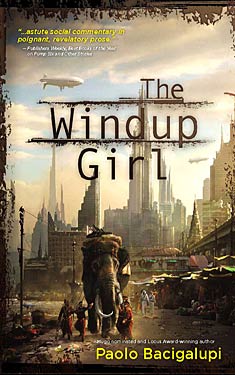
The Windup Girl by Paolo Bacigalupi 
2010 Hugo Award Winner for Best Novel and 2009 Nebula Award Winner for Best Novel 

 I'm a sucker for a good setting. After all, I was raised up on a steady diet of The Lord of the Rings and learned early that a well built setting is a wonderful compliment to a good story, and can even be a pleasure all its own. When you come down to it, that's probably why I love science fiction and fantasy - they're the only genres were I can indulge in the pleasure of world building. Well, The Windup Girl is an absolutely fantastic bit of world building, and I'll waste no more time in giving it high praise.

Rather than being set on some far off planet or in a gritty metropolitan future, The Windup Girl takes place in a Thailand of the future, one that exists in a radically different, but utterly believable, political and economic world from our own. It's that believability that's so incredible about Bacigalupi's world. Our world has gone through many economic shifts, from agrarian to industrial and beyond. But who from an agrarian society could have pictured an industrial world? Of course, there's no guarantee the world will go the way of Bacigalupi's vision (hopefully it won't) but one can readily imagine it, and that makes it a wonder to behold.

Without giving too much away, since so much of the pleasure of The Windup Girl is the slow unraveling of its setting, the world Bacigalupi builds is one of a post-industrial crunch. Well before the time of the book, the petroleum that fuels our world's economy ran out, without any comparable alternative being found, and the global economy quickly became a thing of the past. The world couldn't just go back to being agrarian though, because industry had changed the world forever. Alternative technologies provide for some of what petroleum provided before, though with nowhere near the power, and the world is slowly inching back towards a global economy. Maintaining these technologies is crucial, because during the industrial age the agro-businesses had created genetically engineered crops and plagues that guaranteed humanity would need to continue to rely on advanced technology to keep itself alive and fed.

In the midst of this world of economic isolation and genetic disaster, the city of Bangcock is a boiler plate of political and economic tensions. Two major forces jostle for power within the city, as those who seek to protect the city from the outside world, the "White Shirts" of the environmental ministry, butt heads with those of the Trade Ministry who see salvation for Thailand in the recovering global economy. The Windup Girl is the story of one genetically engineered Japanese girl who becomes caught up in these forces.

This book certainly won't be for everyone, however. It is a story about politics, and so naturally it moves at a lumbering pace. Mind you, I enjoyed nearly every minute of it, but it was certainly not a page turner and took me awhile to finish.  Also, the exploitation which the titular Windup Girl Emiko faces throughout the story is not easy stuff, so if you've got a queasy stomach you should probably stay away. It's also not a book without it's flaws. The prose is perfectly serviceable, but not incredible, and the characters that inhabit it, while not flat, fail to really jump off the page.

It's also not a book whose message I can get on board with, though that certainly doesn't mean its poorly done, or that I can't enjoy it. Without giving too much away, the books overall slant seems to be something of a Buddhist Transhumanism. Which, when you come right down to it, is a very interesting worldview, just one dramatically opposed to my own.

So, if you love world building, and enjoy political stories, I can highly recommend The Windup Girl. If that's not your style, then this book is definitely not for you.

Also, fantastic cover.

Friday, November 26, 2010

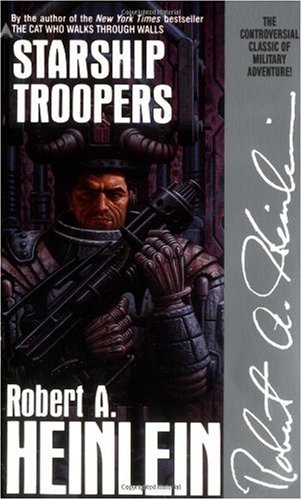
Book Review: Starship Troopers

Starship Troopers by Robert A. Heinlein 1960 Hugo Award Winner for Best Novel 


After finishing The Forever War, it seemed appropriate to pick up and read the book which, in many ways, had been its precursor.  Starship Troopers is considered by many to be the origin of the "space marine" genre (though the titular troopers are actually army) and also criticized by many as being, supposedly, favorable to fascism.


I can't speak for it's views on fascism, but I can see how it started a genre. The book is a fascinating piece of world creation, and chock full of ideas. It's important to know coming in that these ideas are the point of the book. Certainly, Juan Rico, the narrator, is a definite character whose fate you care about, but the narrative is not about an exciting story, and at times gets bogged down in long philosophy or history lectures on the part of his instructors. The first time I picked up this book a few years ago I ended up getting bored with it while Rico was still in training because I'd been expecting an exciting war story. 


 I really don't see fascism in the book, though it was decidedly pro-military and critical of free democracy.  Heinlein dedicates the story "to all sergeants everywhere who have labored to make men out of boys." And that, ultimately, seems to be the theme of the story. Juan Rico begins as a young man, unsure of himself, mediocre in school and unthinkingly following his friends, and bit by bit the military takes him away from this. 


Finally, it should be noted that the mobile infantry of Starship Troopers is a voluntary corps. The book is critical of conscription armies, and in many ways this is what sets it apart from The Forever War. It's not as simple as Starship Troopers being pro-military and The Forever War being anti-military. The one is about a volunteer army fighting to defend its homeland, the other about a conscript army fighting for reasons unknown. One is Vietnam, the other World War 2. Both authors have interesting perspectives (though I don't agree fully with either) and, though Haldeman did criticize the book for being too pro-military,  both share a mutual respect.


This is another one I recommend to pick up. Oh, and I'm told it's nothing like the film. 

Wednesday, November 24, 2010

Book Review: The Forever War

The Forever War by Joe Haldeman1
1976 Hugo Award Winner for Best Novel and 1975 Nebula Award Winner for Best Novel 


Awhile back I did a review of another Haldeman book, Camouflage, another award-winning novel which I found extremely underwhelming. Needless to say, I was somewhat worried in approaching The Forever War. At the same time, all the summaries of the book I'd heard made it sound extremely interesting. The basic concept is this - a physicist, William Mandella, is drafted into the military to fight an alien race which has attacked human vessels, but who no one has ever seen. The war begins, and due to time dilation, a few years of war time for Mandella become thousands of years back home. As Mandella returns home, he must deal with the isolation the war has brought on him. 


Haldeman himself is a physicist and a veteran of the Vietnam war, so I also thought his experience should add well to the story. So how would things turn out? On the one hand, an interesting concept and a writer who knows his subject; on the other hand, a very underwhelming book by the same author.
When the book first started the worst seemed confirmed. The military training the characters went through was absurdly over the top in the lack of care showed by the soldiers's superiors (live ammo training, etc.) and the book looked like it was going to sink into the juvenile use of sex so many sci-fi authors seem to fall into. 


Thankfully, I stuck with the book, and my initial impressions were completely wrong. With this story, Haldeman undoubtedly knows what he's doing. Even the sex that initially worried me was, as my friend pointed out to me when I was half-way through, far too deliberate to be "juvenile" and ended up playing an extremely important role in the alienation experienced by the characters. 


I'm still not sure what I think about the stories ending, but either way it's not really important.  The book isn't so much about a narrative, but about the effects of the Forever War on Mandella and the Earth. We follow him closely, and in many ways experience with him the disillusionment and alienation of the war. 


This is an excellent book, and in many ways it feels like a science fiction book ahead of its time. I recommend it to those interested in creative uses of science fiction tropes and in a soldier's perspective on war. 
__________________________________________________________
1. I actually listened to this one as an audiobook and the reader was quite excellent. 

Thursday, January 28, 2010

Book Review: Camouflage

Camouflage by Joe Haldeman
2005 Nebula Award Winner for Best Novel 


My review of this will be short, because really I don't have that much to say. The basic premise involved to alien shapeshifters who had spent millions of years on Earth. So long, in fact, that both had forgotten their origins. In the near future, however, a team of scientists unearth an alien artifact that draws them both to it - the one because he is trying to discover his origins, the other because he is driven to kill any beings like him. 


 It was a fairly interesting set up, with aliens that were moderately alien in their psychology (though not enough so if you ask me). The pacing was also quite good, and I kept turning the pages waiting to find out who these aliens were, why they were on Earth, and why the one was driven to kill the other. There was too much of that modern science-fiction impulse to have frequent and pointless sex scenes. I find it all rather juvenile, but can look past it for a riveting story.


*SPOILER (mouse over to read)
Unfortunately, all that excited page turning went entirely unrewarded. The book ends with an anti-climactic battle between the two aliens, followed by the "good" one giving us exposition on who he is that only tells us information we (as the readers) already knew, and explaining that he doesn't know who the other alien is. Then he flies away.

That's it.


*END SPOILER*


This actually seems to be a chronic problem with science fiction writers. They're often brilliant at set up, but totally fall on their faces when it comes to execution.


Oh well.


Ultimately, Camouflage was neither particularly spectacular, nor entirely terrible, and so my concluding thoughts on the book are... "meh". 


Tuesday, August 18, 2009

Book Review: Speaker for the Dead

Speaker for the Dead by Orson Scott Card
1987 Hugo Award Winner for Best Novel and 1986 Nebula Award Winner for Best Novel

More than a year after finishing Orson Scott Card’s famous Ender’s Game, I finally got around to reading (well listening to) its award-winning sequel Speaker for the Dead. The later novel concerns the discovery by humans of a second intelligent alien race, called the Pequeninos on the recently settled planet Lusitania. The Brazilian Portuguese settlers of the planet are thereafter confined to a single city and their growth permanently limited by congressional order. The Pequeninos are a small, technologically primitive species with pig like features (earning them their other nickname, Piggies). Congress decides that the best thing for the Pequeninos is that they get as little contamination from humans as possible, and the only people allowed contact with them are specially trained xenologers (anthropologists for aliens) who have to work their hardest to learn about the Pequeninos while not letting the Pequeninos learn anything about them. I can’t really say much more about the plot without spoiling some very important parts of the story.


Speaker for the Dead is a fascinating book that explores important questions of personhood, religion and psychology. General consensus says that Ender’s Game is a far superior book to Speaker for the Dead, but I’ve heard at least two people disagree with this assessment. The first is my friend John Schiefer, and the second is Card himself, who thinks Speaker is the far more important book. In general, the former group are considered rather heretical by the science fiction community at large, but I’m afraid that I have to throw in with them. Not at all to diminish the quality of Ender’s Game, but I simply felt more invested in the world and characters of Speaker. Ultimately, the world felt more creative and the themes addressed are ones that seem more important to me.

The book is not entirely without its flaws, however. I really only have one minor complaint. This is that Speaker is very clearly written to have sequels, which means that while it addresses the major question of the book, it also leaves some things open so you’ll read the sequel. While I know that this is one way to do things, I’ve never been a particular fan of it.

Anyway, Speaker for the Dead is a great book and I highly recommend it. Of course, to read Speaker for the Dead, you first have to read Ender’s Game, so go pick up a copy and read it, and then treat yourself to Speaker

Monday, July 13, 2009

Book Review: The Foundation Trilogy


The Foundation Trilogy by Isaac Asimov


Hugo Award for Best All-Time Series


For someone who loves the genre of science fiction as much as I do, it’s really surprising how little of the work of the big three I’ve read. Indeed, I’ve read almost none of their work. If you don’t know who I’m talking about, the big three were Isaac Asimov, Robert A. Heinlein and Arthur C. Clarke. In the eyes of many, they are the pillars upon which all of modern science fiction stands. When I was younger, my mom read me an Asimov short story about a woman tasked with being a caretaker for a Neanderthal who was brought forward in time, and it was a delightful little story, but when I read The Gods Themselves around Christmas last year I was highly disappointed. Still, Asimov is one of the greats, and one of his most praised pieces of work is The Foundation Trilogy, and my sister gave it to me for Christmas, so I finally got around to reading it.

The basic premise of the story is that almost the entire galaxy is settled by humans, who are all under the reign of a vast interstellar empire, but a scientist named Hari Seldon has figured out by the use of mathematical sociology that the empire is going to fall and that this will lead to thousands upon thousands of years of a galactic dark age. Seldon develops a plan, however, to shorten this dark age by founding two colonies of scientists, called Foundations, at opposite ends of the galaxy. From these Foundations, a second empire will arise much sooner than it otherwise would have. That’s just the background, however, and the book follows the thousands of years of the Foundations development.

The book is far from perfect, but it’s an extremely fascinating world and an exciting story. Sometimes the writing can be awkward, the fact that it was originally published serially means we get a summary of what the story is about at the beginning of every section of the book and it sometimes falls into the trap of expositional dialogue. Ultimately, however, the book is about ideas and in this arena it succeeds. By far the best part of the book is that which centers on the Mule, but I can’t say anything more about that without spoiling what makes it great.

I definitely enjoyed this trilogy, and if you’re someone with an interest in science fiction you should pick it up. If nothing else, you see where a lot of people got their inspiration. Trantor is a proto-Corruscant, and the Imperium of Man from Warhammer 40k borrows heavily from the ideas in the trilogy.


Note: I do, however, think it’s entirely absurd that this trilogy won the one time Hugo Award for “Best All-Time Series” over The Lord of the Rings. That, is a travesty.

Thursday, November 27, 2008

Book Review: The Uplift War

The Uplift War by David Brin


1988 Hugo Award Winner for Best Novel and 1987 Nebula Award Winner for Best Novel

A while ago, I set out to read the all the Hugo and Nebula Award winning Novels. When I started, I was enjoying all of the fiction I was reading, but the last few have been quite disappointing. Thank God than, for David Brin and his excellent novel Uplift War.


This is not to say that Brin's book is of a literary quality on par with Fahrenheit 451 or even American Gods, but it is good classic science fiction. Uplift War has good pacing, engaging story and a fantastic setting.


The story itself takes place on a backwater world of large galactic society of the sort you would find in Star Wars or Star Trek. The setting has its own unique wrinkles, of course, and Brin does a good job of making them important to the story. The galactic society of the Five Galaxies is one of ancient oxygen breathing sentient races with unbending codes of conduct. War is brewing, and humans (who are new on the scene and not very well liked) are suffering greatly. None of these are the most important aspects of the setting, however. Sentience in this galaxy is a gift. Few races since the fabled Progenitors have ever achieved it on their own; instead they are uplifted by already sentient races who they then serve as indentured servants for great lengths of time. Humans themselves have already uplifted chimpanzees and dolphins to sentience by the time the story begins.


All of the details about the setting play into the story in a better than average manner, but at the same time there is definitely a sense of vastness and mystery to the galaxy. Hints about other societies that exist parallel to that of the Five Galaxies and other events going in the background make it seem like this is a real living universe, rather than one engineered to suit the story. This is the perfect balance for a science fiction story of this type, and Brin pulls it off masterfully.


The characters who inhabit it are enjoyable company for the reader. None of them are undyingly memorable, but they are also not infuriating. Also, while Uplift War is the third in a series, you don't have to read the others to follow, which is always a plus.


I highly recommend that anyone with an interest in science fiction pick up and read this book.


Rating: 8.5 out of 10

Sunday, October 26, 2008

Book Review: The Gods Themselves, Ringworld and Jonathan Strange and Mr. Norrell

The Gods Themselves by Isaac Asimov
1973 Hugo Award Winner for Best Novel and 1972 Nebula Award Winner for Best Novel

Isaac Asimov takes the title of his book, and the subsequent titles of its subsections, from the quotation by Friedrich Schiller, “against stupidty, the gods themselves contend in vain.” Asimov's use of this quotation promises and interesting premise that then book ultimately falls quite short of.

In the story, humanity has discovered a source of limitless power that appears to come without consequence. However, one scientist discovers the terrifying truth that this power source threatens to destroy humanity. The novel sets itself up to be an interesting story of the desperate struggle of a few beings to warn humanity that their doom is eminite when humanity just doesn't want to know. This problem, it seems, is one that science can’t solve. Humanity will have to make a sacrifice or die.

Asimov unravels the novel throughout the course of three poorly connected sections. The ultimate climax of the story proves, to my mind, incredibly disappointing in the face of the novel's promising setup (and initially apparent theme). I won’t spoil the way the story ends, but it left a rather sour taste in my mouth.
Another problem with Asimov’s book is one common to science fiction literature written in the 1970s. Asimov, throughout the story, obsessively writes about sex though it has no point to the story. My problem with his portrayal of sex is not from some prudishness on my part (though it does contain a message I happen to disagree with). My problem is that it’s written poorly, serves no purpose to the narrative and feels, as my sister put it, “rather like Asimov is an adolescent boy who just discovered sex”.

My initial reaction to The Gods Themselves as I began the book was one of extreme excitement. The premise was interesting, the science fiction good and the theme promising, but in the end I found it to be a massive let down. This was surely not Asimov’s greatest offering. 

Rating: 5 out of 10 


Ringworld by Larry Niven
1971 Hugo Award Winner for Best Novel and 1972 Nebula Award Winner for Best Novel

Larry Niven’s Ringworld is most certainly not a perfect book, but it was an enjoyable ride in a captivating setting. While the plot ultimately faltered and the human characters were never interesting (and at times repulsive), I still found that I could not put the book down.

The greatest strength of Niven’s novel is certainly his alien characters, who achieve the greatest semblance of true "alienness" I have yet to encounter in science fiction. The Puppeteer Nessus and the Kzin Speaker-to-Animals are enjoyable and exotic. How unfortunate it is, then, that the humans who travel with them ultimately seem bland and obnoxious. I found nothing to like about the main human, Louis Wu. Even less enjoyable was his female companion Teela Brown.  

Throughout the course of the narrative, Louis never struck me as anything but a bored, spoiled brat and Teela never rose above being his shallow sex partner, despite some interesting facts the story reveals about her. Louis Wu goes on the adventure because he’s bored, falls in love because he’s bored, is convinced to bring Teela along so he can sleep with her because he’s bored and does just about everything else because he's bored. The interesting implications of how the paradise of Earth in the far future creates boredom for the human characters is the only thing that redeems them in my eyes. 

Another issue with Ringworld is, as with The Gods Themselves I was bothered by the portrayal of sex in Ringworld because of its emptiness and pointlessness. Indeed, Asimov at least tried to make a point with the sex in The Gods Themselves, where it seems like Niven simply assumes that a 200-year-old man simply couldn’t go a chapter without having sex with his twenty-year-old companion (or another female if Teela wasn’t available). Like any other event, sex should be used in a story only as it furthers the plot or characters, not as method to titillate the reader. 

However, despite the fact that I found the human characters boring, the aliens pulled me through the exploration of the titular Ringworld, and the setting was revealed well. One got a sense of a much bigger world outside of the adventures of Louis Wu’s motley crew without being overwhelmed with needless trivia. Unfortunately, the story, while captivating, does not quite achieve what it’s aiming for. It creates a few interesting mysteries that beg answering, but are never even addressed, and pulls off a twist that struck me as rather lame. 

In the end, I enjoyed Ringworld quite a bit, despite its glaring flaws and I would recommend that fans of science fiction read it and form their own opinions about it.

Rating: 7 out of 10


Jonathan Strange and Mr. Norrell by Susanna Clarke
2005 Hugo Award Winner for Best Novel
Susanna Clarke's debut novel is such a delight to read. The style reads perfectly like a classic Victorian novel, with all the flourish of prose and clever wit. What is more the setting and plot play out like something straight out of Jane Austin, except, of course, that there are wizards.

In many ways Jonathan Strange and Mr. Norrell is an examination of what Victorian England would have been like if their had been wizards. The society gossips about the wizards, and attempts to form strict rules of propriety for them, in an absolutely convincing manner. 

All of the characters in the novel should be enjoyable to anyone with a taste for Austin, Bronte or Dickens. What is more, it has one of the best portrayals of a devilish fairy that I have ever read.

The reader should be warned, however, that the plot is slow moving and the novel is long, and while there are certainly perils which beset the characters, they are not at all of the epic variety. Indeed, one friend of mine commented that I could use the book as a shield because “nobody ever gets through it.” I certainly enjoyed it greatly, but it’s not for everyone, but if you like the Victorian novel, and you like fantasy stories, then you will love Jonathan Strange and Mr. Norrell.

Rating: 9 out of 10

Friday, October 24, 2008

Book Review: Dune, Ender's Game and American Gods

Dune by Frank Herbert
1966 Hugo Award Winner for Best Novel and 1965 Nebula Award Winner for Best Novel

Frank Herbert, at least in Dune, is a masterful world creator almost on par with Tolkien. Dune is fantastic in its exposition (which is about the first 95% of the book) but falters quite a bit during the finale.

In many ways, it feels like the epic background of the book boils down to a few confused moments in a room, but despite this fact I could not help but leave the book with a high opinion of Herbert’s craft. The textures of his world are rich and deep and you truly feel the living, breathing culture of the Fremen. Unlike many fictional cultures, that of the people of Dune feels genuinely shaped by the world around it.

Ultimately, Dune indisputably deserves both the Hugo and Nebula awards that it won. Not only is it well written, it also contains rich thematic depth. Sadly, Herbert’s fiction seems to falter in the stories that follow after.

Rating: 8 out of 10

Ender’s Game by Orson Scott Card
1986 Hugo Award Winner for Best Novel and 1985 Nebula Award Winner for Best Novel


Ender’s Game  is one of the best of the award-winners I have read so far. What makes the story so strong is not so much the world Orson Scott Card creates, but the characters he inhabits it with. That’s not to say the world Card creates in not interesting. The foe humanity faces is both interesting and menacing and the way in which Card unravels the truths about his fictional future is brilliant in execution.


The character’s are amazing, however. Amazing for their intelligence, for their loyalty and most of all for the fact that they are all children. Card treats children with respect. No more needs to be said for the surprising portrayal of children in Ender’s Game than the fact that it forever changed my friend's perspective on children when she read it.

Ender’s Game is a fantastic piece of fiction and one that everyone should read.
Rating: 9.5 out of 10


American Gods by Neil Gaiman
2002 Hugo and Nebula Award Winner for Best Novel

I've always had an interest in mythology, particularly that of the Vikings, so reading a book like American Gods, I feel like a kid in a candy shop.

American Gods is a brilliant exploration of mythology and of the nation of America, and has a fantastic plot that will keep you turning the pages and catches you with brilliant twists.
If your tastes are anything like mine, you will be drawn quickly into the compelling characters, vivid locations and thrilling story of American Gods. 

One thing I appreciate very much about the tale is the fact that, unlike many modern tales involving the ancient pantheons, Gaiman's doesn't sugarcoat the personalities of his deities; they are as oversexed, Machiavellian and brutal as their original myths portray them.

I would caution, however, that this is not a book for the young or easily offended. The book has quite a bit of vulgar language, brutal violence and overt sex (including a homosexual encounter) and can also be frightening in parts.

If I had any criticism of American Gods it would be that some of the vignettes dispersed throughout the story don't fit into, or even complement, Shadow's journey.

American Gods is, hands down, one of my favorite books and one I would recommend in the blink of an eye to anyone who thinks they could handle the more disturbing content of the book.

Rating: 9.5 out of 10

Friday, October 10, 2008

Book Review: The Demolished Man and Fahrenheit 451

 
The Demolished Man by Alfred Bester
1953 Hugo Award Winner for Best Novel

The very first Hugo winner, The Demolished Man is a clever and exciting book with a somewhat disappointing ending.

Alfred Bester truly manages to create an interesting and elaborate world in which some humans have developed psychic abilities. While many of his ideas might might seem cliché to those familiar with science fiction (particularly fans of Babylon 5) this is the story that was the genesis of many of these ideas (as is acknowledged by the character in Babylon 5 named Alfred Bester).

Aside from being a good science fiction novel, Bester's work is also a powerful crime story that will keep the reader glued to the pages.

Ultimately, the only plot problems are the overly optimistic ending and the questionable and outdated Freudian psychology. The ending, while typical of the times, is rather a let down and the psychology sadly dates the story.

A must read for any science fiction fan, and if I say so myself is a tale just begging to be made into a film (with perhaps some updates to the psychology).

As far as writing goes, not much stood out as either particularly good or particularly bad. There are a few places where Bester uses editing tricks to show the powerful difference that psychic abilities would make in the very structure of the way telepaths think in his world. This is an interesting idea, and it basically works within the structure of his story, but I think in the end it would prove to me annoying if used too much.
Rating: 7 out of 10


Fahrenheit 451 by Ray Bradbury
1954 Hugo Award Winner for Best Novel, Retro
The Hugo awards began in 1953, but failed to give out any award in '54. In 2004, in correction of this, a "Retro Hugo" was given to Ray Bradbury's Fahrenheit 451. This is a choice I entirely approve of.
Of all the dystopian fiction I have read (the others being 1984 and A Brave New Work), Fahrenheit 451 is by far my favorite. Bradbury writes with a magnificent prose that ellegently portrays a chilling vision of the future. This is not only my favorite of the dystopias I have read, but is also the best of the award winners so far.

Bradbury masterfully, and almost prophetically, portrays a world in which the desire to avoid offending anyone leads to a horrific dark age.

Fahrenheit 451 is fantastically crafted story that is firmly grounded in mature prose. Everyone should read this one.

Rating: 10 out of 10

Life: The Quest to Read Them All

As a reader of books and a watcher of movies and television, I have always been a fan of science fiction and fantasy. Inspired by my sister’s quest to read all of Newbury award winning novels, I set out some time ago to read all of the Hugo and Nebula award winning novels. I started this for two reasons. The first was for enjoyment. As I stated above, I love books and I especially love science fiction and fantasy. My second reason stems from the fact that I’m a writer, and am primarily interested in writing in my favorite genres. It’s always good to know what the forerunners of your medium have created, what they’ve done right and wrong in their storytelling, so that you can incorporate all of those lessons into your own writing.

This task has been a load of fun, and I’ve read some wonderful books already. It has been, however, a little slow going because of all of the reading I’ve had to do for school, as well as diversions into reading books not on the lists. Nevertheless, I’m going to keep on reading and hopefully, one day, I’ll have read them all.
Over the next few weeks, I hope to write and publish reviews of the award winners I’ve already read and then continue to publish reviews of the books as I read them. Also, as not everything I read comes from the Hugo and Nebula Award lists, my reviews  will not be exclusively of books from that list.
Note: Some of my first reviews will come from one’s I already wrote over on Facebook’s Visual Bookshelf, so if you’ve seen them already I apologize.
Links
Hugo Award Winning Novels
Nebula Award Winning Novels