Showing posts with label philosophy. Show all posts

Tuesday, November 1, 2016

Hold Your Nose and Vote?: On the Wickedness of Voting for "The Lesser of Two Evils"


Most Americans are disgusted with the primary candidates this year. If you're a conservative like me, you've probably seen your fellow conservative Christian friends and relatives squirm while they tell you that we simply must "hold our nose" and vote for Donald Trump. They tell you, “Trump is awful, but I have to vote for him, I have to because the alternative is Hillary Clinton, and that's worse!” The fear is obvious, and understandable. Leaving aside issues of personal evil, Hillary Clinton supports values that stand at odds with the values of politically conservative Christians.

“Perhaps,” you suggest, “there’s another alternative. We could always vote for a third party.”

“No,” your friends and relatives tell you, “A vote for a third party is a vote for Clinton.”

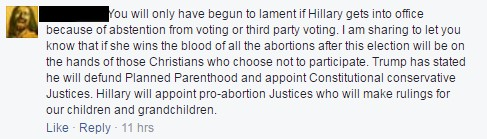
The force of this argument, as far as I can tell, rests on two concerns. The one is pragmatic—a third party candidate eats into votes that might have gone to Trump and so means that Clinton is more likely to win the majority and therefore the presidency. The reasoning here is that Trump is bad, but if he wins our values might at least get a seat at the table. If Clinton wins we’re cut out from power. A particular crux of this fear rests in the appointment of Supreme Court justices. The other crux of the argument though, and the one I think really drives people, is its moral force. We are citizens in a democracy. We are morally responsible for the course of our society, and the fear is that if we vote for a third party candidate we are morally responsible for a Clinton presidency. I have even seen one extreme example of this in a Facebook comment (in response to this post on Vox) that argued that Christians who choose to not vote for Trump will have “the blood of all the abortions after this election” on their hands.


It’s undeniable that some who present themselves as social conservatives want power for its own sake. However, I believe that most want a seat at the table because they believe in their cause and they are convinced that they are morally on the line for the likely Clinton victory if they don’t vote for Trump. I should pause here to say that while I am focusing in this post on the conservative viewpoint, these same principles apply its liberal mirror. Even Michelle Obama has told liberal voters that if they vote for a third party liberal candidate they are voting for Trump, and as with the conservative side, I believe the force here is both pragmatic and moral. Michelle Obama is pointing to Trump and asking liberal voters, "Do you want to be responsible for that?"

However, the moral force of this argument does not hold up under closer scrutiny, and when that crumbles I believe that any case for voting for Donald Trump (or Hillary Clinton if you're a liberal who finds her reprehensible) crumbles with it.

Before I get to the reasoning behind this argument, however, I need to make a point of clarification. I am convinced that both Hillary Clinton and Donald Trump are evil candidates. There’s been plenty of ink spilled on why that’s the case. Matt Anderson has a great post arguing that point on Mere Orthodoxy. So, I’m taking the evil of Clinton and Trump as an assumption for the purposes of this post. I know there are plenty of people who disagree and think either Clinton or Trump admirable. I am not writing to them. I’m writing to those who want to “hold their nose” and vote for Trump.
Voting for the Lesser Evil to Save Your Soul
With that out of the way, let’s get to the idea that if you vote for a third party candidate you are morally culpable for the ultimate election of Hillary Clinton, and that we should therefore vote for Trump. Put formally, the argument looks like this:
  1. A vote for Trump is a vote for an evil candidate.
  2. A vote for Clinton is a vote for an evil candidate.
  3. I am morally responsible for the evil of the candidate I vote for.
  4. A vote for a 3rd party conservative candidate is a vote for Clinton for which I am morally responsible.
  5. Clinton is more evil than Trump because her ends are more evil than his. I will vote for Trump.


I obviously agree with premises a) through c). I am convinced that we, as citizens in a democracy, have a duty to vote and share a responsibility in the direction of our society. I’ve already laid my cards on the table regarding how I feel about Trump and Clinton (personally, I think the premise that Clinton’s ends are more evil that Trump’s is debatable, but that isn’t my concern today). The real crux of the argument, I think, is the notion that if I vote for a candidate other than Trump, I am morally culpable for the evils of a Clinton presidency.

To understand the morality of this from a Christian perspective, we need to take a step back and consider the basic anatomy of a moral action. In the classical Christian tradition, moral action rests on the free human will working itself out in the world. An actions moral content rests both on the ends sought and the means taken to reach that end. Various Christian philosophers, from St. Maximus the Confessor to St. Thomas Aquinas, have broken up the process of willing in different ways, but the general principles remain the same. Human beings have wills. These wills are free, but not arbitrarily so. Rather, we see ends that we wish to bring about, contemplate some action to accomplish those ends, and then engage in that action. Moral goodness and moral evil are both possible at any point along this spectrum. If I plan to kill someone, think up the means, and try and implement those means, I have committed moral evil even if I fail to kill them. By the same token, if I will to bring about world peace but choose as my means the eradication of people who stand in the way, I have also committed moral evil.

At no stage in this process can I be morally culpable for things which happen outside of my will and the means I take to engage that will. To give an example, suppose one of my neighbors decides he very much wants my roommate’s television set. He has an end in mind (acquiring the TV), and has decided on means (burglary) which he engages in one night when no one is home. In this case, both the means decided on and the act actually engaged in are morally evil. That I happen to be out having dinner with my girlfriend when the crime occurs, (which makes it easier for him to commit the crime) in no way makes me culpable for his crime. I am not involved in the chain of cause and effect resulting from his will and ending in the burglary of a television.  In the case of the burglary, the person committing the crime is responsible for their own action. I am responsible for burglary only if I choose to burglar someone myself.  Even if a lot of people in my area decide to start burglarizing other people so that my area becomes an “unsafe neighborhood,” I am only morally responsible for the direct actions I take. Even the choice to go out for dinner with my girlfriend (despite the fact that I live in an unsafe neighborhood and there is a possibility my house will be burglarized) does not make me in any way morally complicit in the burglary.

So what about voting? Does my vote for someone like Evan McMullin count morally as a vote for Clinton if she wins? It should be fairly obvious that I am not  directly responsible for the votes other people cast. Imagine that my best friend loathes NAFTA and decides that the best way to get rid of it is to vote for Clinton, who he judges to have more political savvy. He has an end in mind (NAFTA getting abolished), means (the election of Clinton), and an act he engages in to bring about his end (voting for Clinton). At no point in this process is my will engaged, nor can I do anything directly (short of criminal interference) to prevent him from voting for Clinton.

The possibility remains, however, that by voting for someone other than Trump I could be engaging in a sin of omission. We can be responsible to act to stop a moral evil being committed, and if we don't act we are doing something wrong. For example, if I came home to find my neighbor stealing my roommate’s TV and fail to call the police or otherwise interrupt the burglary, I bear some responsibility for the evil that results. Yet, the reason I bear some guilt is that by coming home during the burglary I become directly involved in the cause and effect chain. As a witness to the crime, I therefore either engage my will to stop the crime or to consent to it.

I would argue that in the case of voting, no similar sin of omission is possible. When we vote, we engage in a very isolated moral scenario. We do not know for a fact how anyone else will vote. Individual voters decide indepently who they would like to represent them as the leader of their nation. When each individual voter has made their decision as to who to vote for, these votes are then added together state-by-state to determine who the States’ electoral votes go to. The electoral decision itself is thus not, strictly speaking, a moral one. No agent is, in and of themselves, choosing the state of affairs that come about. The electoral decision is like the case of the unsafe neighborhood. It is the result of many actions taken by individuals. As with the case of the neighborhood, I am responsible for the direct actions I choose to take. I am not morally responsible for the moral decision other voters make when they cast their vote, because there is no direct cause-effect relationship between my voting for, say Evan McMullin; three other people voting for Trump; and five more voting for Clinton. The fact that the outcome is an electorate that goes to Clinton is not a direct result of my vote, but of the combined results of our independent actions. As such, my action in that case can only rightly be construed as a vote for McMullin, not a vote for Clinton. Because the vote is blind, I act without direct knowledge of how anyone else is going to act. I can at best estimate based on past trends, but that’s not the same kind of moral action as directly intervening to stop a crime (the crime is an event occurring; the predicted statistical outcome of an election is a projection—a likely but still imaginary scenario). My action in voting for a third party candidate is more like that of the choice to go out to dinner with my girlfriend despite the possibility of a burglary. It is at worst imprudent. It is certainly not morally evil.

The Prudential Vote
The question of prudence, then, brings us to the possibility of voting for Trump for merely pragmatic reasons. I may not think I am morally responsible for the election of Clinton if I vote for someone other than Trump, but I may think that the ends I have (ending abortion, for example) are better served by a Trump presidency, and so the most pragmatic means to bring about my end is to vote for Trump. It is possible that some who argue that a vote for a third party is a vote for Clinton are simply saying so as shorthand for this kind of pragmatic reasoning and intend to imply no moral culpability in the election of  Clinton for those who vote for third party candidates. This pragmatic reasoning could be formalized as follows:
  1. A vote for Trump is a vote for an evil candidate.
  2. A vote for Clinton is a vote for an evil candidate.
  3. Trump is more likely to support the causes I agree with.
  4. It is pragmatic to vote for a candidate who will support the causes I agree with. I will vote for Trump.

Yet, this kind of reasoning runs afoul of the classical Christian understanding of moral action described above. Moral evil is not merely relative to the ends I have in mind. The plans I come up with to reach that end and the means by which I engage those plans in the real world also have moral content. Going back to our example of burglary—if I stumble upon the burglary in progress and decide to stop it by torturing the burglar, I am guilty of moral evil. Indeed, the bulk of the Christian tradition would say that if torturing the burglar were somehow my only way to stop the burglary, then it would be better for me to allow the crime to take place than engage in evil to stop evil. In the case of voting, if Trump is evil and I intend to use him to reach the end I desire, my means are evil. Even if my end is something laudable, such as ending abortion, I am culpable for moral evil if I choose evil means to bring it about.

Indeed, this ultimately makes the point that even if the information available to me, such as polling data, so involves me in the chain of cause and effect that a failure to stop the election of Clinton by voting for Trump is something I would be morally culpable for, I could still never be justified in choosing the evil means that a vote for Trump represents.
Conclusion
So, to summarize, you are responsible for the decision you make in voting, not the decisions others make, and choosing an evil candidate simply to stop a worse one is operating in a utilitarian mode that is at odds with Christian ethics. As such, the only real option for Christian voters is to vote for the candidate they consider to be the best potential leader for our country, not to vote for the lesser of two evils. As far as I’m concerned, that means voting for a third party candidate. This is true even though the moral decisions of others will probably mean a candidate. Which candidate is best, of course, still remains for you as the voter to judge.

Thursday, July 19, 2012

Colonization According to My Tin Poetic Ear

Gary Halvorson, Oregon State Archives [Attribution],
via Wikimedia Commons
Warning: This post discusses sexual violence.

In my last post I wrote about why, in the plainest English possible, I found the recent Gospel Coalition complimentarian post disturbing. I wrote it because I felt their defense in response to the outrage had completely missed the point. Anyway, earlier today I read this post, which I felt did a much more thorough job of explaining the problem, and in the meantime defending egalitarianism, than I had done.

Reading this post led to a discussion with one of my roommates, and brought up some points I had glossed over in my last post. I mentioned in my footnotes that the language of colonization and conquest really are a problem, because no matter what you intend to be saying, the realities of public language can mean you're saying something quite different. I would think that at least the problem with the language of conquest should be obvious. War is hell, conquest is brutal. The connotations of that language can't be anything but dark.

Yet, I'm inclined to think that the language of colonization is actually more disturbing, precisely because of the dissonance between its myth and its reality. The myth of colonization is one of brave men and women making a virgin land fertile. The reality was white settlers taking land that already belonged to other people, destroying those people and then reshaping the land in their own image.

 So with the language of colonization, you bring in a metaphor that is, as my roommate pointed out, very appropriate for patriarchy, but also very disturbing. The one thinks he is simply taking something fresh and unclaimed, the other is brutalized and destroyed. There is no virgin land to be taken, a person is already there, and she has the right to that land. If she invites you in, well and good, but if you colonize then you violate her, plain and simple.

Perhaps I have, "a poetic ear like three feet of tin foil" but I do not think these implications can be missed. Do I think Wilson and Wilson were advocating rape? No. Do I think they intended their metaphors to carry these connotations? No, but they do anyway. Language is public, you can't bring in symbols without getting all their baggage. Moreover, a white man especially can't use the language of colonization without some very disturbing implications.

Wednesday, July 18, 2012

Victim Blaming, or Missing the Point Entirely

Image Taken from Restoration Community Church 
Warning: This post discusses sexual violence.

Today, a friend drew my attention to this post over at The Gospel Coalition, then Rachel Held Evans' response, and finally TGC rebuttal.

In the original post, TGC writer Jared C. Wilson writes about the perverted sexuality of 50 Shades of Grey, and quotes from Douglas Wilson’s book Fidelity: What it Means to be a One-Woman Man. The quote, which I won't bother to reproduce here since you can read it both in the original post and in Evans' response, has caused a great deal of outrage.

The reason for this outrage is that Wilson and Wilson appear to be claiming that egalitarianism is ultimately responsible for the existence of rape, sexual violence and forms of sexual perversion that glorify them. In other words: victim blaming. Again.

Wilson and Wilson, of course, responded to the outrage, but their response completely misses the point. They seem to think that they're being accused of advocating rape and other forms of sexual violence. I actually wouldn't be surprised if some people have accused them of it, since they use language of "conquest" and "colonization" in their description of "proper" sexual authority and submission,1 which would quite rightly upset some people.2 By-and-large, though, that isn't what people are complaining about.

People get that Wilson and Wilson are saying that rape and sexual violence is bad. That's hard to miss. Unfortunately, it's also hard to miss when Douglas Wilson says "Because we have forgotten the biblical concepts of true authority and submission, or more accurately, have rebelled against them, we have created a climate in which caricatures of authority and submission intrude upon our lives with violence." Wilson is, undeniably, claiming that egalitarianism creates the environment for sexual violence. He is saying that because woman desire something apart from the life of the curse, and desire to live in equality with men, rape happens. That is a highly disturbing thing to say, and I hope and pray Wilson and Wilson can come to see how horrifying what they're saying is.

I know complimentarians I respect. I don't think that point of view is inherently evil, though I do think it's wrong, but this is not merely complimentarianism, it's sheer unbridled patriarchy, and it's wrong.

________________________________________________

1. Douglas Wilson thinks that using these terms is okay because not all conquest and colonization is violent and destructive... apparently.


2. Just because you intend to be saying one thing, your text can still be saying quite another. In a world in which sexual violence is so prevalent, the use of terms like "conquest" and "colonization" for healthy sexuality is not okay, even if you think you mean something different by it. Language is public. 

Monday, January 30, 2012

The Passionate God


by Desconocido Francais [GFDL]1
via Wikimedia Commons
It is an old axiom in Christian theology, borrowed from the Greek philosophers but supported by scripture, that God is unchanging. The reason for this, on the philosophical side, is that God must by nature be perfect. Any change is, however, either a change for the better or for the worse. Thus, God is immutable. Some points about that idea might be argued, but by and large I agree with it and it is not the focus of my post today.

Rather, I want to address a particularly corollary of the immutability of God according to the Church Fathers and most who came after them - that God is passionless. Passions (or emotions) are themselves changes of state, encompassing certain physical and relational states experienced by the subject. Because they necessarily involve change, the Greek philosophers would argue, the passions are necessarily imperfections, and so God cannot have passions. This led to problems for the Church Fathers, who by and large accepted the Greek vision, but who also acknowledged the genuine incarnation of God as a human person who did indeed suffer. In explaining this, the Church Fathers appealed to Christ's nature as fully God and fully man. He suffered passions as a man, but not as God.

Many, including myself, later questioned this explanation. This, in turn, leads to questions about whether or not God's perfection can in fact be understood in the manner the Greeks understood it. I think the answer is both yes and no.

I say yes to the Greeks because I do believe perfection does in fact entail a kind of immutability. God, if He is truly perfect, cannot grow wiser, for then He would be less then perfectly wise. However, I think their understanding that all change is a change for the better or for the worse is at least partially flawed. For some things, the relative virtue of a change very much depends on that to which it stands in relation. For example, if I want to go to the store, which is to the right of where I am currently sitting, a turn to the left would be bad, while a turn to the right would be good. Lacking a goal, any turn would, of course, be neutral. This, as of yet, does not defeat the Greek's point. For, that I can turn either to the better or to the worse relative to my goal and I am thus not in the best of all possible positions (i.e. perfection) in which no change could either improve or worsen by case.

What then, of passions? Passions themselves are, I believe, good or bad depending very much on circumstances. Fear is a good and appropriate emotion when faced with danger, but bad if it is in response to something neutral or helpful. Important in the world of passions is the conditioning of the emotional system. The perfect emotional being would always have the proper emotional response to every possible stimuli. Few of us, of course, have this. Even the most healthy mind might find itself experiencing fear at a needle bearing beneficial medicine. The point here is that fear is always good/right/fitting when facing genuine danger and always bad when not facing genuine danger. Though our emotional lives are often an admixture of the good and the bad, there is an ideal emotional state in which a change in emotions is not a change for the better or the worse, but simply the appropriate response to the stimuli at hand.

My contention is that God, especially an incarnate God, can in fact have passions without those passions being changes for the better or worse, but instead appropriate. It is appropriate for God to have anger at sin, love for His creatures and joy in their salvation. Moreover, if God incarnates, then it would be appropriate for Him to experience fear at the threat of crucifixion or anger at corrupt and heartless religion.

Divine passions would, of course, not look fully like ours (human language must always fall short in describing the perfect being afterall). Certainly, God the Father would not experience the physical change of state that we associate with emotions. Questions of temporality come in too, but dealing with that is outside of the scope of this article.

So is God immutable perfection? Yes, but that does not mean he is without appropriate passions. Understanding always, that until we meet Him face to face, we always see as in a mirror darkly (1 Corinthians 13:12).
_______________________________________________________
1. By English: Unknown Español: Desconocido Français : Inconnu (Luis García (Zaqarbal), 27–September–2008) [GFDL or CC-BY-SA-3.0-2.5-2.0-1.0]

Tuesday, August 16, 2011

Is Doubt Faith's True Method?: A Lesson for Michael Patton from Aristotle

By After Frans Hals [Public domain],
via Wikimedia Commons
Michael Patton over at Credo House Ministries recently wrote a post that's been getting a lot of attention in the biblioblog sphere. In it, he argues that Roman Catholic scholarship is fundamentally an oxymoron.

Patton argues that Descartes method of doubt, though flawed, provides the basis for what constitutes scholarship. We doubt that we might know better. Since Roman Catholics, apparently, aren't allowed to doubt, they're simply going to end up defending preconceived notions. This, Patton says, is not scholarship, and if anyone who identifies as a Roman Catholic doubts, they obviously aren't a true Roman Catholic.1

There's plenty of critiques to be made of his argument, and indeed many have already been made. Rod at Political Jesus has critiqued the notion of intellectual freedom inherent in Patton's definition of scholarship. Jeremy of Unsettled Christianity criticizes his view of what Roman Catholicism is, and Brian of Near Emmaus argues that if Patton's notion of scholarship would also condemn Evangelicals. My friend James Arnold will also being discussing the post on Evangelical Outpost later today discussing Patton's notion of scholarship.

I'd would also like to discuss the notion of scholarship expressed here, specifically his application of Cartesian doubt. I will also explore an Aristotelian notion of sciences and apply it to the subject at hand.

I am no fan of Descartes, but Patton has, like many of his peers, misunderstood Descartes project. Yes, Descartes set out to doubt in order to find a firm foundation, but once that foundation was located, he felt secure in trusting it that he might build further upon it. Doubt for him was a tool, not a way of life as it was for the skeptics. This meant that doubt would eventually be left behind. Further, doubt only played a role in building up Descartes epistemology and metaphysics. It was not, for example, the driving force when he studied anatomy.

Descartes doubted everything he thought he could, came to the conclusion that he could not doubt his own existence, and using a very strange ontological argument moved from there to the existence of God. Once God was secure, Descartes felt he could securely believe in the existence of the outside world. On the basis of that security, Descartes could then rely on the apparatuses of that world (such as senses) without continuing to doubt them. Likewise, a Roman Catholic (like, say, Descartes) could begin by doubting the church, but after testing it come to believe in papal infallibility. Once that was done, papal infallibility could then be used as a firm basis for making other decisions about truth. I'm not saying anyone would be right to come to this position, nor that it could even be done. What I am willing to say is that we all do this in a myriad ways throughout our lives. The vast majority of things any of us hold to be true, we hold to be true on the warrant of others whose testimony we trust.

This brings me to the Aristotelian notion of science. Aristotle believed that there is a series of sciences, not just one, and that each had its own principles. The science of logic, for example, would depend on certain basic principles such as the law of non-contradiction2, while physics would depend on certain presuppositions about physicality. No science can critique its own principles, instead these are set by other sciences higher than it. For Aristotle these sciences existed in a strict hierarchy. At the top of all of these would stand metaphysics, and from that science you would derive the primary principles of the lower sciences. We might very well doubt the strict hierarchy of sciences affirmed by Aristotelian, but the basic principle seems firm. Good literary critique follows very different laws than good astrophysics.

We can even see the basic sense of how one science takes as givens what another asks as questions in modern physical science. A chemist, for example, will take as given the basic principles of modern physics, making use of them in doing his chemical work. Indeed, a given chemist will assume most things about chemistry to be true except the very specific things he is testing for.

So how does this apply to Roman Catholic Scholarship? For the Roman Catholic scholar, the major area of scholarship upon which his being a Roman Catholic could have any bearing would be theology. Theology, like logic or physics, is its own science and will have its own principles. But what are those principles? The fact of the matter is there's no easy answer to that question, and different faiths and denominations will have different answers to it. For the Protestant Evangelical, the primary principles for good theology will be sound exegesis of infallible scripture, likely coupled with certain basic Evangelical traditions and experience. The Evangelical can of course question these principles, but one can't rightly call him an Evangelical unless he accepts them. It is only once he does accept them that he is doing Evangelical Biblical scholarship. Likewise, the Roman Catholic confession comes with certain principles underlying its interpretation of the science of theology. This includes scripture, but also includes tradition and papal authority. The Roman Catholic can of course doubt these principles, but once he has accepted them he can freely use them, just as Descartes could freely use God in his philosophy once he was convinced of the existence of the divine. The Roman Magesterium leaves many questions in theology unanswered, and the Roman Catholic scholar can explore these questions freely, his method will simply be different and rely on dogmas established by the church (rather than scripture alone). This is a different scholarly method than the pseudo-Cartesian Evangelical one Patton favors, but it is no less scholarly than it. At least, it cannot be shown to be less scholarly unless we can discover a higher science that can show us definitively what the best principles are for theology.
_________________________________________________
1. Based on what he says in the comments, Patton's notion of what makes one a true Roman Catholic (or a true Evangelical, or a true atheist) is the specific propositional content of your beliefs. A Roman Catholic, on his view, has to believe everything the Magesterium teaches to be Roman Catholic. The problem is that this imports an Evangelical Protestant view of identity into Roman Catholicism. However, what makes one a member of the Roman Catholic faith is a much more ecclesial matter. If you are baptized as a Roman Catholic (in fact, if you're baptized in a Trinitarian format) you are a Roman Catholic. You may not be in perfect communion with the church, but your identity is set by the sacrament, not by the propositions you affirm.
2. An proposition cannot be both true and false at the same time.

Friday, August 12, 2011

My Body Before the Chasm

To say something painfully obvious - space is related to body. As embodied creatures, are mode of existence is inherently linked to the limits of physical presence, which in turn means our very identity is radically spacial. Yet, spatiality itself is hardly a fixed concept. Leaving aside issues of modern physics, the way we interact with space is shaped by the technological and cultural framework in which we find ourselves. The citizen of Rome, with access to its incredible system of roads, had a very different interaction with space than a medieval peasant who's life was likely to be constrained to roughly the same area in which he was born. Our modern world takes this to yet another extreme.

This fact was made very vivid to me on my recent trip to the Grand Canyon. The most striking thing was the raw experience of the canyon as an entity. This chasm in the earth, a mile deep and miles wide, was nigh incomprehensible to me, even as I stood before it. To say that I felt tiny before it is to make a nearly criminal understatement. And I don't just mean tiny in a physical sense, I mean existentially minute. Yet this very fact led to a distancing. My mind almost automatically tried to push the Canyon into familiar and manageable categories like paintings and photographs. I had to force myself very consciously to acknowledge the reality of the massive untamed space before me. And my friend's and I also turned very quickly to levity - planking near the edge of the Canyon, for example. I suspect this had a certain aspect of coping to it.

I've been reading Matt Anderson's book, Earthen Vessels and he relates in it his own experience of hiking in the Grand Canyon, and how it forced him to realize more strikingly his physical need for water. I suspect the act of testing your body against the size of the canyon would likewise help to make solid the reality of its massive scale. Yet, the very fact of my body prevented this experience - I am simply not fit enough to hike the Bright Angel trail.

At the same time as all of this was going on, however, there was also a shrinking of space precipitated by modern technology. For one, we left California on a Monday afternoon, spent all of Tuesday at the Grand Canyon (and even got a late start on that) then drove through the night at arrived back in California on Wednesday morning. All the distance from California to Arizona, which dwarfs the size of the Grand Canyon, became a matter of a couple of days and several cups of coffee. Likewise, all of us took a great deal of photographs, extending the moment of our time in the Grand Canyon forward in time, and seeking to share it with others. And I tweeted. And texted. For all the size and distance of my time there, it was largely collapsed by my ability to be in ready contact with others every instant.

I can't begin to imagine all the ways in which this expanding and collapsing of our bodily interaction with space has shaped us. We go about our lives in a world that is forever distancing us from our embodiment. We carry around the internet in the palm of our hands, the entire world never more than a click away. Yet, at times the world forces through, we encounter it in its raw untamable expanse and it humbles us, as did my experience with the Grand Canyon. The more technology advances, however, the rarer these experiences become. This is not an inherently bad thing, but it is dangerous lest we rush headlong into this future and forget what we are at our core. I think here of Thoreau's claim that "We do not ride on the railroad; it rides upon us."1 This, of course, does not have to be the case, but if we don't stop to think about it, if we do not go into this future with a solid anthropology, then I very much think it will be. Man will not make machines, they will make him. The experience of our embodiment is one of the most beautiful things about our nature, and it is an inextricable part of our being. If we loose sight of it, it will be to our peril.
_______________________________________________
1. Walden, Henry David Thoreau

Wednesday, June 29, 2011

Words are Deeds

Image from Jemima's Journal

"Words are deeds." This quote from Wittgenstein adorns the door of David Kaplan's office in the UCLA Philosophy department. But what does it mean?

Words are deeds because words change the world. They are not simply resounding sounds, nor are they merely matters of intention. When I ask you to pass me a pencil and you do, my words have altered the world. When I say words that call certain thoughts to your mind, my words have altered you. Of course, this also means your words can alter me. Indeed, over time words can transform us.

This is because we are, in the words of my friend Josh Charles, "captivated by language." It's not simply that we speak and listen, words are our world. Indeed, I believe that, at least on a conscious level, we even sense and emote through our words. My visual field is filled with a wealth of sensory information, but I hone in on part of it, and this happens in a large part by how I identify it. That is a person, that is a chair. These categories are linguistic. When I feel an emotion, say fear (at least if it is rational fear), it is not mere affect, but has semantic content. There is something which presents danger to me. Once again, categories. Language.

A further truth is that these words often shape us in ways we don't even realize. Words, in their fullest capacity, are not private entities. Neither you nor I, through our intentions, decide the meanings of our words, if that were the case we could not communicate. Instead, words are born out of community, out of interaction, and they therefore, in some sense, have a life of their own. This is why, if I say something insulting, it doesn't necessarily make it not hurt that I didn't intend it to be insulting. Words have their own power.

I've believed this for some time, but something has recently called to my attention just how true this is. My friends Judie and Josh1 began to criticize me for calling my female peers "girls." I'd talk about hanging out with a girl, being interested in a girl, etc.

"You mean a woman," they would say. So, out of respect for them, I started to work on calling my female peers women. I didn't really think much of it, after all, it was just a word. I didn't intend by "girl" to mean that they weren't mature, it's just how modern Americans talk. But a funny thing happened, as I made this change, and it took some effort, as overcoming any habit will, I found my psychology starting to change. The way I looked at my peers genuinely altered. They are adults, not children. What is more, it helped me to recognize that I am an adult. They are women. I am a man.

Again, there was no conscious attachment of "child' to my calling them "girls," but on some level my very use of that word shaped my world. The transition to calling them "women" had a similarly powerful effect.

So when you use words, think about them. They are far more potent than you realize. Words are your world. Words are deeds.
______________________________________________
1. I would very much like to thank Judie and Josh for getting on my case about my choice of words.

Friday, June 24, 2011

Flesh

From the Patt Morrison page

Warning: The subject of this post is somewhat macabre. If you're squeamish, you might want to skip this one.

From ossuaries to urns, one thing is certain, humans care for our dead. Egyptians mummified their Pharaohs because they believed they needed their bodies preserved for the after-life. That doesn't seem to be the case in most cultures, however. Most people seem to think that whatever preserves the person after death, if anything does, is gone from the body with death. Yet, in spite of that, we seem to recognize that the now dead body is an important part of who they were, and we honor that. Some of us bury them in graveyards facing east, others scatter their ashes in the sea. But, in some way, we honor them.

It wasn't surprising to me, then, that when Patt Morrison discussed a new funeral process on her show, reactions were mixed. The new process,called Alkaline Hydrolysis, liquefies the bodily tissues of a body, leaving behind only bones. It is, reportedly, a much more "green" process, than cremation. 

Some callers metaphorically shrugged their shoulders - "if its better for the environment, then why not do it, I'm gone from the vessel anyway." One caller in particular, however, a Jewish woman, was incensed, saying it was one of the most disgusting things she could imagine. The body is sacred, created by God, and should be treated as such.

She isn't alone in this reaction, as the Patt Morrison page reports "Catholics across the nation have raised ethical concerns" regarding this new process.

So, what do we do with this? I have to admit I'm not entirely certain. As a Christian,  I believe not only that God created all things, but that He became incarnate. The very creation of man by God gives the body a certain dignity, but the fact that God Himself shared in it elevates that dignity immeasurably.  What is more, I believe in the Resurrection of the dead. This means I believe that one day my body shall be raised to live in restored Creation with God. This means I am intimately tied to my body.

Of course, I recognize that bodies decay. In many ways, Alkaline Hydrolysis is simply sped up decay. The body I am in the Resurrection will not be of the selfsame matter that my body now is. Heck, my body in ten years won't even be the selfsame matter as it is now. So, I'm not an ancient Egyptian, I don't believe my body as such has to be preserved. Cremation and urns seem fine to me, as do many other funeral processes.

Yet, I worry that we are already far too inclined to view our bodies as things external to ourselves. Far too often we draw a line between our identity and our flesh - seeing the latter as merely a vessel we happen to inhabit. This line of thought is wrong, and part of me things this process carries something symbolic with it that reinforces this view.

In the end, I'm inclined to think that this process is fine so long as we find a way to imbue it with dignity. If we liquefy the bodies, dump the refuse down the drain and throw the bones in the trash, that seems wrong to me. We have to recognize the importance of our bodies. But maybe we can restore the practice of using ossuaries? Or find some new an inventive ritual to show that we recognize we are dealing with one of the most fundamental elements of a human being. But I'm not sure.

What do you think?

Saturday, April 30, 2011

On the Differences that Unite

By Christoph Michels (Own work)
 [GFDL , CC-BY-SA-3.0
or CC-BY-SA-2.5-2.0-1.0
 via Wikimedia Commons
Today, Rod over at Political Jesus gave this blog a much appreciated shout out. In the course of that post, Rod said something that got me thinking. See, he mentioned the post I wrote a few weeks back on etiquette. The post, as you may recall, was about the moral core of etiquette, but I also talked about how etiquette can become oppressive.

Or at least, that's how I saw it.

For Rod, it was a post about "how sometimes being polite can be oppressive." What for me was a post about how etiquette relates to morality was for him a post about oppression. This isn't to say that either of our readings were off of the text, all of it was there. Still, we approached the very same text and came away with two different  readings.

And that's a good thing.

Our world is filled with people from all sorts of backgrounds, with all kinds of values. Inevitably we will bring our own lives to any text (including the world). This might be seen as something that divides us, putting a wall of separation between us and those around us, but it doesn't have to be. In this world of differing values, the text mediates. Rod's and my reading of my earlier post were different, but they were both grounded in the text. Any reading, so long as it's actually a reading (and not an imposing, let's say) will ultimately be anchored in the word that stands between us.

This is an especially salient point for those of us trying to understand church catholicity. As Christians we are bound by scripture, creeds and traditions, but all too often we read them in widely varying ways. Too easily, these differences can divide us, but that central text is the bond of unity between us.

We all interpret differently, because we are all (thank God) different people, but that we interpret means there is a thing interpreted. There is a text, and it unites us.

Monday, April 4, 2011

You Ought to Ask Nicely: The Moral Core of Etiquette

Image from Legal Juice
Etiquette is a funny thing. We all act according to rules of etiquette, and are often somewhat offended if someone breaks them in our presence. At the same time, we've all run up against rules of etiquette foreign to us, and these often seem utterly alien, at times even offensive. I'll often eat with my elbows on the table, but from time to time I do so in the presence of someone brought up in a context in which that is not done. This experience of something being a thing we ought to do, combined with the realization of great variance in codes isn't something exclusive to etiquette.

On the one hand, the rules of etiquette seem to function something like a game. In games there are rules, you follow those rules so that the game is a good one, and infractions are a great offense. If I'm playing chess and I try and move my bishop forward horizontally, I'm breaking the rules of chess (at that point it might be questionable if I'm even playing chess anymore). Yet, etiquette seems importantly different than a game. Games have fixed points of beginning and ending. Outside of the game, one isn't held to their rules. No one forces the chess-playing Bishop to always move diagonally. Conversely, etiquette is a game all society plays.1

Yet, we generally seem to think etiquette is quite different on the other end from morality. There is a huge gap between "You ought to ask nicely" and "You ought not kill strangers." Though we vary on this, most people think that a prohibition against murder or slavery goes beyond society. If a society institutionalizes slavery, it has committed a moral infraction. It hardly seems possible for a whole society to breach etiquette.

So etiquette seems bigger than a game, and smaller than a moral law. It tells us things we should do, but those things often seem utterly arcane. To some, this means etiquette is at best a nuisance and at worst tyrannical fraud.

Why should we be polite?

I believe that there is a moral core to etiquette. Etiquette is a kind of language, specifically, it is a language that says "I respect you." This can work itself out in all kinds of ways, from not swearing to not putting your elbows on the table. The "grammar" of this language is always changing. You do violence to etiquette when you refuse not to swear in front of grandma, but you also do violence to it when you put it in a book and insist that these are the rules of polite society that you must always follow.

There's a darker side to etiquette though. The language of respect can become a language of despotism. Etiquette is good when the respect is equal, but it can set up one individual to be inherently over the other. It is this kind of etiquette that says the southern black man must always sit in the back of the bus. When etiquette becomes this it has subverted its purpose, it has become a moral monstrosity instead of a sign of respect.

You ought to follow etiquette, but do so only insofar as it shows respect. If etiquette in turn becomes a tool for bondage, throw it off. 
____________________________________________________
1. There are "mini societies" that have their own etiquette, such as clubs. 

Tuesday, March 22, 2011

God's Will is Not a Triangle

William M. Connolley at the English language Wikipedia
[GFDL (www.gnu.org/copyleft/fdl.html)]
 via Wikimedia Commons
I used to be to be an open theist.

I'm not anymore, and I decided I should do a series of posts as to why. Let me be clear, I think open theism is a valid interpretation of the Christian creed and narrative. I just think it's wrong.

One of the more prominent open theists is Greg Boyd. Though I often disagree with him, I think he's a fantastic theologian, so I follow his blog. Recently, he did a review of The Adjustment Bureau, and used it as an opportunity to discuss his views on divine sovereignty. During the review he said the following:
Indeed, both groups often wallow in the “mystery” (nonsense, in my opinion) of how determinism and free will are “two sides of the same coin.” ... free choices can’t be predetermined for the same reason triangles cannot be round and bachelors cannot be married.
That is basically true when things are put in those terms, but it's also a bit of a straw man. Specifically, in using the terms determinism and free will, Greg Boyd sets up two terms which are, it is true, definitionally opposed. This isn't, however, what those who advocate a "mystery" approach to the relationship between divine and human will are talking about. The divine will controls what happens in the world, we also, in some sense choose. To speak of our choice being logically determined by God's will is to miss the point of the mystery.

To understand this, let's look at one of the parallel examples Boyd gives - the round square. Generally speaking, Christian theologians have held that it would be impossible for God to create a round triangle. God is omnipotent true, but that doesn't mean He can do what is logically impossible. Or, put another way, the round triangle is nonsensical. It doesn't even make sense to ask if God could make it. The definition of triangle excludes round, and vis versa.

On face value, the same thing happens when we talk about wills. If I will to walk down the street, and you will to stop me, only one of us can get our way. Insofar as we understand wills, they can only be compatible if they are both going in the same direction

If God wills that I stop typing right now, and I will that I continue, only one of us can get our way, presumably God, since He is the omnipotent one. How then, is this any different than the case of the triangle? To answer this, I'll have to draw on the resources of Medieval Philosophy.

You see, the Medievals had a very robust doctrine of God's transcendence, perhaps sometimes a bit too robust. The question was, if God is so transcendent, how do we talk about Him? Various answers were given to this, and Thomas Aquinas's is one of my favorites.

Aquinas, borrowing from Aristotle, spoke of the different ways words can predicate. That is, the different ways in which a words can be applied to things. The first of these is univocal predication. When we univocally predicate, we apply the same word to two different things in the same way. When I say I am an animal, and the cow out by the roadside is an animal, I mean the same thing by animal.

Equivocal predication involves things like homonyms. We equivocally predicate "bank" of the side of a river and the financial institution.

Finally, there is analogical predication. A lecture I heard from historian of philosophy Thomas Williams put it this way. Imagine we're at a party, I take you over to someone and introduce him as "my rommate." Now imagine, instead, there is a picture open on my computer screen of a person, you point to it and as "who is that?" and I tell you "my roommate." The same predicate is being used in both cases, but it is being used slightly differently. In the first, the word directly refers to my roommate. In the second, it refers to a picture and through that picture to my roommate.

According to Aquinas, whenever we predicate things of God, we do so analogically. Our understanding of things is derived from the world, and so the meanings of our words derive from that world. God, on the other hand, transcends that world and cannot be spoken of rightly with the same words we speak of that world about. At the same time, that world was created by Him, and nothing exists apart from Him, and so we can speak of him in this analogical way.

The problem with the round triangle is that roundness and triangleness are two things existing in the same space, we're speaking of shape univocally when we talk about them. But things don't work that way with God, or His will. God's will is like our will, but just how that functions is a mystery. That what happens in the world is God's willing, and also our willing, is not impossible, because we do not mean the same thing when we speak of will in each case.

Theology (Guest Post): We Believe, We Acknowledge, We Look

By Ingersoll
 via Wikimedia Commons
I've been thinking a lot about what makes the church Christian. What is it that separates the line between orthodoxy and heresy? This was not simply a reflection of current events, but those events have certainly had an effect on it.

Last week, I wrote a post on the subject. That post came out of a conversation I had been having with my roommate Josh, in which I had used Wittgenstein to elucidate my understanding of the creed. Josh, who's blog you can find here, expressed similar ideas, but did it through Heidegger. I asked him to do a guest post on the subject as a follow up to my post. This is it.

We Believe, We Acknowledge, We Look: the Nicene Creed as Dwelling by Joshua David Charles

“Building is really dwelling.” With this simple mantra Martin Heidegger in his later essay Building Dwelling Thinking poetically meditates on how building things, building our dwelling places (homes, offices, metro stations, etc.), is already dwelling. That is, in this world, we are creatures who dwell, and we primarily dwell by making things to dwell in. Heidegger intends this in a broad sense—we dwell not just in our homes but also in our workplace and in our work, in art, in thought. Building things, whether that’s an actual home or any construction (systems of thought, class systems, artworks, social roles, anything really) is our primary way of dwelling in this world—our primary way of making ourselves comfortable, making this “place” a home.

Heidegger goes on to elucidate how any building, and therefore anything, is a site of dwelling. He uses the example of a bridge and defines its capacity as a dwelling point by how it gathers—namely, how “the bridge gathers the earth as landscape around the stream.” Before there was a bridge, there was no site for a bridge—these two emerged contemporaneously. Before, there were two strips of land and a stream that were in no way connected, nor disconnected; they were simply there. However, once the bridge began being built, the location at the same time started becoming a site. Suddenly the two strips of land became disconnected and “needed” a bridge in that “location.” What was once nothing becomes a thing—a site of dwelling:
“Before the bridge stands, there are of course many spots along the stream that can be occupied by something. One of them proves to be a location and does so because of the bridge. Thus the bridge does not first come to a location to stand in it; rather, a location comes into existence only by virtue of the bridge.”

All fine and good. But what does this have to do with creeds? Well, the Nicene creed is such a site of dwelling, such a location that gathers what appear to be disparate elements of faith into one concise whole. Rightly speaking, there was no “outside” of the creed, i.e. heresy, until there was a creed as a location, just as there was no stream to be crossed until there was a bridge. There was no concise narrative of the “Christian faith” until there was a creed to articulate it—that is, these ideas emerged contemporaneously, just like the building and the dwelling-ness of the bridge emerged contemporaneously. There was no apostolic church, no catholicity, no spirit which bound these together, and no “looking for the resurrection of the dead” until there was the Nicene creed which allowed these things to emerge as such. Creeds, in short, gather disparate ideas and snippets of faith into a whole, a unity, in order that these things might emerge as doctrinal and orthodox—in order that the creed might gather those who speak it into a unity and a whole.

Just as building reveals itself to already be a kind of dwelling, so too we find ourselves dwelling with others by speaking the creed. We share a site with them, inhabit a space, side-by-side. This happens regardless of what interpretation we have of the creed we share—because it is not in our thoughts or beliefs about the bridge that we dwell in it (although our beliefs and thoughts matter), but in our mutual building of it, in our crossing of it. It is by saying a creed together that we inhabit the same religious site. It is in the speaking that the creed becomes what it is and we become what we are as those who speak it. It is in the building, in the speaking, we find a home.

Thursday, March 17, 2011

Philosophy/Politics: Justifying Wickedness

Let me tell you a story. A long time ago, a great nation was embroiled in a costly war. For every inch of ground gained against their enemy, the nation lost many sons. But they would not back down, they would destroy whatever stood in the way of victory, because God was on their side. And they won, they found the key to victory, they slaughtered hundreds of thousands of the enemies men, women and children. They weren't soldiers, but it sent a clear lesson. We will do whatever it takes to win. The enemy surrendered, the great nation one. God was on their side.

When I tell this story, what is your reaction? Probably, you think the "great nation" acted monstrously. It killed civilians in the name of winning a war. It murdered to achieve its victory.

Unless of course you knew I was talking about the United States bombing of Hiroshima and Nagasaki. You're reaction might have been the same, but some of you will defend what the US did. I know because I've heard it. I know because, sadly, there was a time when I did it.

The logic goes something like this. It was sad, but it had to be done. More lives would have been lost if we hadn't. The Japanese were never going to surrender. They were going to give sharpened sticks to their women and children, fight for every inch of ground.

None of that matters. None of it matters because if using a weapon of mass destruction on a city can be justified, then any atrocity can be justified so long as the end goal is good enough (and presumably succeeds). Don't forget that the Nazi's committed their genocides in the name of establishing a lasting pax romana of German rule. If obliterating over 150,000 civilians in the name of wining a war is justifiable, surely murdering a few million Jews in the name of lasting world peace is. At the very least, surely torturing a few suspected terrorists or jailing a few uppity reporters is.

In the end, we justify the bombings of Hiroshima and Nagasaki not because they were right, but because they were done by us. We were the victors. God is on our side.

Friday, March 11, 2011

Philosophy/Politics: The Justice of War

I believe deeply in the sacredness of life; it’s why I’m a vegetarian, it’s why I’m against abortion, it’s why I oppose the death penalty. It is also what inclines me towards pacifism, but I find myself unable to call myself a pacifist.

War is horrendous. Death reigns, atrocities are committed. No matter how robust our notions of just war, there is something about the act of war that makes us forget our humanity. Even World War II, that epitomous symbol of just war, saw much evil on both sides. The Nazis had to be defeated. They were murdering human beings by the millions. The Japanese empire wasn’t any better. And yet, the Allies share their own sins – Dresden, Hiroshima and Nagasaki, internment camps, to name a few.

Inevitably, our justifications for war end up treating human lives as mere statistics. Ten can die that a thousand might live. More would have died if we hadn’t nuked Japan. This sort of think, to me, is abhorrent. It treats life as a strategic resource.

War assumes a genuine separation of us and them. It feeds on tribalism. Your people attacked our people, so we will avenge ourselves on you.

Pacifism also makes sense to me as a Christian. The Christian way is to conquer through submission, to love even our enemies.

Yet, there is another side to the issue. I recently read a post railing against pacifism. The post itself was quite deplorable. It treated pacifism as a sort of childish immorality. It acted as if this were some kind of easy question. Yet, something was said which carries a lot of weight for me. It is the same argument that holds me back from pacifism every time I hear it. It talked about the current situation in the Middle East. Civilians are rioting, trying to overthrow tyrants, and are being brutally beat down. Those who cannot defend themselves are being subjected to terrible violence, and we have the power to do something about it. Is it not an ethical duty for the strong to defend the weak?

I think it’s something of an illusion to think that any war has actually been fought for these reasons, but it remains at least a theoretical possibility, and one that strongly compels. At the very least, wars not fought for these reasons have had these results.

This makes becoming a pacifist a difficult, if not impossible, choice for me, but it doesn’t negate what was said at the beginning of this post. War is wicked and evil. War treats life as a matter of statistics, of us and them. But war also allows the strong to defend the weak.

In the end, I find myself befuddled. Either way I go seems to me a great evil, and I do not know how to decide between them.

Saturday, March 5, 2011

Philosophy: Smart Phones and Space

I love technology, computers especially. That isn't to say I'm the world's biggest tech geek, not by a long shot, but I'm a fan. I don't always rush out and buy the latest thing, but if I could afford it I probably would.

But I gave up my smart phone. Not only that, but I don't plan on ever having one again.

Don't get me wrong, I loved my smart phone. I loved being able to access the internet anywhere, play cool games, and all the like. It was an awesome toy, even if it wasn't the best smart phone, but something about it started to disturb me.

One of the things about human nature that I find incredible is our embodiment. Of course, this is something we often take for granted, and sometimes distance ourselves from, but it's an undeniable fact. We are bodies, we exist in a place and a time, and I think being present to that is immensely important. As I used my smart phone, I felt my connection to space and time slipping. I was always connected to the internet, I could always check my email or Facebook. Anytime I wondered about any random fact, Wikipedia was just a swipe of the finger away. These things in themselves were perfectly fine, but the accompanying loss of spatial and temporal presentness I felt was deeply disturbing to me.


Saturday, February 19, 2011

Philosophy: Objectifying "the" Environment

Of all of the debates that fall prey to absurd polemicism, protection of the environment is one of the worst. On either side of the debate, you seem to have people entirely incapable of discussing a concern that by all rights they should both share. The liberal side seems willing, at times, to die for the environment, and to treat as callous an evil anyone who will not. On the other side, concern for the environment is seen as a kind of pagan madness.

The problem in the debate about the environment is... well... just that - "the" environment. That we talk this way indicates a mistaken psychology. Speaking of "the" environment says that we have objectified it, made it into a thing other. It is that objectification which radicalizes the debate. Do we or do we not sacrifice to care for this thing. But the environment is not a thing, not in the way a shoe or a rock is a thing. It is not, properly speaking, the environment, but our environment. Our environment emerges out of a vast network of trees, and rocks, and people, our environment extends beyond us, it supports us, and, in shaping us, it is even a part of us. This is not the "our" of possession, but the "our" of inclusion, the our we use to speak of our own bodies - it is in us and we are in it. If we recognize this, the radicalism on both sides should disappear. We could not pretend it was a thing disconnected from us to which we owe no fealty, but we could likewise not see it as some static other to be nobly sacrificed to.

Friday, January 28, 2011

Life/Philosophy/Theology: Why I am a Vegetarian

Yes, for those of you who don't know, I am now a vegetarian. It's something I've considered before, and rejected. Rejected because I didn't want to be a burden to my family. But now I'm on my own, and it's a real possibility.

But why do it?

There's many reasons to give up meat - health, protesting the killing of animals, the price of meat, the desire to feel superior to others, etc.

I suppose there's a mix of all of those in my decision, but there are two specific things I wanted to share.

First, there is the matter of respect for life. Of all of the things in God's creation, life is perhaps the most incredible. I don't think there's anything inherently wrong with killing and eating animals, but I do think it needs to be done with respect. I don't think we do that anymore. We've industrialized the consumption of animals, and have thereby turned life into pure product. I think this is a problem, and I've chosen, as much as I can, not to participate in it.

Of course, there's a certain hypocrisy here, since plants are also life, and I do continue to consume them.

I have further chosen to make the giving up of meat into fast dedicated to God, and thereby a prayer. We typically think of prayer in mental terms, and that's a very important part of prayer, but it isn't everything. God is the creator of matter as well as thought, and just as we can direct thoughts to Him, we can direct actions. A little bit of discipline is a good thing in a life, and I have dedicated this discipline to God.

Friday, November 26, 2010

Philosophy: Freedom as Limits

We are only free in that we have limits.


What do I mean?

A little over a month ago, I wrote a post on homosexuality, and on what I see as a mistake in how the debate about it is usually conducted. I got many responses to that post (protip: if you want your blog to get a lot of hits, write on something controversial) and, in response to one of those, I wrote a comment about the relationship between genetics and choice. 


As I said in that comment, genetics are, in one sense, predetermining of the kind of people we will be. It might seem, then, that where genetics controls us, freedom is absent. Yet, I contend, there is a much more complicated relationship here, and, speaking more broadly, a much more complicated relationship between limits in general and freedom. 


Typically, we think of freedom, and consequently choice, as the ability to be free from constraints. Often, this is a metaphysical reflection on a political reality. A person held back by the law from driving 100mph down a busy street is not, in one sense, free to perform that action. And there is some truth in this, an utterly predetermined being, with no choice whatsoever in its course of action (for example, a rock) would in no sense be free.


However, there is a flipside to this. In having limits, I have something to act against, and that in turn actually gives me choice. Take the above mentioned case of genetics - genetics gives me a certain sort of body, and that body gives me limits (I can't fly or run faster than a locomotive), yet at the same time it is only in terms of that body that I can make many of my choices (whether to type and this computer or go for a jog for example). Without the limits of a body, the choices of physical actions would be meaningless. Likewise, the law may prevent me from going 100mph (without consequences) but this in turn means I'm free to cross the busy street without fearing a car barreling over me at 100mph. 


This last case also relates to a further point, that limits not only make us free, but they make us free to flourish. This is particularly true in the case of morality. Whatever your views to the objectivity of morality, anyone would agree that a person who feels protected from murder will be more likely to thrive (even though the choice of murdering another is thereby cut off to him). 


Further, if we have in mind any view of human nature in which men are fallible and liable to fall into grave immorality, whatever system or training helps that nature to take hold of its passions and become thereby better able to follow morality, even though it blocks off the former bad choices, creates in the man another kind of positive freedom.


Thus, freedom, at least for humans, seems to always exist in light of limits. Limits are a precondition for genuine choice1
_______________________________________________________________
1. I cannot claim these ideas as my own, though the specific expression of them, especially in terms of embodiment, is. I'm not sure exactly where I've picked up these notions, but I am aware that I have heard similar views advocated at various times and do want to give those individuals due credit to the best of my ability. It seems to me that Kant espouses something like this view in the last section of the Groundwork of the Metaphysics of Morals, though typical of Kant it is written in very obscure language that makes it hard to be sure. I've further heard a discussion of the difference between negative freedom (freedom from restraints) and positive freedom (freedom for a kind of action) given at certain times. One case was a Mars Hill Audio discussion, and another was in a discussion of the ideas of Phillip Blond. Finally, my wonderful Bishop and pastor Todd Hunter espoused a similar idea in a sermon while talking about training in virtue. This in turn, I am told, comes from Aristotle and can also be found in Anselm (and no doubt Aquinas).