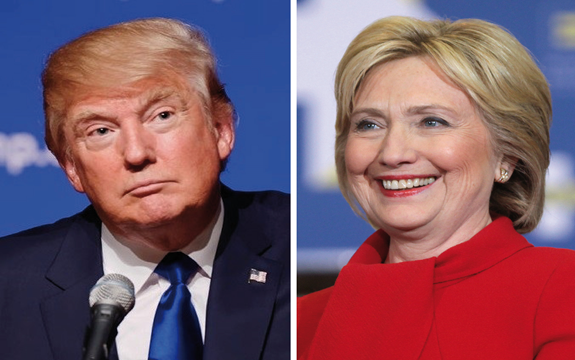
Most Americans are disgusted with the primary candidates this year. If you're a conservative like me, you've probably seen your fellow conservative Christian friends and relatives squirm while they tell you that we simply must "hold our nose" and vote for Donald Trump. They tell you, “Trump is awful, but I have to vote for him, I have to because the alternative is Hillary Clinton, and that's worse!” The fear is obvious, and understandable. Leaving aside issues of personal evil, Hillary Clinton supports values that stand at odds with the values of politically conservative Christians.
“Perhaps,” you suggest, “there’s another alternative. We could always vote for a third party.”
“No,” your friends and relatives tell you, “A vote for a third party is a vote for Clinton.”
The force of this argument, as far as I can tell, rests on two concerns. The one is pragmatic—a third party candidate eats into votes that might have gone to Trump and so means that Clinton is more likely to win the majority and therefore the presidency. The reasoning here is that Trump is bad, but if he wins our values might at least get a seat at the table. If Clinton wins we’re cut out from power. A particular crux of this fear rests in the appointment of Supreme Court justices. The other crux of the argument though, and the one I think really drives people, is its moral force. We are citizens in a democracy. We are morally responsible for the course of our society, and the fear is that if we vote for a third party candidate we are morally responsible for a Clinton presidency. I have even seen one extreme example of this in a Facebook comment (in response to this post on Vox) that argued that Christians who choose to not vote for Trump will have “the blood of all the abortions after this election” on their hands.
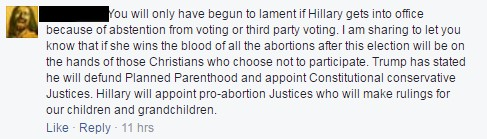
It’s undeniable that some who present themselves as social conservatives want power for its own sake. However, I believe that most want a seat at the table because they believe in their cause and they are convinced that they are morally on the line for the likely Clinton victory if they don’t vote for Trump. I should pause here to say that while I am focusing in this post on the conservative viewpoint, these same principles apply its liberal mirror. Even Michelle Obama has told liberal voters that if they vote for a third party liberal candidate they are voting for Trump, and as with the conservative side, I believe the force here is both pragmatic and moral. Michelle Obama is pointing to Trump and asking liberal voters, "Do you want to be responsible for that?"
However, the moral force of this argument does not hold up under closer scrutiny, and when that crumbles I believe that any case for voting for Donald Trump (or Hillary Clinton if you're a liberal who finds her reprehensible) crumbles with it.
Before I get to the reasoning behind this argument, however, I need to make a point of clarification. I am convinced that both Hillary Clinton and Donald Trump are evil candidates. There’s been plenty of ink spilled on why that’s the case. Matt Anderson has a great post arguing that point on Mere Orthodoxy. So, I’m taking the evil of Clinton and Trump as an assumption for the purposes of this post. I know there are plenty of people who disagree and think either Clinton or Trump admirable. I am not writing to them. I’m writing to those who want to “hold their nose” and vote for Trump.
Voting for the Lesser Evil to Save Your Soul
With that out of the way, let’s get to the idea that if you vote for a third party candidate you are morally culpable for the ultimate election of Hillary Clinton, and that we should therefore vote for Trump. Put formally, the argument looks like this:
- A vote for Trump is a vote for an evil candidate.
- A vote for Clinton is a vote for an evil candidate.
- I am morally responsible for the evil of the candidate I vote for.
- A vote for a 3rd party conservative candidate is a vote for Clinton for which I am morally responsible.
- Clinton is more evil than Trump because her ends are more evil than his. ∴ I will vote for Trump.
I obviously agree with premises a) through c). I am convinced that we, as citizens in a democracy, have a duty to vote and share a responsibility in the direction of our society. I’ve already laid my cards on the table regarding how I feel about Trump and Clinton (personally, I think the premise that Clinton’s ends are more evil that Trump’s is debatable, but that isn’t my concern today). The real crux of the argument, I think, is the notion that if I vote for a candidate other than Trump, I am morally culpable for the evils of a Clinton presidency.
To understand the morality of this from a Christian perspective, we need to take a step back and consider the basic anatomy of a moral action. In the classical Christian tradition, moral action rests on the free human will working itself out in the world. An actions moral content rests both on the ends sought and the means taken to reach that end. Various Christian philosophers, from St. Maximus the Confessor to St. Thomas Aquinas, have broken up the process of willing in different ways, but the general principles remain the same. Human beings have wills. These wills are free, but not arbitrarily so. Rather, we see ends that we wish to bring about, contemplate some action to accomplish those ends, and then engage in that action. Moral goodness and moral evil are both possible at any point along this spectrum. If I plan to kill someone, think up the means, and try and implement those means, I have committed moral evil even if I fail to kill them. By the same token, if I will to bring about world peace but choose as my means the eradication of people who stand in the way, I have also committed moral evil.
At no stage in this process can I be morally culpable for things which happen outside of my will and the means I take to engage that will. To give an example, suppose one of my neighbors decides he very much wants my roommate’s television set. He has an end in mind (acquiring the TV), and has decided on means (burglary) which he engages in one night when no one is home. In this case, both the means decided on and the act actually engaged in are morally evil. That I happen to be out having dinner with my girlfriend when the crime occurs, (which makes it easier for him to commit the crime) in no way makes me culpable for his crime. I am not involved in the chain of cause and effect resulting from his will and ending in the burglary of a television. In the case of the burglary, the person committing the crime is responsible for their own action. I am responsible for burglary only if I choose to burglar someone myself. Even if a lot of people in my area decide to start burglarizing other people so that my area becomes an “unsafe neighborhood,” I am only morally responsible for the direct actions I take. Even the choice to go out for dinner with my girlfriend (despite the fact that I live in an unsafe neighborhood and there is a possibility my house will be burglarized) does not make me in any way morally complicit in the burglary.
So what about voting? Does my vote for someone like Evan McMullin count morally as a vote for Clinton if she wins? It should be fairly obvious that I am not directly responsible for the votes other people cast. Imagine that my best friend loathes NAFTA and decides that the best way to get rid of it is to vote for Clinton, who he judges to have more political savvy. He has an end in mind (NAFTA getting abolished), means (the election of Clinton), and an act he engages in to bring about his end (voting for Clinton). At no point in this process is my will engaged, nor can I do anything directly (short of criminal interference) to prevent him from voting for Clinton.
The possibility remains, however, that by voting for someone other than Trump I could be engaging in a sin of omission. We can be responsible to act to stop a moral evil being committed, and if we don't act we are doing something wrong. For example, if I came home to find my neighbor stealing my roommate’s TV and fail to call the police or otherwise interrupt the burglary, I bear some responsibility for the evil that results. Yet, the reason I bear some guilt is that by coming home during the burglary I become directly involved in the cause and effect chain. As a witness to the crime, I therefore either engage my will to stop the crime or to consent to it.
 I would argue that in the case of voting, no similar sin of omission is possible. When we vote, we engage in a very isolated moral scenario. We do not know for a fact how anyone else will vote. Individual voters decide indepently who they would like to represent them as the leader of their nation. When each individual voter has made their decision as to who to vote for, these votes are then added together state-by-state to determine who the States’ electoral votes go to. The electoral decision itself is thus not, strictly speaking, a moral one. No agent is, in and of themselves, choosing the state of affairs that come about. The electoral decision is like the case of the unsafe neighborhood. It is the result of many actions taken by individuals. As with the case of the neighborhood, I am responsible for the direct actions I choose to take. I am not morally responsible for the moral decision other voters make when they cast their vote, because there is no direct cause-effect relationship between my voting for, say Evan McMullin; three other people voting for Trump; and five more voting for Clinton. The fact that the outcome is an electorate that goes to Clinton is not a direct result of my vote, but of the combined results of our independent actions. As such, my action in that case can only rightly be construed as a vote for McMullin, not a vote for Clinton. Because the vote is blind, I act without direct knowledge of how anyone else is going to act. I can at best estimate based on past trends, but that’s not the same kind of moral action as directly intervening to stop a crime (the crime is an event occurring; the predicted statistical outcome of an election is a projection—a likely but still imaginary scenario). My action in voting for a third party candidate is more like that of the choice to go out to dinner with my girlfriend despite the possibility of a burglary. It is at worst imprudent. It is certainly not morally evil.
The Prudential Vote
The question of prudence, then, brings us to the possibility of voting for Trump for merely pragmatic reasons. I may not think I am morally responsible for the election of Clinton if I vote for someone other than Trump, but I may think that the ends I have (ending abortion, for example) are better served by a Trump presidency, and so the most pragmatic means to bring about my end is to vote for Trump. It is possible that some who argue that a vote for a third party is a vote for Clinton are simply saying so as shorthand for this kind of pragmatic reasoning and intend to imply no moral culpability in the election of Clinton for those who vote for third party candidates. This pragmatic reasoning could be formalized as follows:
- A vote for Trump is a vote for an evil candidate.
- A vote for Clinton is a vote for an evil candidate.
- Trump is more likely to support the causes I agree with.
- It is pragmatic to vote for a candidate who will support the causes I agree with. ∴ I will vote for Trump.
Yet, this kind of reasoning runs afoul of the classical Christian understanding of moral action described above. Moral evil is not merely relative to the ends I have in mind. The plans I come up with to reach that end and the means by which I engage those plans in the real world also have moral content. Going back to our example of burglary—if I stumble upon the burglary in progress and decide to stop it by torturing the burglar, I am guilty of moral evil. Indeed, the bulk of the Christian tradition would say that if torturing the burglar were somehow my only way to stop the burglary, then it would be better for me to allow the crime to take place than engage in evil to stop evil. In the case of voting, if Trump is evil and I intend to use him to reach the end I desire, my means are evil. Even if my end is something laudable, such as ending abortion, I am culpable for moral evil if I choose evil means to bring it about.
Indeed, this ultimately makes the point that even if the information available to me, such as polling data, so involves me in the chain of cause and effect that a failure to stop the election of Clinton by voting for Trump is something I would be morally culpable for, I could still never be justified in choosing the evil means that a vote for Trump represents.
Conclusion
So, to summarize, you are responsible for the decision you make in voting, not the decisions others make, and choosing an evil candidate simply to stop a worse one is operating in a utilitarian mode that is at odds with Christian ethics. As such, the only real option for Christian voters is to vote for the candidate they consider to be the best potential leader for our country, not to vote for the lesser of two evils. As far as I’m concerned, that means voting for a third party candidate. This is true even though the moral decisions of others will probably mean a candidate. Which candidate is best, of course, still remains for you as the voter to judge.