Saturday, April 30, 2011

On the Differences that Unite

By Christoph Michels (Own work)
 [GFDL , CC-BY-SA-3.0
or CC-BY-SA-2.5-2.0-1.0
 via Wikimedia Commons
Today, Rod over at Political Jesus gave this blog a much appreciated shout out. In the course of that post, Rod said something that got me thinking. See, he mentioned the post I wrote a few weeks back on etiquette. The post, as you may recall, was about the moral core of etiquette, but I also talked about how etiquette can become oppressive.

Or at least, that's how I saw it.

For Rod, it was a post about "how sometimes being polite can be oppressive." What for me was a post about how etiquette relates to morality was for him a post about oppression. This isn't to say that either of our readings were off of the text, all of it was there. Still, we approached the very same text and came away with two different  readings.

And that's a good thing.

Our world is filled with people from all sorts of backgrounds, with all kinds of values. Inevitably we will bring our own lives to any text (including the world). This might be seen as something that divides us, putting a wall of separation between us and those around us, but it doesn't have to be. In this world of differing values, the text mediates. Rod's and my reading of my earlier post were different, but they were both grounded in the text. Any reading, so long as it's actually a reading (and not an imposing, let's say) will ultimately be anchored in the word that stands between us.

This is an especially salient point for those of us trying to understand church catholicity. As Christians we are bound by scripture, creeds and traditions, but all too often we read them in widely varying ways. Too easily, these differences can divide us, but that central text is the bond of unity between us.

We all interpret differently, because we are all (thank God) different people, but that we interpret means there is a thing interpreted. There is a text, and it unites us.

Wednesday, April 27, 2011

A Bit of (Unintentional) Evangelical Propaganda

Recently, I found myself reading the TV Tropes article on Christianity. Within the article, quite a few mistakes were made regarding Protestant sacrementology, particularly with regards to the frequency of belief in the Real Presence of Christ in the Eucharist (the errors have been corrected, I couldn’t help myself). The particular error is question is the claim that a belief in Real Presence is largely a Roman Catholic phenomenon largely unheard of in the Protestant church. That TV Tropes made this error is not particularly troubling, it is after all a wiki without any particular checks on correctness. However, I find that this particular mistake is very common within Evangelical Protestant circles. I recently had a conversation with a friend (and not by any means an unintelligent friend) who was completely unaware of the fact that Luther had argued vehemently for the actual presence of Christ in the Eucharist. It seems to me that it is a piece of unintentional and very successful propaganda we have told ourselves.

The fact of the matter is that even if we leave aside the Eastern Orthodox church (whose existence many Evangelicals seem to be unaware of), the doctrine of Real Presence is far from rare. According to Wikipedia, there are 752 million Protestants (if we include Anglicans in that number1) in the world. Of those, 337 million are Anglican, Lutheran, Methodist or Reformed, all of whom profess some sort of belief in Real Presence.2

I would imagine that this misunderstanding arises for two reasons. First, because almost all Protestants do, in fact, reject the particular formulation of Real Presence confessed by the Roman Catholic church – namely transubstantiation. This is not, however, the same thing as rejecting Real Presence and being a mere memorialist. Second, because the "lower" church Christians who reject Real Presence tend to have a greater number of denominations as a result of the fact that they tend to be more fundamentalist.3

This mistake is serious because Protestants, whether they should do so or not, will oftentimes reject doctrines seen as mainly Roman Catholic without even giving them consideration merely because they are “romish.” However, if they take seriously the fact that a huge number of Protestants, who uphold the sole authority of scripture, affirm Real Presence, then they should give the doctrine a real look.
_____________________________________________________
1. Wikipedia does not, but I will.
2. This isn’t a scientific study, it’s quite possible that some of the sub-denominations of these groups don’t profess Real Presence. Regardless, the point is that around half the Protestants in the world profess Real Presence.
3.  It seems that the more fundamentalist a church, the more frequently it fragments.

Sunday, April 24, 2011

Alleluia! He is Risen!

The king who was dead now lives forever. He reigns incorruptible. And now we, who have through the sacrament of baptism died in Him now live with Him, and at the last day we shall be raised. As my friend said on Twitter, You are risen!

I will have more to say on Easter later, but I wanted to put up this shout of celebration. Below is a song I have always loved as a beautiful celebration of this day.


Go, you who were dead, and celebrate that you now live.

Alleluia! He is Risen!

Saturday, April 23, 2011

Sitting in the Dust

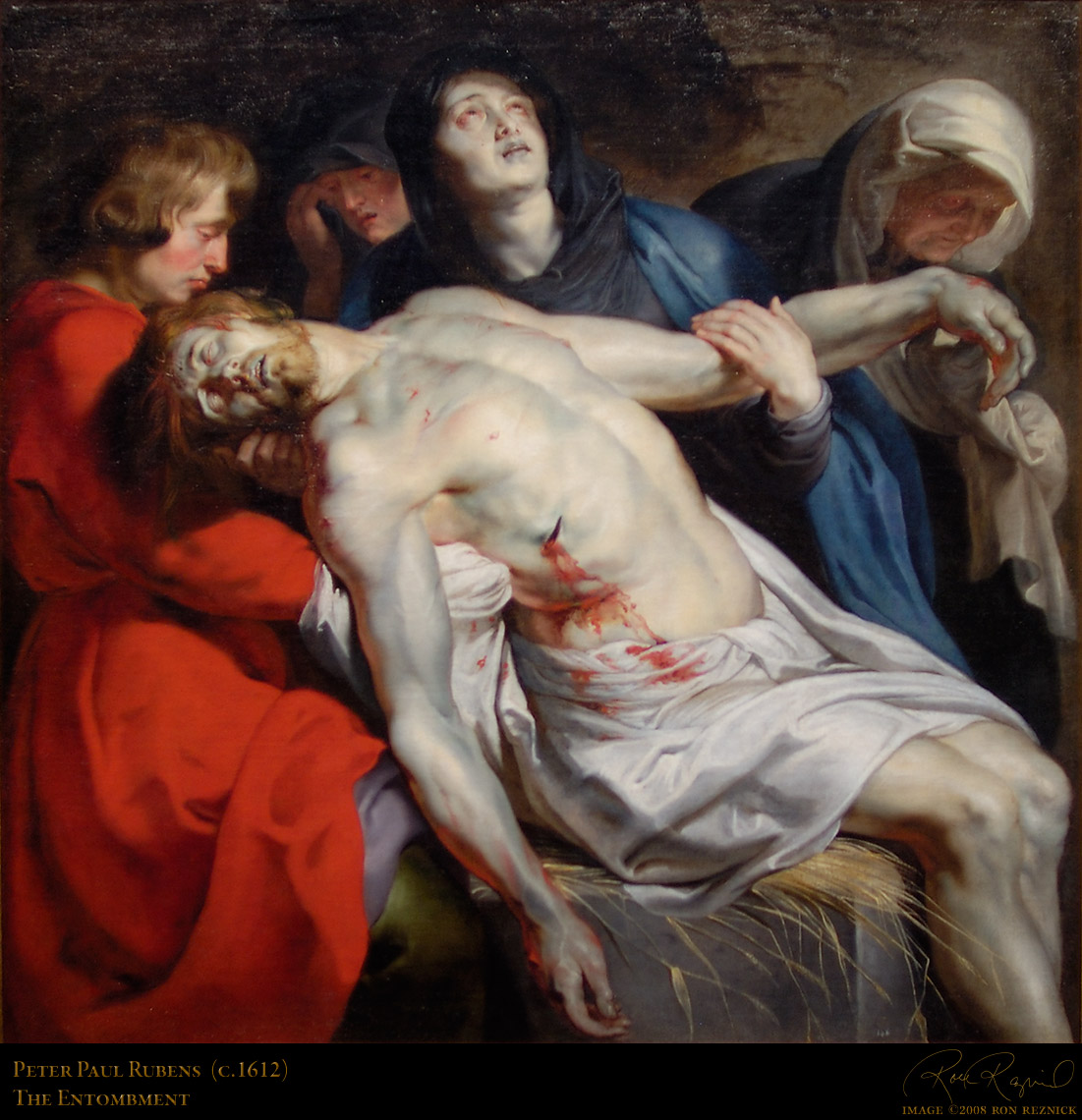
The Entombment by Peter Paul Rubens
from Digital Images
Today is the day we call Holy Saturday. We call it so, because it is a remembrance of the day Christ body lay in the tomb, and His spirit "descended into hell." For us, this is a day of hope, for we know what is just around the corner.

But we must not forget the gravity of this day. We must not forget what Holy Saturday was for the disciples, whose hopes had been dashed. We must not forget what it was for his mother. God gave me this child, He told me He was the child of promise. How can this be? 

Holy Saturday is the day of Job, where we all lie in the dust of our lives, covered in boils, having lost all that is dear to us. 

We must not forget the gravity of this day, because it is in this day that many in the world live. They live day today only with death their only certainty, and hope but a memory. Even for many in the church, it is easy to forget the promise of the Resurrection when we see the horror of suffering in our world. 

Holy Saturday is important, because it is the day in which God sits in the dust with us in our despair. On Holy Saturday, God did not come in a whirlwind and speak of the wonders of creation. Instead, He was pulled down to the very depths of Hell. "I am in fidelity with you in your suffering" declares God. This is the first answer to the problem of evil. 

Let us never forget to sit with those that suffer, to be with them in the reality of what they face. If God did not see fit to trivialize suffering, but instead to take it upon Himself, let us do no less. 

Friday, April 22, 2011

Three Good Friday Meditations

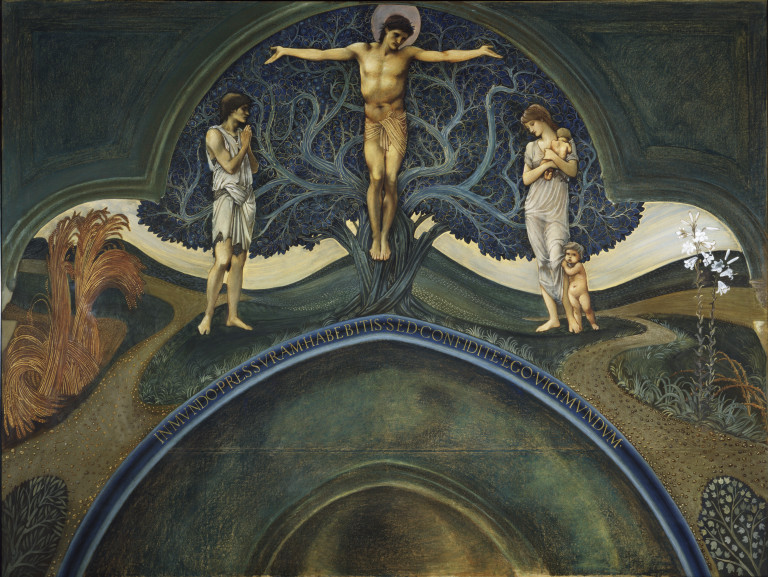
Tree of Life by Burne Jones
from V&A

Death

In the beginning God created the heavens and the earth.

And it was good.

And He walked with man in the garden.

And in the middle of the garden stood a tree, its fruit pleasant to the eye. God told man not to eat of the tree, but the serpent whispered to man "You will be like God."

So man took the fruit of the tree that day in the garden.

And man died.

Wherever he went, death followed in his wake. The earth did not give up food without toil, and the food bought with sweat would just as quickly rot away. Birth came with suffering and pain, and the children lived their lives in the valley of the shadow of death.

Then a Man came, a Man who was also God. This God-Man walked the wasteland of death. He knew His purpose, and with resoluteness He walked towards it. The God-Man took the wine, born of the rot and the bread born of toil, and declared it to be His body.

Then the God-Man went to the tree.

And God died.

Desecration
Piss Christ (Vandalized) by Serrano
from Art Observed

They did not know what it was they were doing. They beheld a man, a dirty carpenter from Nazareth, and he called himself God.

Could you imagine? The Holy God of Israel coming into the world of dirt and blood and flesh. It would be as if the most holy found itself submersed in piss.

So they did what any one who honored God would do, the scarred that which desecrated their God.


Black Box
From Wiki Answers
Darkness

God died, and darkness covered the land. 

God died, and the veil was torn. 

In time, we would come to see this for what it was. The death of death itself. The end of the separation between God and man.

But it was not this yet. The veil was torn, and it showed the holy of holies. It showed the place where God had once dwelt in His glory. 

It tore and it showed the temple which for hundreds of years had stood empty of His glory. 

Sunday, April 17, 2011

Liturgical Colors

If you actually read my blog on this site (as opposed to a feed reader) you've noticed that I've changed the design template to a red and purple one. These are the colors of Holy Week, and it seemed appropriate to reflect that on this blog. Depending upon how I feel about the change, I may create a template that reflects the Easter season, or I may return to my regular template.

Palm Sunday: The Duality of Holy Week

Today Holy Week begins. Today we are on the road to Easter, but first we must go through the cross. This is the most intense week in the Christian year. Not only in terms of the business of those who work in the church, though that is certainly true. This is the most intense week because this is the week when it all comes together. All the symbols of the Christian narrative are pulled together this week as the rhythm of the liturgy reaches its climax.

This is the week of Christ's death, mere days before his Resurrection. Sorrow and rejoicing, bitterness and light, wedded together by a mere span of days.

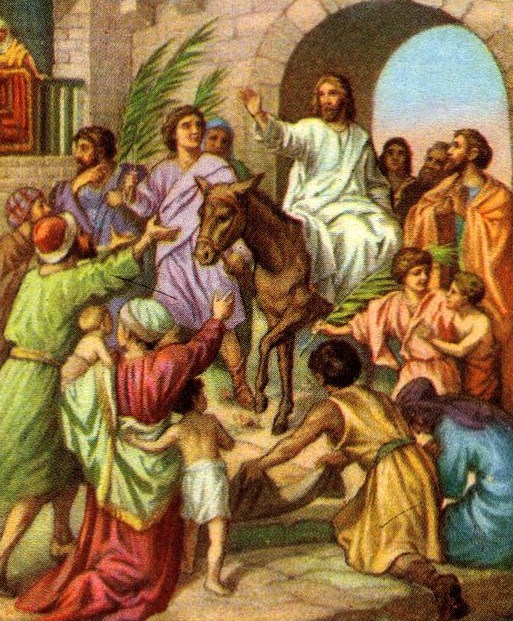
Today, Palm Sunday, is a sort of second Christmas. Today Christ is born, not to flesh, but to the people of Jerusalem. Today the people adore him as the shepherds and the magi adored his birth. Today we welcome him in, singing praise to him.

"Hosanna! Blessed is he who comes in the name of the Lord."

But soon we will cry "crucify him," indeed many of us already have in the Palm Sunday liturgy.

Let us, then, approach the cross in silent reverence.