Wednesday, July 6, 2011

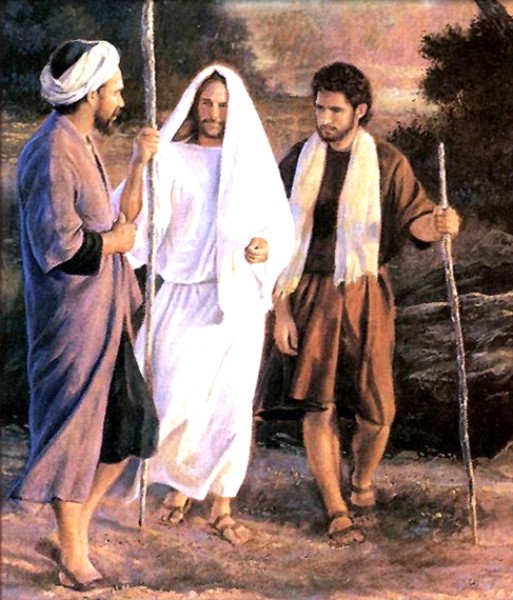
The Road to Emmaus

Image taken from MariaKumar.org
The Incarnation, Resurrection and the Eucharist are three of my great theological passions. All of them are about Christ's presence, the affirmation of Creation through the joining of the glory of God to the world. They are beautiful. This morning, I was reading the Lectionary readings, and the gospel was Luke 24:12-35. The story here is that of the disciples on the road to Emmaus, a story which brings all three of these elements together.

Two disciples, unnamed, are going down the road to Emmaus, when Jesus joins them on their way. They do not recognize him, perhaps because His Resurrection body has changed Him so, perhaps because He chose to hide Himself from them. Who knows?

They tell Him about the death of Jesus, astonished that He has apparently not heard of it, and go on to tell Him that some of the women reported that He was missing from His tomb, and that angels had reported Him raised from the dead. Jesus, His identity still hidden, goes through the Scriptures and reveals to them all the prophecies revealing that the Messiah would have to die, but would be raised again. They then invite Him, still a stranger, into their home.

It is then, when the meal is being shared, and Christ breaks the bread, that He is revealed to them.

What I find fascinating here is that the presence of Christ in their lives is not revealed to them when He walks and talks with them, it is not revealed to them when He shows himself to them in scripture, but it is instead revealed when He breaks the bread. Christ's bodily presence is revealed to them by the Eucharist.

Now, I do not think that the Eucharist alone could have revealed Him. Christ first had to be Incarnate, and, of course, having died had to be Resurrected. What is more, to know His nature they had to be shown His presence in scripture. The Ministry of the Word and the Ministry of the Table had to come together to reveal the Lord, and both of these ministries had to be joined together by the incarnate God. It is almost as if, the Eucharist is here Christ-Fully-Man and the Word is Christ-Fully-God, and when both are revealed to the disciples, then they know Him as He is.

Tuesday, July 5, 2011

The Rage Against God: How atheism led me to faith by Peter Hitchens

From Tower Books
Peter Hitchens, the brother of famed atheist polemicist Christopher Hitchens, tells the story of his personal journey to faith in the pages of The Rage Against God: How atheism led me to faith. This story is a fascinating and brilliantly written one, and well worth reading.

That is not to say it is a perfect book. Far from it. It strikes me that Peter is definitely of the same seed as his brother, and at times The Rage Against God can certainly descend into polemic mirroring his brothers, though always filled with more charity. I do not think this book is the sort that would persuade anyone to faith, nor, in fact, does Peter. This is his story, and when it focuses on that it is at its strongest. As such, the beginning section where Peter tells his own story, and the final section where he reflects closely on the case of Soviet Russia (a world he lived in for quite some time as a reporter) are the best parts of the book. In the middle, Peter goes through a rapid-fire examination of some of the more famous arguments of the "New Atheists," and while it is interesting I doubt it could change anyone's mind.

The personality that comes across in the book also varies. At times, Peter seems the compassionate prophet, concerned deeply with the decay he has seen progress in his society during his lifetime, targeting genuine problems and weeping for his nation. At other times, Peter can come across as an old cranky man complaining about this new-fangled modern art.

But in the end, reading this book, I find myself quite likely Peter, and his command of prose is to be envied. I also share with Peter his largest concern, the fear over the totalitarian nature of the New Atheist rhetoric. On my good days, I like to think the best of Richard Dawkins, Christopher Hitchens, and their ilk. I don't believe they have any desire to harm the religious, though they certainly seem to fear us. Yet, their language carries with it the seeds of just such injustice. The world is broken, they rightly say, and it could be made better if only religion were gone. Of course, religion is not something that stands on its own, religion is only there because of the religious, and so they are the ones in the way of utopia. That is, as Peter points out, always the language of bloody revolutions, "the world would be perfect if only these people were gone." Again, I do not think Dawkins or the elder Hitchens want this, nor do I think Peter believes they do, but it's only a matter of time until the language they use inspires someone to think in just such a way.

 So, pick up this book if your interested in the heart and journey of a man so close to one of the vanguards of the New Atheist movement. In many ways, Peter is man Christopher might have been had he taken a different road. Don't expect to be persuaded one way or another on the questions he addresses, but enjoy the exploration of the man's heart and his skill with words.

Friday, July 1, 2011

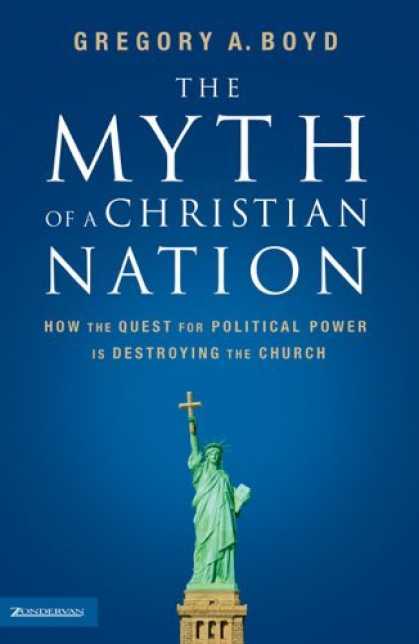
The Myth of a Christian Nation by Greg Boyd

Image taken from Cover Browser
It's no secret that the "evangelical voter" is a big ticket in American elections. I have no idea how much money is spent trying to win them over, but I'd bet quite a bit that it's a large sum. A large part of the rhetoric employed in this campaign involves the notion that America is, or was, a Christian nation. Of course, lots of ink has been spilled arguing that this neither is nor ever was the case (the founding fathers were deists, America was founded to be a secular nation inspired by the writings of Locke and Montesquieu, etc.) In many ways, Greg Boyd's book The Myth of a Christian Nation is yet another text of this sort. However, Boyd is not only arguing that America is not and has never been a Christian nation, he is arguing that it can never be a Christian nation.

The center of Boyd's argument is that Christianity is centered around living the example of Christ. Christ did not conquer through power or force, but instead overcame through the crazy, irrational act of submitting himself to death on a cross. Christians, Boyd argues, are to follow in his footsteps, changing others lives through the "power under" force of sacrificial love, instead of the "power over" force of the sword.

Boyd's argument here is strong. It is certainly true that all governments are held up by the sword, even those governments that use it sparingly necessarily have it. It also seems equally true that Christ commanded us not to resist evil, to love our enemies, etc.

It is important to note that Boyd doesn't think we, as members of a democratic nation, to refrain from participating (except in wars it seems), but that we should clearly understand the difference between the good work our government does, and the work of the kingdom. This is, perhaps, were things become less clear. I'm simply not sure how one is supposed to play both involve oneself in government, and yet treat it as something totally different than one's Kingdom calling. Ultimately, the Kingdom of God is supposed to be a redeeming power, making everything new, including, I would think, nations.

There are a few other places where I find his arguments to be problematic, if for no other reason than the tactics he takes. For example, he falls into the obnoxious tendency of seeing the pre-Constantinian church as some sort of idyllic model of what he thinks Christians should be - ignoring both its flaws and the possibility that the Church is a maturing entity.2

It is important not to conflate what Boyd is arguing for here with a simple notion of "separation of church and state." Yes, in the end, that seems to the practical import of it, but what drives it is quite a different matter. This is not about political or religious freedom, but about the nature of God's Kingdom.

In the end, I think much of what Boyd draws out here is true, and should be taken seriously. Governments are violent, nations are tribal. However, in the end, we think we should interact with them, we should never conflate them with the mission of God in this world. Doing so leads to the commitment of all kinds of atrocities. The job of the Church is not to preserve the moral fiber of an immoral world, but instead to love directly. And that, in the end, is I think the most important lesson of this book. It's far to easy to judge from a distance, to do "moral work" through the proxy of government. Of course, governments are moral agents, since laws are inevitably moral in nature, but our job as Christians isn't necessarily to police that agent. Instead, our job as Christians is to get into the trenches, to be there with the sick, the dying, the prisoners, the widows, the prostitutes and the tax collectors in face to face relationship. It is only when you know people face to face that you can even begin to know how to act.

So, I recommend picking up this book, if for no other reason that to shake up some of your perceptions of the world. It's certainly not timeless, and should be read with a critical eye, but it has some good lessons to teach.
_____________________________________________________
1. While this is generally seen as a conservative problem, it can just as much be a problem for liberal Christians who seek to make the world more "Kingdom-like" through, say, wielding the power of government to crush corporations.
2. Which it quite clearly is, if you pay any attention to the development of things like the scriptural canon, or orthodoxy theology (Christology, Trinitarianism, etc).
Wednesday, June 29, 2011

Words are Deeds

Image from Jemima's Journal

"Words are deeds." This quote from Wittgenstein adorns the door of David Kaplan's office in the UCLA Philosophy department. But what does it mean?

Words are deeds because words change the world. They are not simply resounding sounds, nor are they merely matters of intention. When I ask you to pass me a pencil and you do, my words have altered the world. When I say words that call certain thoughts to your mind, my words have altered you. Of course, this also means your words can alter me. Indeed, over time words can transform us.

This is because we are, in the words of my friend Josh Charles, "captivated by language." It's not simply that we speak and listen, words are our world. Indeed, I believe that, at least on a conscious level, we even sense and emote through our words. My visual field is filled with a wealth of sensory information, but I hone in on part of it, and this happens in a large part by how I identify it. That is a person, that is a chair. These categories are linguistic. When I feel an emotion, say fear (at least if it is rational fear), it is not mere affect, but has semantic content. There is something which presents danger to me. Once again, categories. Language.

A further truth is that these words often shape us in ways we don't even realize. Words, in their fullest capacity, are not private entities. Neither you nor I, through our intentions, decide the meanings of our words, if that were the case we could not communicate. Instead, words are born out of community, out of interaction, and they therefore, in some sense, have a life of their own. This is why, if I say something insulting, it doesn't necessarily make it not hurt that I didn't intend it to be insulting. Words have their own power.

I've believed this for some time, but something has recently called to my attention just how true this is. My friends Judie and Josh1 began to criticize me for calling my female peers "girls." I'd talk about hanging out with a girl, being interested in a girl, etc.

"You mean a woman," they would say. So, out of respect for them, I started to work on calling my female peers women. I didn't really think much of it, after all, it was just a word. I didn't intend by "girl" to mean that they weren't mature, it's just how modern Americans talk. But a funny thing happened, as I made this change, and it took some effort, as overcoming any habit will, I found my psychology starting to change. The way I looked at my peers genuinely altered. They are adults, not children. What is more, it helped me to recognize that I am an adult. They are women. I am a man.

Again, there was no conscious attachment of "child' to my calling them "girls," but on some level my very use of that word shaped my world. The transition to calling them "women" had a similarly powerful effect.

So when you use words, think about them. They are far more potent than you realize. Words are your world. Words are deeds.
______________________________________________
1. I would very much like to thank Judie and Josh for getting on my case about my choice of words.

Friday, June 24, 2011

Flesh

From the Patt Morrison page

Warning: The subject of this post is somewhat macabre. If you're squeamish, you might want to skip this one.

From ossuaries to urns, one thing is certain, humans care for our dead. Egyptians mummified their Pharaohs because they believed they needed their bodies preserved for the after-life. That doesn't seem to be the case in most cultures, however. Most people seem to think that whatever preserves the person after death, if anything does, is gone from the body with death. Yet, in spite of that, we seem to recognize that the now dead body is an important part of who they were, and we honor that. Some of us bury them in graveyards facing east, others scatter their ashes in the sea. But, in some way, we honor them.

It wasn't surprising to me, then, that when Patt Morrison discussed a new funeral process on her show, reactions were mixed. The new process,called Alkaline Hydrolysis, liquefies the bodily tissues of a body, leaving behind only bones. It is, reportedly, a much more "green" process, than cremation. 

Some callers metaphorically shrugged their shoulders - "if its better for the environment, then why not do it, I'm gone from the vessel anyway." One caller in particular, however, a Jewish woman, was incensed, saying it was one of the most disgusting things she could imagine. The body is sacred, created by God, and should be treated as such.

She isn't alone in this reaction, as the Patt Morrison page reports "Catholics across the nation have raised ethical concerns" regarding this new process.

So, what do we do with this? I have to admit I'm not entirely certain. As a Christian,  I believe not only that God created all things, but that He became incarnate. The very creation of man by God gives the body a certain dignity, but the fact that God Himself shared in it elevates that dignity immeasurably.  What is more, I believe in the Resurrection of the dead. This means I believe that one day my body shall be raised to live in restored Creation with God. This means I am intimately tied to my body.

Of course, I recognize that bodies decay. In many ways, Alkaline Hydrolysis is simply sped up decay. The body I am in the Resurrection will not be of the selfsame matter that my body now is. Heck, my body in ten years won't even be the selfsame matter as it is now. So, I'm not an ancient Egyptian, I don't believe my body as such has to be preserved. Cremation and urns seem fine to me, as do many other funeral processes.

Yet, I worry that we are already far too inclined to view our bodies as things external to ourselves. Far too often we draw a line between our identity and our flesh - seeing the latter as merely a vessel we happen to inhabit. This line of thought is wrong, and part of me things this process carries something symbolic with it that reinforces this view.

In the end, I'm inclined to think that this process is fine so long as we find a way to imbue it with dignity. If we liquefy the bodies, dump the refuse down the drain and throw the bones in the trash, that seems wrong to me. We have to recognize the importance of our bodies. But maybe we can restore the practice of using ossuaries? Or find some new an inventive ritual to show that we recognize we are dealing with one of the most fundamental elements of a human being. But I'm not sure.

What do you think?

Sunday, June 19, 2011

The God that Walked the Earth

From Wikipedia
One of the inevitable effects of a liberal arts education is that one ends up leaving behind quite a few half-read books. Summer time, for me, is clean up time when I can finish up some of these wayside casualties. At the moment, I'm finishing up Joseph Campbell's The Hero with a Thousand Faces. It's a book about the commonalities of our myths, particularly in the journey of the hero.

Today, as I was reading, something stood out to me. It's no secret to any of my friends or readers of this blog that I'm rather obsessed with the incarnation, the resurrection, and what these things say about our bodies and this material world we walk in. In Chapter 4 of The Hero with a Thousand Faces, Campbell relates how the heroes return from the divine realm separates him from those around him. He tells, for example, the story of the Irish hero Oisin, who after a time in the Land of Youth returns home. However, he can only do this riding on a magical horse than insulates him from the earth. If he touches the ground the horse will immediately return to the Land of Youth and Oisin will be left behind a blind old man.

Campbell goes on to say, "The idea of the insulating horse, to keep the hero out of immediate touch with the earth and yet permit him to promenade among the peoples of the world, is a vivid example of the basic precaution taken generally by the carriers of supernormal power... over the whole earth the divine personage may not touch the ground with his foot" (Campbell 193).

How powerfully this reinforces the distance of the divine, the unchanging spiritual realm that cannot be corrupted by the lowly degenerate flux of this dirty, earthy mess of a world. This spiritual state is what the Platonists called Being - the ultimate whole self-encompassing and never changing entity.

Yet the Christian story tells us something suprising. Being became. The God of the Universe did not despise the material world, but became one with it. This is not merely the sending of an Avatar, or the wearing of some special skin to insulate His divine self from the carnal world. Instead, the Word which was with God from the beginning, and through Whom all the universe was made, "became flesh and dwelt among us" (John 1:14). He was born of a woman in a dirty stable. He walked the dusty roads of backwater Nazareth, he worked as a carpenter, ate fish and bread, drank wine and suffered the worst death imaginable. And in the end, He ascended into Heaven, still embodied, to dwell forever as fully man and fully God (for more on the Ascension and what it says about the earth, see the blog of Peter David Gross).

In so doing, God said something powerful about our bodies and about this material creation. It is good, so good that He saw fit to join Himself to it, to redeem it from its fallen state. The vast expanse between heaven and earth, Being and Becomming, collapsed to the space of a baptismal font.

Graduation

Well, it's official. I am now a graduate of the University of California, Los Angeles with a Bachelor of the Arts in Philosophy. It's been a long, interesting and rewarding road. Of course, this isn't really an end, soon enough I'll be on my way to England to study a year of theology at Trinity College in Bristol. Nevertheless, it is certainly a milestone.

Over these years I've grown and changed, built friendships and learned to see the world in ways I never imagined. I've gained new friends, grown in some old friendships, and parted ways with others. I've seen one sister move away to Napa, another to Mexico where she fell in love and married. It was also during my college years that I finally found my church home as an Anglican.

Through all this time my family has been by my side, and God has been my guide. Life has been good, and I look forward to the road that lies ahead.

To all my friends and family - I love you and I look forward to exploring the coming years with you, Lord willing.